

Dülger Law Office/Publications/Book
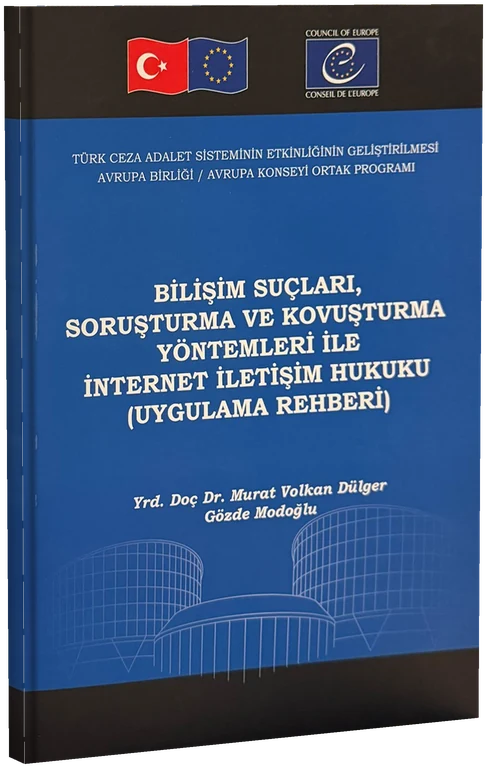
Practice Guide to Cybercrime, Methods of Investigation and Prosecution, and Internet Communication Law
(Bilişim Suçları, Soruşturma ve Kovuşturma Yöntemleri ile İnternet İletişim Hukuku Uygulama Rehberi)
About the book
This work was written in Turkish. The summary on this page is a translation; the citation gives the original title in parentheses.
This work covers all the cybercrimes found in Turkish criminal legislation and the offences committed by using information systems. It also shows how these offences should be investigated and prosecuted, with the support of sample decisions, correspondence and practical exercises. A practice guide has thus been created for judges, public prosecutors, lawyers and investigating officers.
Full text
This text is a translation of the Turkish original, prepared for this website. Numbers in square brackets are the page numbers of the original; sources in the footnotes are given as in the original. For citation, the original publication (PDF) is authoritative.
“IMPROVING THE EFFICIENCY OF THE TURKISH CRIMINAL JUSTICE SYSTEM”
European Union - Council of Europe Joint Project
PRACTICE GUIDE TO CYBERCRIME, METHODS OF INVESTIGATION AND PROSECUTION, AND INTERNET AND COMMUNICATIONS LAW
Prepared by
Asst. Prof. Dr. Murat Volkan Dülger
(Cybercrime, Methods of Investigation and Prosecution, and Internet and Communications Law)
Attorney Gözde Modoğlu
(Cybercrime, Methods of Investigation and Prosecution, and Internet and Communications Law)
The content of this book belongs to the author and is not the responsibility of the Council of Europe, the European Union and/or the beneficiary institutions.
This book has been printed within the framework of the European Union / Council of Europe Joint Project entitled “Improving the Efficiency of the Turkish Criminal Justice System”, which is financed by the European Union / the Council of Europe / the Republic of Türkiye and implemented by the Council of Europe. The Ministry of Justice of the Republic of Türkiye, the High Council of Judges and Prosecutors, the Justice Academy of Türkiye and the Union of Turkish Bar Associations are the beneficiaries of this project. The contracting authority of the project is the Central Finance and Contracts Unit.
- 1. LEGAL PROVISIONS RELATING TO INFORMATION TECHNOLOGY11
- 1.1. International Conventions11
- 1.1.1. Convention on Cybercrime11
- 1.2. Statutory Provisions13
- 1.2.1. Turkish Criminal Code:13
- 1.2.2. Law No. 5651 on the Regulation of Publications on the Internet and on Combating Offences Committed by Means of Such Publications15
- 1.2.3. Electronic Communications Law No. 580916
- 1.2.4. Electronic Signature Law No. 507016
- 1.2.5. Bank Cards and Credit Cards Law No. 546416
- 1.2.6. Code of Criminal Procedure No. 527116
- 1.2.7. Law on Intellectual and Artistic Works19
- 1.2.8. Turkish Code of Obligations19
- 1.2.9. Turkish Civil Code19
- 1.2.10. Turkish Commercial Code19
- 1.2.11. Code of Civil Procedure19
- 1.3. Provisions of Regulations19
- 1.3.1. Regulation on Judicial and Preventive Searches19
- 1.3.2. Regulation on Games of Chance Played in the Virtual Environment20
- 1.3.3. Regulation on Electronic Communications Security20
- 1.3.4. Regulation on Devices Bearing Electronic Identity Information20
- 1.3.5. Regulation on the Procedures and Principles for Coded or Encrypted Communication by Public Institutions and Organisations and by Natural and Legal Persons within Electronic Communications Services20
- 1.3.6. Regulation on the Procedures and Principles concerning the Registered Electronic Mail System20
- 1.3.7. Regulation on the Processing of Personal Data and the Protection of Privacy in the Electronic Communications Sector20
- 1.3.8. Regulation on the Procedures and Principles to Be Observed in Protecting the Information Systems of the Ministry of Justice against Threats from the Internet and in Ensuring Data Security20
- 1.3.9. Regulation on Internet Public Use Providers21
- 1.3.10. Regulation on the Procedures and Principles concerning the Regulation of Publications on the Internet21
- 1.3.11. Regulation on Internet Domain Names21
- 1.4. Provisions of Communiqués21
- 1.4.1. Communiqué on the Processes and Technical Criteria relating to Electronic Signatures21
- 1.4.2. Communiqué on the Processes and Technical Criteria relating to the Registered Electronic Mail System21
- 1.4.3. Communiqué on the Registered Electronic Mail Directory and Registered Electronic Mail Account Addresses21
- 2. CONCEPTS25
- 2.1. Information System25
- 2.2. Computer25
- 2.3. Data25
- 2.4. Electronic Data25
- 2.5. IP (Internet Protocol) Address25
- 2.6. Ethernet Card26
- 2.7. MAC (Media Access Control) Address26
- 2.8. Computer Log26
- 2.9. Server Log26
- 2.10. Computer Program26
- 2.11. RAM (Random Access Memory)26
- 2.12. Forensic Imaging and Hash Value26
- 2.13. Information Network (Network), Internet, Internet Environment, Intranet, Cloud Computing27
- 2.14. Wide Area Network (WAN), Local Area Network (LAN)27
- 2.15. Domain (Domain Name)27
- 2.16. Hosting Provider, Content Provider, Service / Access Provider, Public Use Provider, Electronic Certification Service Provider28
- 2.17. Traffic Data (Log Records)28
- 2.18. Technical Tools and Methods Used in Committing Offences28
- 2.18.1. Virus28
- 2.18.2. Trojan Horse (Trojan)29
- 2.18.3. Worm29
- 2.18.4. DoS and DDoS Attacks30
- 2.18.5. Phishing Attacks30
- 2.18.6. Password Cracking Attacks30
- 2.18.7. Hacking31
- 2.18.8. Botnet Attack31
- 2.18.9. Dumpster Diving32
- 2.18.10. Eavesdropping32
- 2.18.11. Data Diddling32
- 2.18.12. Scanning32
- 2.18.13. Superzapping33
- 2.18.14. Salami Technique33
- 2.18.15. Rabbits34
- 2.18.16. Hidden Doors34
- 2.18.17. Asynchronous Attacks34
- 2.18.18. Unsolicited Electronic Messages34
- 2.18.19. Wrongful Misuse of the DNS35
- 2.18.20. Web Page Redirection35
- 2.18.21. Piggybacking36
- 2.18.22. Logic Bombs36
- 2.18.23. Impersonation36
- 2.18.24. Chameleon36
- 2.18.25. Providing Unlawful Content37
- 2.19. DNS (Domain Name System)37
- 2.20. Server37
- 2.21. Internet Environment37
- 2.22. Publication Made in the Internet Environment38
- 2.23. Access38
- 2.24. Information38
- 2.25. Cracker38
- 2.26. Hacker38
- 3. CYBERCRIMES REGULATED IN THE TURKISH CRIMINAL CODE41
- 3.1. Offences Committed in the Field of Information Technology41
- 3.1.1. The Offence of Unlawfully Entering and Remaining in an Information System (Art. 243 TCK)41
3.1.2. The Offence of Hindering or Disrupting the Functioning of an Information System and the Offence of
- Destroying or Altering Data (Art. 244(1)–(2) TCK)44
- 3.1.3. The Offences of Misuse of Bank or Credit Cards (Art. 245)50
- 3.2. Offences in Which the Use of an Information System Is Regulated as an Aggravated Form of the Offence54
- 3.2.1. The Offence of Theft Committed through the Use of an Information System (Art. 142(2)(e) TCK)54
- 3.2.2. The Offence of Fraud Committed through the Use of an Information System (Art. 158(1)(f))56
- 3.3. Offences Committed through the Use of Information Systems58
- 3.3.1. Payment Systems, BKK 23, 39, Offences Regulated in the Bank Cards and Credit Cards Law58
- 3.3.2. Offences Contained in the Electronic Signature Law (Arts. 16-17 EİK)66
- 3.3.3. Online Gambling (Art. 228 TCK)71
- 3.3.4. Child Pornography (Art. 226(3) TCK)72
- 3.3.5. Obstruction of Communication (Art. 124 TCK)75
- 3.3.6. Offences against Private Life and the Confidential Sphere of Life/Offences against Personal Data (Arts. 132, 133, 134, 135, 136, 137, 138 TCK)76
- 3.3.7. Offences against State Secrets (Arts. 326(1), 327, 329, 330, 333, 334, 335, 336, 337 TCK)88
- 3.3.8. Article 71 of the Law on Intellectual and Artistic Works92
- 3.3.9. Theft of Virtual Game Characters and Items103
- 4. METHODS OF OBTAINING EVIDENCE109
- 4.1.1. Taking Statements109
- 4.1.2. Information to Be Requested from the Complainant109
- 4.1.3. Information to Be Asked for in the Suspect’s Statement109
- 4.1.4. Identification of the IP Address109
- 4.1.5. What Is an IP Address?109
- 4.1.6. Whois Information and Identification of the IP Number110
- 4.2. Analysis of E-mail Information111
- 4.2.1. Examining E-mail Header Information111
- 4.2.2. Requesting E-mail Account Detail Information111
- 4.2.3. Points to Be Observed in Internet Investigations111
- 4.3. Search and Seizure112
- 4.3.1. Search and Seizure Warrant112
- 4.3.2. Search at the Scene113
- 4.4. Electronic Evidence113
- 4.4.1. Digital/Electronic Evidence (e-evidence)113
- 4.4.2. Where Is Digital Evidence Found?114
- 4.5. Obtaining and Preserving Electronic Evidence115
- 4.6. Forensic Imaging115
- 4.6.1. Hardware Imaging116
- 4.6.2. Software Imaging116
- 4.6.3. Preservation117
- 4.7. Decryption, Decoding and Data Recovery117
- 4.7.1. Decryptology (Decryption)117
- 4.7.2. Steganography (Decoding of Hidden Data)117
- 4.7.3. Data Recovery117
- 4.8. Examination of Electronic Evidence (Identification)117
- 4.9. Analysis of Electronic Evidence118
- 4.10. Reporting and Submission to the Competent Authority118
- 4.11. Return and Confiscation118
- 5. RESPONSIBILITIES AND OBLIGATIONS OF INTERNET ACTORS, BLOCKING OF ACCESS AND REMOVAL OF UNLAWFUL CONTENT FROM PUBLICATION (LAW NO. 5651)121
- 5.1. Responsibilities and Obligations of Internet Actors121
- 5.1.1. Obligation of Internet Actors to Provide Information121
- 5.1.2. Other Responsibilities and Obligations of Internet Actors121
- 5.1.3. Obligation to Remove Content from Publication128
- 5.1.4. Obligation to Take Filtering and Similar Measures133
- 5.1.5. Obligation to Retain Traffic Data133
- 5.1.6. Obligation to Retain Log Information134
- 5.1.7. Offences under Law No. 5651 for Which a Decision to Block Access Is to Be Given134
- 5.1.8. Catalogue Offences in Law No. 5237134
- 5.1.9. Offences under Other Laws for Which a Decision to Block Access May Be Given138
- 5.2. Blocking of Access as a Coercive Measure144
- 5.2.1. Legal Basis144
- 5.2.2. Who May Give the Decision144
- 5.2.3. Procedure to Be Applied145
- 5.2.4. Lifting of the Measure145
- 5.2.5. Sanction147
- 5.3. Blocking of Access as an Administrative Measure147
- 5.3.1. Legal Basis147
- 5.3.2. Who May Give the Decision148
- 5.3.3. Legal Nature of Blocking of Access as an Administrative Measure148
- 5.3.4. Procedure to Be Applied150
- 5.3.5. Sanction151
- 5.4. Removal of Content from Publication and Blocking of Access151
- 6. INTERNATIONAL LETTERS ROGATORY157
- 6.1. International Letters Rogatory in General157
- 6.2. Legal Bases of International Mutual Legal Assistance as regards Türkiye : ..157 6.3. Basic Principles of International Letters Rogatory in Criminal Matters158
- 6.3.1. Requests Are Executed in Accordance with the Legislation of the Requested State158
- 6.3.2. As a Rule, No Costs Are Charged158
- 6.3.3. Documents Are Translated into the Official Language of the Requested State158
- 6.4. Grounds for Refusing a Request for Mutual Legal Assistance159
- 6.4.1. Where the Requested State Considers the Request to Concern Political Offences or Fiscal Offences159
- 6.4.2. Where the Requested State Considers that Execution of the Request Is Contrary to Its Sovereignty, Security, Public Order or Other Essential Interests159
- 6.4.3. The Requirement of Dual Criminality159
- 6.5. European Convention on Cybercrime159
- 6.6. Requests for Mutual Legal Assistance for Obtaining Traffic Data / IP Numbers in Cybercrime Cases161
- 6.7. Problems Arising in Cybercrime Cases from the Fact that the Place Where the Offence Was Committed or the Whereabouts of the Suspect Are Unknown:162
- 6.8. Situations in Which IP Information or Traffic Data May Be Obtained Directly by the Judicial Authorities:162
- 6.9. International Letters Rogatory in Cybercrime Cases within the 24/7 Framework163
- 6.10. Mutual Legal Assistance with Certain Countries in Cybercrime Cases163
- 6.10.1. United States of America163
- 6.10.2. The Offence of Insult163
- 6.10.3. The Offence of Calumny164
- 6.10.4. Other Offences Committed alongside the Offence of Insult164
- 6.10.5. Offences Committed on the Internet by Using Bank or Credit Card Information165
- 6.10.6. Mutual Legal Assistance in respect of the Offence of Violation of Privacy165
- 6.10.7. Requests concerning Gaming Sites or Game Characters165
- 6.11. Preparation of the Mutual Legal Assistance Documents in Cybercrime Cases165
- 6.11.1. The Letter of Request for Mutual Legal Assistance166
- 6.11.2. When Requesting Mutual Legal Assistance in respect of Offences Committed on the Internet, the Following Points Are Also Important, Depending on the Object of the Offence166
- 6.11.3. The Following Points Must Be Taken into Account When Preparing the Letter of Request in Requests concerning Offences Committed via Facebook166
- 6.12. Removal from Publication of the Content Constituting the Offence167
- 6.13. Request for the Preservation of Traffic Data or Content167
- 7. SAMPLE MATERIALS ON INTERNATIONAL COOPERATION169
- 8. SAMPLE MATERIALS ON CYBERCRIME INVESTIGATION LEGISLATION AND PRACTICE195
- 9. SAMPLE CASE STUDIES ON CYBERCRIME293
PRACTICE GUIDE TO INVESTIGATION TECHNIQUES AND METHODS OF OBTAINING EVIDENCE IN CYBERCRIME CASES
1. LEGAL PROVISIONS RELATING TO INFORMATION TECHNOLOGY
The concept of cybercrime is essentially regulated in Arts. 243-246, which are contained in Chapter 10 of the Turkish Criminal Code (TCK). When these articles are examined closely, it is seen that in these provisions the legislature has made external interferences with information systems (accessing the system without authorisation, altering or destroying the data held there, hindering or disrupting the functioning of the system, etc.) the subject of regulation.
Cybercrimes are not found only in Chapter 10 of the TCK. Apart from these articles, the concept of cybercrime also denotes all offences carried out by using information systems (for example, calumny committed by using computer systems to report or complain to the competent authorities about an offence which one knows the person did not commit; insulting a person, again by using the same systems; violating the confidentiality of communications between persons by using information systems; storing or disseminating on computers images relating to the sexual abuse of children; and also the acts of aggravated theft referred to in Art. 142(2)(e) and of aggravated fraud referred to in Art. 158(1)(f) TCK).
For, in determining whether the offence concerned has been committed, the investigative procedures used in investigating the cybercrimes contained in Arts. 243-246 TCK will be applied (for example, identifying the IP number of the computer from which the message or act constituting the offence was sent or carried out, then taking a forensic image of the computer of the suspect who owns the computer with the IP number so identified, and then having these data examined by experts). In the end, although an offence committed by using an information system (such as an insult directed at the complainant on social networking sites) retains its original identity (that is, the offence of insult), this does not affect the fact that it was committed by using an information system. Apart from this, the very same problems as are encountered during the investigation of the cybercrimes referred to in Arts. 243-245 TCK (such as the fact that law enforcement and judicial personnel do not have sufficient knowledge and experience of these offences) are also encountered during the investigation of the other offences carried out by using information systems.
For these reasons, our study examines, together with the cybercrimes regulated in Arts. 243-246 TCK, the other types of offence which are not listed among these articles but which can be committed by using information systems. In fact, a great many classical offences can also be committed by means of information systems: for example, the person instigating the offence of intentional killing giving the principal perpetrator, via the internet, the order to kill the victim, or propaganda for a terrorist organisation being made by using computer systems. In these cases too, evidence will be sought in exactly the same way as in cybercrimes.
We may now turn to a collective examination of the cybercrimes referred to in the legislation in force and of the offences that may be committed by using information systems:
1.1. International Conventions
1.1.1. Convention on Cybercrime
In the Convention on Cybercrime, the effect on criminal law of computer systems, as information systems, and the problems to which they give rise have been addressed from the standpoint both of substantive criminal law and of criminal procedure, and the aim has been to provide solutions to the problems which arise in these fields and which centre on the use
of computer systems. The problems relating to substantive criminal law and to criminal procedure, which make up the second part of the Convention, are divided into two main sections. The first section contains the provisions on substantive criminal law; in the second section, the problems relating to criminal procedure are addressed and the aim has been to provide a solution in particular to the problems arising in connection with the obtaining, preservation and storage of evidence.
Title 4 of the Convention on Cybercrime, “Search and seizure of stored computer data”, is worded as follows:
“Article 19 - Search and Seizure of Stored Computer Data
1. Each Party shall adopt such legislative and other measures as may be necessary to empower its competent authorities to search or similarly access the following within its own national borders:
a. a computer system or part of it and the computer data stored therein, b. the devices in which computer data are stored.
2. Each Party shall adopt such legislative and other measures as may be necessary to ensure that, where its competent authorities search or access a specific computer system or part of it pursuant to paragraph 1 (a) and, in addition, have grounds to believe that the data sought are stored in another computer system or part of it within its own national borders, those authorities are able to extend the search or access to that system.
3. Each Party shall adopt such legislative and other measures as may be necessary to empower its competent authorities to seize or otherwise secure computer data accessed pursuant to paragraph 1 or 2 within its own national borders. These measures shall include the conferral of powers to do the following:
a. seizing or similarly securing any computer system or part of it or the devices in which computer data are stored, b. making and retaining a copy of those computer data, c. maintaining the integrity of the stored computer data in question, d. rendering inaccessible and unusable, or deleting, the data in question in the accessed computer system.
4. Each Party shall adopt such legislative and other measures as may be necessary to enable its competent authorities to order any person who has knowledge about the functioning of the computer system concerned or about the measures used to protect the computer data in that system to provide, as is reasonable, the information necessary to enable the measures referred to in paragraphs 1 and 2 to be carried out.
5. The powers and procedures referred to in this article shall be subject to Articles 14 and 15.”
The countries that are parties to the Convention are required to transpose these norms into their own domestic law, and this point is mentioned frequently in the Convention.
In the first paragraph of the article, in order that the competent authorities may be empowered to search or obtain access, the drafters did not content themselves with the sentence “a computer system, a part of a computer and the computer data stored in these” but also included the expression “the devices in which computer data are stored”, and in this way the deficiency which we have mentioned in the Code of Criminal Procedure (CMK) has been remedied. Since a computer is a machine that processes and stores data in accordance with specific commands, all of its physical parts fall within the scope. The first article of the Convention, providing for a more general definition, speaks not of all the physical hardware belonging to the machine but of the devices in which computer data are stored. Practice is thereby made easier: instead of searching the whole computer in its entirety and, where the conditions are met, seizing it, the same measure can be applied to HDDs or DVDs alone. The second paragraph of the article has likewise broadened the concrete meaning by also covering the other systems to which the computer system is connected.
The third paragraph of the article regulates the seizure of the computer data in question and the securing and storage of those data.
In the fourth paragraph of the article the “digital forensics expert” comes into play.
The text of the article states the need to make the necessary legal provision so that the expert may be ordered to provide, as is reasonable, the information necessary to enable the measures in the first and second paragraphs to be carried out. In our country this matter is carried out by the law enforcement agencies, and there is not a sufficient number of digital forensics experts.
The last paragraph of the article states that the powers and procedures shall be subject to Arts. 14 and 15 of the same Convention.
1.2. Statutory Provisions
1.2.1. Turkish Criminal Code:
a. Art. 6(g) TCK, by stating that “the expression ‘through the press and broadcasting’ means publications made by any kind of written, visual, audio and electronic mass medium”, emphasises that the expression “through the press and broadcasting” is also to be understood as covering “publications made by an electronic mass medium”.
b. Under Art. 125(2) TCK, the commission of the act of insult by means of an audio, written or video message addressed to the victim is also deemed an offence. For example, messages sent via the internet, or writings and messages of an insulting nature directed at the other party on social networking sites, may be assessed within this scope.
c. Art. 132 TCK makes the violation of the confidentiality of communications an offence.
Accordingly, the acts of violating the confidentiality of communications between persons, recording those communications and disclosing them are punished under the article. In addition, on the basis of the definition in Art. 6(1)(g) TCK and of the explanation given above concerning that definition, the disclosure through the press and broadcasting (for example on social networking sites or news sites) of data obtained as a result of the violation of this confidentiality also calls for punishment.
d. Art. 133 TCK defines as offences the listening, by means of a device, to non-public conversations between persons or the recording of them with a sound recording device without the consent of one of the parties; the recording of a non-public conversation without the consent of the other speakers; the disclosure of the data obtained as a result of the act defined in paragraph 1; and the making of that disclosure through the press and broadcasting within the meaning of Art. 6(1)(g) TCK and in the light of the explanations given above. Accordingly, for example, listening to a conversation between two persons without the consent of one of the parties and subsequently disclosing it on websites falls within the scope of this article.
e. Art. 134 TCK defines as offences the violation of the privacy of persons’ private life, the violation of that privacy by recording images or sounds, and the disclosure of these through the press and broadcasting within the meaning of Art. 6(1)(g) TCK and in the light of the explanations given above. Accordingly, for example, placing a hidden camera in someone’s home and disseminating on the internet the images and sounds obtained calls for punishment under this article.
f. The act of aggravated theft carried out by using information systems, referred to in Art. 142(2)(e) TCK, is regulated as an offence.
g. As stated in Art. 158(1)(f) TCK, defrauding persons by using information systems constitutes the offence of aggravated fraud. Accordingly, for example, in the simplest sense, where the suspect, by engaging in fraudulent conduct towards the victim via the internet, deceives the victim and obtains a benefit for himself or for another, it will be possible to impose a penalty on the suspect under this article.
h. Where the offences contained in Chapter 5, between Arts. 213 and 218 TCK, are committed through the press and broadcasting (within the meaning of Art. 6(1)(g) TCK and in the light of the explanations given above), the penalty to be imposed shall, pursuant to Art. 218 of the Law, be increased by one half. However, expressions of opinion which do not exceed the limits of reporting and which are made for the purpose of criticism shall not constitute an offence.
i. Art. 226 TCK regulates the act of obscenity, and a person who publishes through the press and broadcasting (within the meaning of the definition in Art. 6(1)(g) TCK and in the light of the explanations given above) the acts falling within the scope of this article, or who acts as an intermediary in their publication, will also be punished under paragraph 2 of the article. Likewise, under paragraph 4 of the article, a person who produces, brings into the country, offers for sale, sells, transports, stores, makes available for the use of others or possesses products containing writings, sounds or images relating to sexual acts performed with the use of violence, with animals, on a dead human body or in an unnatural manner may be punished. In addition, under paragraph 5 of the article, a person who publishes the content of the products referred to in paragraphs three and four through the press and broadcasting (within the meaning of the definition in Art. 6(1)(g) TCK and in the light of the explanations given above), or who acts as an intermediary in its publication, or who enables children to see, hear or read it may also be punished.
j. Chapter 10 of the TCK regulates the cybercrimes that form the basis of the workshop.
In Art. 243, which is contained in this chapter, the following acts — in paragraph 1, unlawfully entering the whole or any part of an information system and continuing to remain there; in paragraph 2, the commission of the act referred to in paragraph 1 in respect of systems that can be used in return for payment; and, in paragraph 3, the destruction or alteration of the contents of the system by reason of these acts — are made subject to a criminal sanction.
Art. 244, which is contained in this chapter, punishes in paragraph 1 the act of hindering or disrupting the functioning of an information system; in paragraph 2 the acts of corrupting, destroying, altering or rendering inaccessible the data in an information system, placing data in the system and sending existing data elsewhere; and in paragraph 3 the commission of these acts on an information system belonging to a bank or credit institution or to a public institution or organisation. Paragraph 4 of the article, by stating that “Where a person, by committing the acts defined in the above paragraphs, obtains an unjust advantage for himself or herself or for another and this does not constitute another offence, a sentence of imprisonment from two years to six years and a judicial fine of up to five thousand days shall be imposed.” provides that, where the unjust advantage which the suspect has obtained for himself or for another by reason of the acts defined in the preceding paragraphs does not constitute another offence, the suspect is to be punished under this paragraph.
Art. 245, which is contained in this chapter, regulates the misuse of bank and credit cards as an offence. It must be said that, in our view, it is not appropriate for this provision to be regulated within the category of cybercrime. For it is seen that the article in question makes it an offence for a bank or credit card obtained without consent to be used, again without the consent of the cardholder. In this form, since what is at issue in this offence is in fact the use of the card after it has left its holder’s hands without his consent, as where it has been obtained as a result of theft, robbery or loss, we are of the opinion that it would be more correct for it to be regulated among the “Offences against Property” contained in Chapter 10 of Part 2 of Book 2 of the Law.
k. Art. 267 TCK regulates the offence of calumny, and under paragraph 1 of this article, in order for a report or complaint to constitute the offence of calumny, it must have been addressed to the competent authorities or made through the press and broadcasting.
Here one may at first wonder how the offence of calumny can come into being where the report or complaint is made through the press or broadcasting. However, as is known, it is possible for public prosecutors to treat any news item appearing in the press as a report of an offence and to open an investigation. In this sense, just as it is possible for a news item appearing in the print or visual media to be treated by the public prosecutor as a report of an offence and made the subject of an investigation, so too, in the light of the definition in Art. 6(1)(g) TCK and of the explanations given above, there is no obstacle to public prosecutors investigating a report or complaint appearing on social media or on websites. In an investigation begun in this way, if the conclusion is reached, for example, that the report or complaint made via the internet is unfounded and that the person who made it did so with the intent to calumniate, there is no obstacle to a separate investigation for the offence of calumny being conducted against the person who made this report or complaint on the internet.
l. Art. 318(2) TCK provides for an increase in the penalty to be imposed where the act of alienating the public from military service is committed through the press and broadcasting.
It should be noted that the words press or broadcasting referred to here, in the light of the definition in Art. 6(1)(g) TCK and of the explanations given above, cover not only the print and visual media but also electronic mass media.
1.2.2. Law No. 5651 on the Regulation of Publications on the Internet and on Combating Offences Committed by Means of Such Publications
This law regulates the actors connected with publications made on the internet, the
responsibilities of these actors, the obligation to provide information, the decision to block access, the removal of content from publication and the right of reply, and the administrative structure and duties.
1.2.3. Electronic Communications Law No. 5809
This law regulates the principles of electronic communications; the competent authorities in the electronic communications sector and their duties and powers; authorisation in the electronic communications sector; the rights and obligations of operators; tariffs; access and interconnection; rights of way; expropriation; numbering and internet domain names; spectrum management; consumer and end-user rights; notified bodies and market surveillance; supervision; the powers of the Authority; and administrative sanctions and penal provisions.
1.2.4. Electronic Signature Law No. 5070
1.2.5. Bank Cards and Credit Cards Law No. 5464
1.2.6. Code of Criminal Procedure No. 5271
Under the conditions created by rapidly developing information technology, computers and computer programs have become an important and inseparable part of life. Like many other people, persons who commit offences also use computer systems and leave traces relating to the offences they commit. The CMK, which aims to proceed from the evidence to the accused and attaches importance to technical evidence, could not have been expected to remain indifferent to the obtaining of evidence likely to be found in computer systems. At the same time, because the computer has entered people’s lives so intensively, a great deal of information relating to persons’ private lives and commercial lives is stored in computer systems. For this reason, interference with these systems, namely searching computer systems and seizing them, has been made subject to stricter conditions than ordinary seizure.
The Code of Criminal Procedure No. 5271 contains certain distinct provisions on ‘search, copying and seizure in computers, computer programs and logs’, in Art. 135 on ‘detection, interception and recording of communications’ , and in Art. 140 on ‘surveillance by technical means’. These rules in the CMK are mainly concerned with making it possible to turn to the field of information technology in proving, apart from cybercrimes, certain offences to which special importance is attached, or offences in general.
Art. 134 of the Code of Criminal Procedure No. 5271 reads verbatim as follows:
“Article 134 - (1) In an investigation conducted in respect of an offence, where there is no possibility of obtaining evidence by other means, the judge shall, upon the request of the public prosecutor, decide that a search be carried out on the computer and computer programs used by the suspect and on the computer logs, that copies be made of the computer records, and that these records be decrypted and converted into text.
(2) Where the computer, computer programs and computer logs cannot be accessed because the password cannot be cracked, or where the hidden information cannot be reached, these tools and equipment may be seized so that the decryption can be carried out and the necessary copies can be made. Once the decryption has been carried out and the necessary copies have been made, the seized devices shall be returned without delay.
(3) During the seizure of computers or computer logs, a backup shall be made of all the data in the system.
(4) If so requested, a copy of this backup shall be made and given to the suspect or his representative, and this shall be entered in the record and signed.
(5) A copy of all or part of the data in the system may also be made without seizing the computer or the computer logs. The data copied shall be printed out on paper, and this shall be entered in the record and signed by the persons concerned.”
The first paragraph of the article is structured in conformity with the Constitution and the Convention on Cybercrime, and “the absence of any possibility of obtaining other evidence” is laid down as a precondition. It is not a measure that may be resorted to only at the investigation stage; it may readily be resorted to at the prosecution stage as well. A request by the public prosecutor is required. In order for this method, by which the right to respect for private life is directly interfered with, to be resorted to, all other possibilities must have been tried.
It must therefore be resorted to as a last resort. Only a judge may order the measure.
The phrase ‘where there is no possibility of obtaining evidence by other means’ in the text of the article shows that the first condition for being able to conduct a search is “the absence of any possibility of obtaining evidence by other means”. If there is strong evidence relating to the offence concerned, there is no need to reach electronic evidence. In order to protect the individual’s private life and privacy, the legislature has adopted the principle of “the method to be resorted to last” for electronic evidence. However, although this precondition is appropriate from the standpoint of individual rights and freedoms, it is so constituted that it may give rise to problems in view of the nature of the matter. For instance, the fact that in an investigation computers cannot be seized immediately or searched immediately may result in the loss of evidence. For this reason, this paragraph of the article must be interpreted narrowly. This matter must be assessed by the public prosecutor according to the particular features of the specific case. In addition, since the legislature has not specified the degree of suspicion, the existence of simple suspicion is sufficient for the measure to be applied.
The CMK has set apart from the other measures a number of coercive measures which it regards as important, and has allowed these measures to be applied in cases where the classical methods of investigation and of obtaining evidence have been tried and no result has been obtained. This condition, also expressed as ‘subsidiary applicability’, is a concrete form of the principle of proportionality. Accordingly, if there are two coercive measures serving the same purpose, the one that is more moderate and interferes less with individual rights and freedoms must be preferred.
Pursuant to Art. 134(1) CMK, a search may be carried out only on the computer, computer logs etc. used by the suspect and belonging to him. This coercive measure cannot be applied to computers used by persons other than the suspect, or to computers belonging to third parties provided that the suspect has not used them. First of all, there must be a suspect. In order for this coercive measure to be applied to a computer belonging to a third party, the suspect must have used or be using the computer or computer log.
Where the computer which the suspect has used belongs to someone else, it will likewise be possible to search the computer once the necessary conditions have been fulfilled.
The second paragraph of the article specifies the cases in which computers and other related devices are to be seized. The fact that seizure is stated to take place only where it is established that the computer is encrypted and that the hidden data could not be reached means that the devices cannot be seized outside these cases. The article clarifies the situation in which the password cannot be cracked. Under the paragraph in question, it is stated that where there is encryption in the computer itself, in its programs, in its logs or in its operating system and this encryption cannot be broken, so that in the end the hidden data cannot be examined, the computer itself, external memory devices or other tools and equipment may be physically seized. The seizure is temporary in nature. Accordingly, once the encryption has been broken and the copying has been carried out, this measure is brought to an end. It is beyond dispute that all these operations must also be carried out within a reasonable time.
The third paragraph of the article states that, during the seizure, a backup must be made of all the data in the system. The fact that in practice the backup is made not during the seizure but after it is criticised. Because technical and physical conditions are inadequate, the possibility of making a backup at the scene may not be realised properly, and this may also result in the loss of evidence. Because of the computer used by the suspect and the components of that computer, a laboratory environment may not always be available at the time of the backup either. In addition, a backup produced after the seizure will not be reliable and may leave question marks in people’s minds as regards the investigation stage. For this reason, the procedures and principles of backing up need to be regulated in greater detail. Here the phrase “during the seizure” must be interpreted well. It is not possible to confine this situation to the scene of the incident alone. Accordingly, in keeping with the purpose of the Law, the backup must be made while the data are being identified, after safekeeping has been effected, in an environment in which no damage will be done to the computer and its logs.
The fourth paragraph of the article provides that a copy of the backed-up data in the system shall be given to the suspect or his representative. Although this is appropriate, in investigations concerning, for example, an offence of child pornography, an allegation that persons’ private photographs and videos are present, or credit card information belonging to persons, giving the copies to the suspect may enable the commission of the offence to continue, and such situations must therefore be given separate consideration.
The fifth paragraph of the article provides that, during the investigation, instead of the whole system being backed up, only the essential points are to be put on paper in order to save time. This method, which constitutes an exceptional situation, may be used only where very important, pinpoint evidence relating to the investigation, found in computer programs or logs, is obtained. In order to forestall data loss and concerns at this point, the “hash value” of the data may be calculated and a record drawn up of the resulting value.
Backing up electronic evidence and sealing it electronically is in fact to the benefit of the officers collecting the evidence rather than of the suspect. For, in an environment in which electronic evidence may change or be changed at any moment, the person who is essentially standing on slippery ground is the officer collecting the evidence. Whenever evidence is collected without these procedures being carried out, the suspect or his lawyer may raise the objection that the evidence collected is unlawful, and in that case it falls to the police officers to prove the contrary. For this reason it is very important that digital evidence in particular be collected in good time and in the correct manner. In this way no delays are caused in the proceedings.
1.2.7. Law on Intellectual and Artistic Works
1.2.8. Turkish Code of Obligations
1.2.9. Turkish Civil Code
1.2.10. Turkish Commercial Code
1.2.11. Code of Civil Procedure
1.3. Provisions of Regulations
1.3.1. Regulation on Judicial and Preventive Searches
Art. 17 of the Regulation on Judicial and Preventive Searches bears the heading “Search, copying and seizure in computers, computer programs and logs” and is worded as follows:
“Article 17 - In an investigation conducted in respect of an offence, where there is no possibility of obtaining evidence by other means, the judge shall, upon the request of the public prosecutor, decide that a search be carried out on the computer and computer programs used by the suspect and on the computer logs, that copies be made of the computer records, and that these records be decrypted and converted into text.
Where the computer, computer programs and computer logs cannot be accessed because the password cannot be cracked, or where the hidden information cannot be reached, these tools and equipment may be seized so that the decryption can be carried out and the necessary copies can be made. Once the decryption has been carried out and the necessary copies have been made, the seized devices shall be returned without delay.
During the seizure of computers or computer logs, a backup shall be made of all the data in the system. This procedure shall also be applied in respect of computer networks and other remote computer logs and removable hardware.
A copy of this backup shall be made in electronic form and given to the suspect or his representative, and this shall be entered in the record and signed.
A copy of all or part of the data in the system may also be made without seizing the computer or the computer logs. A record shall be drawn up concerning the nature of the data copied and shall be signed by the persons concerned. A copy of this record shall also be given to the person concerned.”
While this article runs parallel to Art. 134 of CMK No. 5271, it also covers “computer networks and other remote computer logs and removable hardware”. In this way the phrase “the computer and computer programs used by the suspect and the computer logs” used in the Code has been broadened. However, the provision, which is insufficient and remains incomplete, ought also to cover memory cards, handheld computers, mobile telephones, portable memory devices, printers and fax machines, modems and other carriers of electronic data. The computer case, which is what is understood by “computer” in practice and which is in most cases seized on its own, is only one
unit of the computer and not the whole of it. Instead of the computer case, which cannot on its own have the character of an instrument of the offence, all the units belonging to the computer must be examined or, where necessary, these units must be seized.
1.3.2. Regulation on Games of Chance Played in the Virtual Environment
The regulation governing the procedures and principles for the monitoring and supervision of games of chance being unlawfully played via the virtual environment and for the prevention of announcements and advertisements for them was published in the Official Gazette No. 26108 on 14.03.2006.
1.3.3. Regulation on Electronic Communications Security
The regulation governing the procedures and principles relating to electronic communications security was published in the Official Gazette No. 26942 on 20.07.2008.
1.3.4. Regulation on Devices Bearing Electronic Identity Information
The regulation governing the procedures and principles relating to the registration of devices bearing electronic identity information, to the prevention of the provision of electronic communications services to lost, smuggled or stolen devices and to devices whose electronic identity information has been altered was published in the Official Gazette No. 27271 on 27.06.2009.
1.3.5. Regulation on the Procedures and Principles for Coded or Encrypted Communication by Public Institutions and Organisations and by Natural and Legal Persons within Electronic Communications Services
The regulation determining the procedures and principles to be applied, and the work and operations to be carried out, in the production of coded or encrypted communication systems, the principles of application, their evaluation, the authorisation procedures, the security and safekeeping measures, supervision, sanctions and the keeping of their records was published in the Official Gazette No. 27738 on 23.10.2010.
1.3.6. Regulation on the Procedures and Principles concerning the Registered Electronic Mail System
The regulation governing the procedures and principles relating to the legal and technical aspects and the operation of the registered electronic mail system was published in the Official Gazette No. 28036 on 25.08.2011.
1.3.7. Regulation on the Processing of Personal Data and the Protection of Privacy in the Electronic Communications Sector
The regulation governing the procedures and principles to be complied with by operators active in the electronic communications sector for the processing and storage of personal data and the protection of their confidentiality in the electronic communications sector was published in the Official Gazette No. 28363 on 24.07.2012.
1.3.8. Regulation on the Procedures and Principles to Be Observed in Protecting the Information Systems of the Ministry of Justice against Threats from the Internet and in Ensuring Data Security
The regulation governing the procedures and principles relating to the security measures to be taken in order to protect the information systems belonging to the Ministry of Justice against threats coming from the internet and to ensure data security has not been published in the Official Gazette.
1.3.9. Regulation on Internet Public Use Providers
The regulation governing the principles and procedures relating to the obligations and responsibilities and to the supervision of internet public use providers and of internet public use providers operating for commercial purposes was published in the Official Gazette No. 26687 on 01/11/2007.
1.3.10. Regulation on the Procedures and Principles concerning the Regulation of Publications on the Internet
The regulation governing the principles and procedures relating to the obligations and responsibilities of content providers, hosting providers and access providers and to combating, through content providers, hosting providers and access providers, certain offences committed on the internet was published in the Official Gazette No. 26716 on 30/11/2007.
1.3.11. Regulation on Internet Domain Names
The regulation governing the procedures and principles relating to the management of internet domain names with the “.tr” extension was published in the Official Gazette No. 27752 on 07/11/2010.
1.4. Provisions of Communiqués
1.4.1. Communiqué on the Processes and Technical Criteria relating to Electronic Signatures
The communiqué determining in detail the processes and technical criteria relating to the electronic signature was published in the Official Gazette No. 25692 on 06/01/2005.
1.4.2. Communiqué on the Processes and Technical Criteria relating to the Registered Electronic Mail System
The communiqué determining in detail the processes and technical criteria relating to the registered electronic mail system was published in the Official Gazette No. 28036 on 25/08/2011.
1.4.3. Communiqué on the Registered Electronic Mail Directory and Registered Electronic Mail Account Addresses
The communiqué determining the procedures and principles relating to the structure of registered electronic mail account addresses and to the creation, updating, operation and use of the registered electronic mail directory was published in the Official Gazette No. 28294 on 16/05/2012.
2. CONCEPTS
2.1. Information System
It denotes a system for processing, storing and transmitting data which consists of a computer, peripherals (loudspeakers, CD-ROM, mouse, keyboard, headphones, printer etc., which are not essential for a computer to operate but make it easier to use), communication infrastructure (such as electronic communications, the internet and an intranet) and programs.
2.2. Computer
It denotes desktop and laptop computers, mobile telephones and all similar electronic devices which are capable of performing arithmetical and logical operations in accordance with the program in their memory, of holding in memory the program they are to run and the data they are to process, and of interacting with their surroundings.
The electronic part of the computer is called hardware and the program part is called software. There are 4 components in a computer. These are:
a) Input of information (input units: keyboard, mouse, camera, scanner, fax-modem),
b) Storage of information (memory: hard disk, floppy disk, CD, DVD, USB, external hard disk, cloud computing etc.),
c) Processing of information (brain: the central processing unit, i.e. the CPU),
ç) Output of information (output units: such as the monitor, i.e. the screen, printer, plotter and modem).
2.3. Data
It denotes any kind of value that can be processed by a computer (see Art. 2(a) of Law No. 5651).
2.4. Electronic Data
It denotes records produced, carried or stored by electronic, optical or similar means (see Art. 3(a) of Law No. 5070)
2.5. IP (Internet Protocol) Address
It denotes the address, assigned in accordance with the internet protocol standards, which devices connected to a particular network use in order to recognise one another, to communicate with one another and to send data to one another.
Every computer that connects to the internet is assigned an IP address by the internet service provider, and the other computers on the internet reach this computer by means of the IP address assigned to it.
IP addresses are divided into two groups, dynamic and static. In general, a dynamic IP address is used. Dynamic IP addresses change according to time and session, because the service provider assigns to the user the IP address that is free at that moment. A static IP address, on the other hand, denotes an address that does not change according to time and session. It may, however, be defined and changed by the system administrator.
There is also an IP address for domain names. A connection can also be made by typing this IP address into the part where we type an internet page (the web browser). However, since typing these digits is neither practical nor easy to remember, a domain name system is used in which the domain name corresponds to the IP address.
2.6. Ethernet Card
It is the network interface card which is used in network systems and which provides communication between the computer and the network. Every Ethernet card has a MAC address. This address takes the form 00-23-c3-45-00-b3. The Ethernet card divides the data to be transmitted into packets and sends them to the network cable connected to the card’s output.
2.7. MAC (Media Access Control) Address
In an Ethernet network, systems are distinguished from one another by the MAC address they have. It denotes the physical address information which serves to identify network hardware in environments such as Ethernet, wi-fi and Bluetooth and which is encoded by the manufacturer on a computer’s Ethernet card. Every Ethernet card has an address that has no equal in the world. For example, if a notebook computer has a modem, wired Ethernet and wireless (wi-fi) Ethernet, there are three separate MAC addresses.
2.8. Computer Log
It denotes the data in which records are kept of the stages through which the computer and the files on the computer have passed.
2.9. Server Log
It denotes the log file in which all changes on a server are recorded. Records such as access to the computer network, changes made to files, and the downloading and uploading of data are kept in logs.
2.10. Computer Program
The set of commands given to a computer in order to make it carry out a task is called a computer program. A computer program is written by using a programming language. When the program is run, the computer reads the relevant commands and carries out the task described to it in the program.
2.11. RAM (Random Access Memory)
It means random access memory. It consists of memory cells that are independent of one another. Data can be stored, deleted, read and changed. RAM continues to operate for as long as the computer is running. When the computer is switched off, however, the data stored in RAM are erased.
2.12. Forensic Imaging and Hash Value
Forensic imaging denotes the process of copying data storage devices, sector by sector, to another data storage device.
The hash value may be described as the fingerprint of files. Files are scanned with various complex algorithms and a unique fingerprint of the file is produced.
In digital forensics it is used in order to ascertain whether the information in a storage area has been changed over a period of time. The hash value of the data is taken before and after the operations carried out in relation to the data. If the hash value is the same before and after the operation, it may be concluded that there has been no change in the data; if the hash value is different, it may be concluded that the data have been changed. There are, however, exceptions to this as well. For example, in images taken where there are defective sectors, if a “bad sector” forms after the first hash operation, the hash value will naturally come out different in the second hash operation some time later. Another exception is a RAM fault. In addition, the hash value may also come out different because the hardware used has deteriorated or is faulty, or because of electrical problems. For this reason, in order to prevent the hash value from coming out different and to avoid possible disputes, law enforcement in practice prefers to take the images of computers in its own units.
2.13. Information Network (Network), Internet, Internet Environment, Intranet, Cloud Computing
Information network (network) denotes the structure formed by the connection of computers to one another;
Internet denotes the electronic communication network that connects computer networks and institutional computer systems throughout the world to one another;
Internet environment denotes the environment which is created on the internet, is open to the public and falls outside communication and personal or institutional computer systems;
Intranet denotes the network that connects to one another the computers, local area networks and wide area networks within a particular organisation only;
Cloud computing denotes the general name given to services that provide the shared use of information among computing devices.
2.14. Wide Area Network (WAN), Local Area Network (LAN)
Wide area network denotes a large physical or logical network that enables more than one device to communicate with one another. These are very wide networks that enable local area networks to be connected to one another. The best-known wide area network is the internet.
Local area network denotes a computer network that connects computers and devices to one another in a limited geographical area such as a home, a school or workplaces.
2.15. Domain (Domain Name)
It is the name and address of a website on the internet. In the computer environment these are numeric, but they have been converted into meaningful words so that they are easy to remember and easy to use.
2.16. Hosting Provider, Content Provider, Service / Access Provider, Public Use Provider, Electronic Certification Service Provider
Content provider denotes natural or legal persons who produce, modify and provide any kind of information or data offered to users via the internet;
Hosting provider denotes natural or legal persons who provide or operate the systems hosting services and content;
Service / access provider denotes any kind of natural or legal persons who provide their users with the possibility of access to the internet;
Public use provider denotes persons who provide people with the possibility of using the internet at a particular place and for a particular period;
Electronic certification service provider denotes public institutions and organisations and natural persons or legal persons under private law that provide services relating to electronic certificates, time stamps and electronic signatures.
2.17. Traffic Data (Log Records)
It denotes values such as the parties, the time, the duration, the type of service used, the amount of data transferred and the connection points relating to any kind of access effected on the internet.
Hosting provider traffic data denotes information such as the source IP address, the destination IP address, the date and time of the connection, the address of the page requested, the transaction information (details of the GET and POST commands) and the result information relating to any kind of hosting on the internet;
Access provider traffic data denotes information such as the subscriber’s name, identity details, first name and surname, address, telephone number, the date and time of connection to the system, the date and time of disconnection from the system, the IP address assigned for the connection concerned and the connection points relating to any kind of access made on the internet.
2.18. Technical Tools and Methods Used in Committing Offences
2.18.1. Virus
Computer viruses are small software programs designed to spread from one computer to another and to interfere with the operation of the computer.
A virus may corrupt or delete the data on your computer, use your e-mail program to spread itself to other computers, or delete everything on your hard disk.
Computer viruses are generally spread by attachments in e-mail messages or by instant messaging. For this reason, it is important that e-mail attachments should never be opened where it is not known from whom the message has come or where it was not known that such an attachment would arrive. Viruses may disguise their identity in the form of attachments such as funny pictures, greeting cards or audio and video files.
Computer viruses also spread by way of downloads made from the internet. They may be hidden in illegal software or in other files or programs which one wishes to download.
2.18.2. Trojan Horse (Trojan)
They are computer programs which appear to be useful but which in fact cause harm.
Trojan horses spread by people being led to open a program which they think has come from a legitimate source. Trojan horses may also be found in software that is downloaded free of charge. Software should never be downloaded from an untrusted source.
A Trojan is a program which, in a manner not anticipated by its “victim” and without the victim’s wish, engages in a hidden and generally malicious activity. Although this is not universally accepted, it may be said that what distinguishes it from a virus is that it does not replicate itself.
2.18.3. Worm
A worm, like a virus, is designed to copy itself from one computer to another, and it does this automatically. First, it takes control of the features on the computer that transmit files or information. Once a worm has entered your system, it can travel on its own.
The greatest danger of worms is their ability to replicate themselves in large numbers. For example, a worm may send copies of itself to everyone in your e-mail address book, and their computers may then do the same thing. The heavy network traffic brought about by this domino effect may slow down workplace networks and the internet as a whole.
When new worms first appear, they spread very rapidly. They clog networks and cause users to wait for long periods when viewing web pages on the internet.
A worm is a subclass of viruses. A worm generally spreads without any user action and distributes complete (possibly modified) copies of itself from network to network. A worm may use up memory or network bandwidth, and this may cause the computer to crash.
Since worms do not need a “host” program or file in order to spread, they may also open a tunnel in the system and enable someone else to take control of the computer remotely. The Sasser worm and the Blaster worm may be given as examples of worms of the recent past.
Examples of Worms on the Internet:
While surfing the internet, we come across small windows containing things that attract our interest. When we click on these, the internet browser (Internet Explorer, Firefox etc.) downloads files carrying a worm virus. From the moment we click, the virus
becomes active on our computer. Examples of the text in some of these windows:
• Congratulations, you have won 250 SMS messages; click to download them to your phone.
• Congratulations, you have won a free prize draw for the chance to go to America.
• Congratulations, America is at your door.
• You have earned a bonus on your Visa card.
• You are the 1,000,000th person to visit our site. You have won a gift song from us.
• Today is your lucky day. You have won a cash prize from us.
• Congratulations, you have won a watch from us.
2.18.4. DoS and DDoS Attacks
DoS, which stands for Denial of Service, is a type of attack that is a method of disrupting a service. It is a type of attack in which, as a result of regular or successive attacks made by a person on a system, the target system becomes unable to serve anyone, or which aims at the consumption of all the resources belonging to that system. Denial-of-service attacks can be carried out by many methods.
DDoS, on the other hand, is a type of attack which aims to render the target system incapable of serving anyone by attacking the target computer through a large number of machines that the attacker has prepared in advance. This operation, carried out in a coordinated manner, both increases the scale of the attack and enables the person carrying it out to remain concealed. The devices that perform these operations are called “zombies”. In this type of attack it becomes difficult to find the attacker, because the attacker at the centre of the attack does not actually take part in it; he merely directs the other IP numbers. If the attack is made from a single IP address, a firewall can easily block it. However, where the attack comes from a larger number of IP addresses, the firewall is put out of action (log overflow stops the firewall services). It is precisely this feature that most importantly distinguishes it from a DoS attack.
2.18.5. Phishing Attacks
Phishing is a type of attack whose name was formed by combining the words “password” and “fishing” and which has been rendered in Turkish as “yemleme” (“oltalama”), that is, baiting (angling). Phishing attacks are among the most popular types of attack of recent times. By means of phishing, computer users are caused losses of billions of dollars every year. Phishing is generally used in order to learn a person’s password or credit card details. With the help of an e-mail made to look as though it came from a bank or an official institution, computer users are directed to fake sites. For phishing attacks, fake web pages of banks, social networking sites, mail services, online games and the like are prepared. Through these web pages, computer users are asked for information such as their personal details, card number and password. The information of users who comply with the requests in the e-mail and on the fake site is stolen.
It should also be noted here that, considering that fake web addresses of some banks, prepared by fraudsters, appear in search engines, these attacks are evidently widespread. As a precaution, it may be recommended that bank addresses be typed into the address bar by hand (manually).
2.18.6. Password Cracking Attacks
Recovering or discovering the password of data that are transmitted from a computer system or stored on a computer is called password cracking. The general approach to this is to try all guesses one by one. Password cracking can be of help to people who have forgotten their computer password. Password cracking also provides the possibility of access to confidential data in the digital world.
The time needed to crack a password may vary according to the length and complexity of the password; this measure is in fact derived from the password’s entropy, that is to say, if not only letters and numbers but also characters such as ^%&/();? are used in the password, its complexity increases. With “brute-force attacks”, known as “brute-force cracking”, all the possible passwords are guessed and tried. One of these attempts will inevitably hit upon the real password. The most frequently used password cracking methods – for example dictionary attacks, pattern checking, word list substitution and similar methods – reduce the number of attempts and are generally used before a brute-force attack.
2.18.7. Hacking
Alongside the persons described above, who use their expertise in information systems in order to commit offences, there are also persons who use this knowledge to test the security of systems. Understanding how hackers so easily get past information systems, enter them and carry out various acts, and taking measures against this, is very difficult without support from such persons. Indeed, many companies do not report to the competent authorities the offences committed by hackers within their own systems and, rather than lose their customers, prefer to remain silent and bear their losses.
In overcoming these difficulties, recourse is had to the knowledge and experience of persons who formerly engaged in hacking. Having the security of information systems audited by persons who have never engaged in hacking has not produced sufficiently useful results. The expert can test the security of the information system against attack at most by straining his imagination or by applying the knowledge he has acquired on the subject. For, since an IT security expert is not in fact a hacker, he cannot think and act like a hacker however hard he tries to do so.
When auditing the security of an information system, IT security experts cannot think themselves into the psychological state of a real hacker at the moment of committing an offence and launch sudden attacks on the system. Yet what matters is that the security measures of the information system be checked against a real hacker attack. Although an IT security expert can carry out this test, the test can never be like that of a hacker. Starting from this need, former hackers who have now given up committing offences are used for these tests, and they are called “ethical hackers”.
2.18.8. Botnet Attack
If a person has under his command an army made up of zombie PCs, that army is called a “botnet”. By means of a botnet, criminals send viruses from their master computers to other computers and take the infected computers (called zombies) captive.
On the other hand, they are able to control these hundreds of thousands of computers at the same time and to attack a single target – for example, a single target with the power of 200,000 computers. Those who run botnet servers are able to steal all the noteworthy information on the computers
they have enslaved (account details, passwords, projects, files, programs, personal data).
2.18.9. Dumpster Diving
In the method of “dumpster diving”, also referred to as “scavenging” or “waste collection”, the information left over after a data-processing operation carried out in an information system is collected.
This information is obtained primarily by collecting the information remaining on materials such as paper and ink ribbons that are produced by output devices and later thrown away, or by using advanced methods to restore deleted information that is held in the memory of the information system and is no longer needed.
2.18.10. Eavesdropping
Eavesdropping is the obtaining of data by entering the networks that information systems use to carry data or by capturing the electromagnetic waves emitted by information systems. Eavesdropping may take the form of capturing the electromagnetic waves emitted by computer monitors and converting them back into a screen image; obtaining data by means of radio transmitters capable of capturing electromagnetic waves that are placed in the centres of information systems; obtaining data by capturing electromagnetic waves from a great distance by means of interposed amplifiers; or obtaining the data flowing over the network as a result of physical interference during the transmission of data over the networks used.
2.18.11. Data Diddling
Data diddling is the deliberate entry of false data when data are being entered into data systems, or the alteration of data after they have been entered.
The methods of data diddling may be listed as the falsification of data-processing documents, the alteration by special tools of data kept on a data storage medium, the recording of other data in addition to the data, and the deletion of certain data or their concealment at the control stages.
Persons who supervise the creation, recording and processing of data, or who transport, check or encrypt data, are able to commit this offence. Persons who are able to reach information systems on any network may also commit this offence by circumventing the security measures.
2.18.12. Scanning
Scanning consists of operations carried out by rapidly entering into information systems data whose value changes each time following a sequential series, in order to report the cases in which the system gives a positive response.
The operation is repeated, the number being increased by one each time. In this way the information systems located within a given range are identified. The same method is also used to find IP address numbers connected to the internet or the ports that are open on IP addresses.
Port scanning in particular is one of the methods to which cybercriminals have frequently resorted of late. The port referred to here means the logical ports, as distinct from the physical serial and parallel ports found on computers. Every IP address is divided into ports, that is, virtual data paths. In this way data can be exchanged with different programs from the same IP address at the same time. By port scanning, information about the other system is obtained and the system’s vulnerabilities can be found.
Password scanning is also carried out in order to break the passwords of password-protected systems. In particular, words chosen from dictionaries and simple passwords consisting only of digits or only of letters can easily be broken by password scanning programs. Scanning programs can easily be found via the internet. In order to find the valid password, password scanner programs try the words and letter sequences in their database one by one and check the system’s responses. The database is in the nature of a dictionary made up of the most commonly used passwords worldwide, starting with meaningful words.
2.18.13. Superzapping
These are programs which, when information systems have become inoperative for various reasons, make it possible to modify the system by bypassing all security controls in order to get the system working again within a very short time.
It first emerged as a program that circumvented the “copy protection” software which prevented any program on computers from being copied from diskette to diskette.
Because they can pass freely through all security measures, superzap programs offer very wide opportunities to cybercriminals who wish to cause large-scale destruction in information systems.
2.18.14. Salami Technique
This technique is an effective method generally used for offences of obtaining an unlawful benefit that are committed in the information systems of banks. The system is based on obtaining a very small amount of unlawful benefit per source from a very large number of sources (for example, from a large number of bank accounts). In this way neither the bank nor the account holders can easily notice the unauthorised movement in the accounts, while the fact that small amounts have been collected from a large number of sources yields a large unlawful benefit for the perpetrator. To carry out this technique, too, varieties of Trojan horse software or software with a similar function are generally used.1
In a very frequently cited case, a bank employee noticed that the interest payments made every four months on the millions of deposit accounts held by the bank were calculated to four decimal places and then rounded down or up. Under the software in the bank’s information system, every figure above some 0.0075 of a dollar was rounded up to the next cent and paid to the depositor, while figures below that were rounded down and added to the bank’s account. Once the bank clerk had grasped how this worked, he wrote a piece of software that altered the operation performed by the system and ensured that the amounts rounded down went to an account he had opened himself instead of to the bank’s account. The bank clerk is reported to have applied this procedure for three years and, during that
period, to have obtained an unlawful benefit amounting to millions of dollars.2
2.18.15. Rabbits
The programs known as rabbits are able, like the animal from which they take their name, to reproduce very quickly. Inside the information system they have entered, they continuously give the processor meaningless commands, thereby preventing the processor from issuing the commands that ensure the normal functioning of the information system; they cause the system to run ever more slowly and ultimately render it inoperable.3
Rabbits are a type of software generally used to disrupt the functioning of large multi-user systems and to break the data transmission network. In a case that occurred in England, a hacker using the pseudonym “Mad Hacker”, by means of rabbit programs he had loaded onto the information systems of Queen Mary University and the University of Hull, made those systems incessantly write the messages “I think you know that I am mad… I am also depressed” and “I see that you are challenging me”, thereby rendering the systems inoperative.
2.18.16. Hidden Doors
Hidden doors, also called trap doors, back doors or open doors, are a piece of virus software placed secretly inside a system’s software by the person who wrote that software. The person who has placed the virus on the computer on which this program runs is able, by remote access, to infiltrate the information system without being caught by the system controls. As the name indicates, they are open points deliberately left by the company or person that developed the application.
2.18.17. Asynchronous Attacks
In certain situations computers, instead of operating simultaneously, carry out operations in a particular order. The start of one operation is determined by the result of another. This principle of operation is called asynchronous operation.
The form of attack based on making changes to data waiting in memory is called an asynchronous attack. For example, while one is waiting for other operations to finish in order to obtain from the printer the results of work done with some program, persons with good programming knowledge are able to make additions, deletions or changes, as they wish, to the data waiting in memory.
2.18.18. Unsolicited Electronic Messages
“Spam”, that is, unsolicited electronic mail, has become, particularly in recent years, a significant problem with which many users and the administrators and users of large information systems have to contend. The word spam is of US origin; it is an abbreviation first used by the company Hormel Foods Corporation in connection with the foodstuffs it produced, and it is made up of the initial letters of the words “spiced pork and ham”. Although this abbreviation is unrelated, it came in time to be used for electronic mail sent unsolicited to the masses. In the “ICC Guidelines on Interactive Marketing Communicating” published in 1996 by the International Trade Organisation, spam is defined as advertising via a bulletin board or newsgroup which does not serve a commercial purpose, which is unrelated to the topics of that forum and the sending of which has not been expressly permitted.
Spam is generally used for advertising and marketing a product and for conveying advertisements and messages with pornographic content to the masses worldwide.
It is stated that messages of this kind have increased as organisations holding large numbers of electronic mail addresses sell the databases they possess.4
2.18.19. Wrongful Misuse of the DNS
One of the commonly encountered offences is web page theft. A website is reached through addresses called domain names. Domain names are kept in the database of domain name servers (DNS) and announced to the whole world. When an internet user wishes to reach a website, the web browser performs a DNS query for the domain name, learns the IP address of the server on which the web page is located and fetches the page from that IP address.
When a person wishes to publish a web page, he must first obtain a domain name. To do so he applies to the service providers that offer domain name services.
If, before this application, another person acts more quickly and has the domain name registered, the right to the name belongs to that person. Registered domain names, too, may have their registration record altered, in their own favour or in favour of a third party, by hackers or by an employee of an internet service provider (ISP) who has access to this information.
These persons then try to sell the domain names they have had registered, at high prices, to those who ought to be their real owners.
This offence may be committed by internet service providers in some way leaking the information relating to an internet application to malicious third parties.
It may equally be committed by hackers entering the service provider’s systems and gaining access to the information.
2.18.20. Web Page Redirection
Web page redirection is the redirecting of a website to another IP address by making unlawful changes on the DNS servers, which are the databases in which the domain names and IP addresses of websites are kept.
Users enter the domain name in the web browser in order to reach the site. However, because the DNS records have been altered, the user is directed not to the IP address he ought to reach but to the address chosen by the perpetrators, and arrives at an entirely different site.
This method is generally applied to users wishing to reach a bank’s web page. The web page to which users are redirected is a different web page designed to resemble the one they actually intended to visit. When the user enters his passwords on this page, the hacker obtains them. The spread of shopping and banking transactions over the internet in particular has increased criminals’ tendency to procure bank credit card details by using this method.
2.18.21. Piggybacking
Piggybacking is the technique of gaining unauthorised entry to information systems by physical or electronic means.
Physical piggybacking is entry into the parts of information systems to which access is subject to authorisation by making use of the access authorisation of a user who is authorised to enter.
Electronic piggybacking, for its part, is unauthorised access to information systems by using the lines over which users connected to those systems are connected.
2.18.22. Logic Bombs
A logic bomb is in fact a kind of Trojan horse software. Just like a Trojan horse, it enters the information system in the guise of a useful program, runs normally within the system and performs no harmful operation. However, when particular conditions specified within the software are fulfilled, or when a date specified by the software arrives, it assumes its true identity and begins its harmful operations.5
Since logic bomb programs are created solely in order to damage the information system they have entered, they are devastating for the system once they are activated. The “Chernobyl virus incident”, which occurred in our country on 26.4.1999, is a good example of logic bombs. The virus named CIH was presented by the person who wrote it at a local IT conference as useful software and distributed to participants from various countries. Through these persons the software reached, within a very short time, countries such as Austria, Australia, Israel, Chile, Switzerland, Sweden, the USA, Russia and England. The logic bomb, which runs on the Windows 95 and Windows 98 operating systems, becomes active when a set-up file containing it is executed, and waits in the memory of the information system. The software begins its harmful acts on the 26th of every month and causes irreparable damage to the system. This software damaged a large number of information systems in our country as well and caused considerable material loss.6
2.18.23. Impersonation
Information systems connected to a given network are divided into sections in terms of access rights. The possibility of access to the systems may not be at the same level for every computer.
System users are authorised at different levels. By means of the user names and passwords they hold, users are able to carry out operations at different levels in information systems.
With developing technology, personal characteristics such as fingerprints and the retinal structure of the eye have begun to be used for system access alongside user names and passwords. Impersonation is the term used where others gain entry to systems by typing in the user name and password of a person who has authorised access to the information systems or by imitating that person’s personal characteristics.
2.18.24. Chameleon
Programs known as chameleons get into the system by deceiving it, like Trojan horse software. Chameleons, which behave like a harmless program running normally for the system and appear to possess its characteristics, reveal their true identity once they have entered the system and begin their harmful acts. This software owes its name to its success in concealing itself.
Chameleon programs, particularly in multi-user systems, record in a hidden file the user names and passwords held in the information system they have entered, thanks to their ability to imitate data, and then display on the system’s monitor the warning that “the system will be shut down temporarily for maintenance”. After the system has shut down, the person using the chameleon program can reach wherever he wishes in the system he has entered and carry out his acts.7
2.18.25. Providing Unlawful Content
Another very frequently encountered way of committing cybercrime is to keep unlawful content in information systems and make it accessible to other users by means of data transmission networks. Such content may be racist, discriminatory, inciting to violence or infringing personality rights, and it may also be content relating to human trafficking or child pornography.
In a case that occurred in our country, a member of the teaching staff who also held administrative duties at a university was sent an electronic mail containing insults and threats directed at his attitudes and practices at the university. The mail in question contained the threat that a relative of the academic living in Ankara was being followed and that the relative would be harmed if he did not mend his ways.
As a result of the technical work carried out on this electronic mail, it was established first that the message had been sent from within Türkiye, and then that it had been sent from the same province in which the academic was located. By following the electronic traces, the perpetrator of this act was eventually caught and brought before the court.8
2.19. DNS (Domain Name System)
It is a system that serves to divide the internet space into sections, to name the sections and to organise communication between the sections.
2.20. Server
It is a computer unit in computer networks that hosts resources which other network components (users) can access and which are open to their use and/or sharing.
2.21. Internet Environment
It is the environment which is created on the internet, is open to the public and falls outside communication and personal or institutional computer systems.
2.22. Publication Made in the Internet Environment
These are data which are located in the internet environment and whose content can be reached by an indeterminate number of persons.
2.23. Access
It is the acquisition of the possibility of use by connecting to the internet environment by any means.
2.24. Information
It is the form in which data have acquired meaning.
2.25. Cracker
These are persons who, by cracking paid programs, enable them to be used free of charge. Hackers and crackers should not be confused with one another. Crackers do not break programs; they merely make changes to the program as configured and install on the program modifications such as free use, theme and language. In Turkish, the word ‘ilaç’ is also used instead of ‘crack’.
Crack is the name given to the act of breaking programs and to reverse engineering. Hack, for its part, literally means “to chop off small pieces”, and hackers’ abilities in algorithmic thinking, in constructing an objective topology and in statistics (iterating within reasonable ranges and interpreting fit (correlation)) have developed by chance. They have no solid background in, and make no claims to, low-level programming and hardware.
2.26. Hacker
A hacker is also known by the other name of computer pirate. Hackers are persons who gain unauthorised entry to personal computers or to computers and networks belonging to various institutions and organisations. In the field of computer programming, a hacker is a programmer who achieves an aim, or ‘cracks’ it, by applying a series of modifications to an exploit or by using existing code. On information systems, they cause damage to other systems or to websites by various methods.
| Offences in the Field of Information Technology |
|
|---|---|
| Offences against Private Life and the Confidential Sphere of Life |
|
| Offences in Various Chapters of the Turkish Criminal Code (TCK) That Can Be Committed by Means of Information Systems |
|
3. CYBERCRIMES REGULATED IN THE TURKISH CRIMINAL CODE
3.1. Offences Committed in the Field of Information Technology
3.1.1. The Offence of Unlawfully Entering and Remaining in an Information System (Art. 243 TCK)
“Article 243
(1) Any person who unlawfully enters the whole or any part of an information system and continues to remain there shall be sentenced to imprisonment of up to one year or to a judicial fine.
(2) Where the acts defined in the above paragraph are committed in respect of systems that can be used in return for payment, the penalty to be imposed shall be reduced by up to one half.
(3) If, by reason of this act, the data contained in the system are destroyed or altered, a sentence of imprisonment from six months to two years shall be imposed. ”
a. Protected Legal Interest
The legal interest protected by this offence is the security of the information system. By preventing unlawful access to the information system, a large number of interests of different kinds are protected, namely those of persons who benefit from the system in some way, such as its owner or user. The interests of these persons may be different legal interests, such as the protection of the confidentiality of data, the inviolability of private life, or the sense of security needed by persons or institutions. Above all of these, however, and
encompassing them, stands the legal interest of the security of the information system.1
b. Material Elements of the Statutory Definition of the Offence
aa. Perpetrator: The text of the article uses the words “any person” for the one who will commit the offence and specifies no particular characteristic; accordingly, anyone may be the perpetrator of this offence. The offence of unlawfully entering and remaining in an information system therefore displays no special feature as regards the perpetrator.2
bb. Victim: The offence of unlawfully entering and remaining in an information system displays no special feature as regards the victim; anyone may be the victim of this offence. The victim is the person who holds the right or interest that is harmed or endangered by a given offence, that is, the holder of the legal interest protected by the offence. In the commission of this offence, too, the victim of the offence is the person whose interest is harmed by the breach of the security of the information system. In our view only natural persons can be victims of an offence, whereas legal persons can only be persons harmed by the offence; accordingly, the victims of this offence too are natural persons, but where this offence is committed against the system of a company or of a public legal person, the legal persons in question will be persons harmed by the offence.3
cc. Object of the Offence: The object of the offence is the “information system” that is unlawfully entered or in which the perpetrator continues to remain. However, whereas for the purposes of paragraph 1 the object of the offence is the system itself, for the qualified form of the offence in paragraph 2 the object of the offence is “an information system that can be used in return for payment”, and for the result-aggravated form of the offence in paragraph 3 it is “the data contained in the information system”.4
dd. Act: The material element of the offence of unlawfully entering and remaining in an information system consists of the acts of entering an information system, by whatever means, and of continuing to remain in the information system. This is clear from the wording of Art. 243, “who unlawfully enters the whole or any part of an information system and continues to remain there”.
The term “enters” needs to be corrected to “access”. Indeed, in practice the term “enters” is understood as “access”.
Because the wording of the Law reads “enters and continues to remain there”, the perpetrator must carry out the acts of entering and of continuing to remain there together. This provision, however, is not appropriate. The act of “entering” alone is sufficient for this offence to be constituted. Moreover, to require remaining there as well renders the application of the article, or the protection of the legal interest concerned, impossible. The explanatory memorandum to the article states: “It has made the act of unlawfully entering the whole or any part of an information system or continuing to remain there an offence.” In view of the principle of legality, it is not possible to understand the provision in the article in this way. It would be appropriate here to amend the phrase “enters and continues to remain there” to read “enters or continues to remain there”. That said, it would also be appropriate, in conformity with the European Convention on Cybercrime, to introduce the term “access” in place of the distinction “enters and continues to remain there”.
For the offence of entering and remaining in an information system to be constituted, it is regarded as sufficient that the acts of entering the information system and remaining there are performed; it is not further required, for the offence to be committed, that any harm has occurred or that an imminent danger of harm has arisen. It is therefore an offence of abstract endangerment.5
ee. Qualified Forms: In paragraph 2 of Art. 243 TCK, the legislature has provided that the commission of the acts of unlawfully entering or remaining in an information system in respect of “systems that can be used in return for payment” is a ground for mitigating the penalty.6
c. Mental Elements of the Statutory Definition of the Offence
The mental element of the offence of entering and continuing to remain in an information system is intent; since the law does not expressly state that the offence can be committed negligently, it cannot be committed by negligence.7
d. Element of Unlawfulness
In the TCK No. 5237, the grounds of justification are grouped under four main headings.
These are the “exercise of a right” (Art. 26(1)), “carrying out a provision of law” (Art. 24(1)), “self-defence” (Art. 25(1)) and the “consent of the person concerned” (Art. 26(2)). The grounds of justification that may come into question with regard to the offence of entering and continuing to remain in an information system are “carrying out a provision of law” and the “consent of the person concerned”.8
e. Special Forms of Appearance of the Offence
aa. Attempt: In the offence of entering and remaining in an information system, the performance of the acts of entering the system and continuing to remain there is laid down as the material element; beyond this, the occurrence of harm is not required for the offence to be constituted. With this feature, the type of offence in question is a type of offence without a result. Since there is no distinction between act and result, an attempt to commit the offence in the form of the act being completed but the result failing to occur for a reason beyond the perpetrator’s control is not possible, for the offence will be completed upon performance of the act. Although it is debated in legal scholarship whether, after the information system has been entered, the act of remaining in the system can remain at the stage of attempt, the prevailing view is that this offence is not capable of being attempted.9
bb. Participation: Participation in this offence is always possible in accordance with the participation provisions of the TCK.10
cc. Concurrence: The first situation that comes to mind with regard to the offence under examination is whether a continuing offence will arise. It is indeed possible for the perpetrator, acting on the same decision to commit an offence, to enter an information system at different points in time and to continue to remain in the system. It is precisely in this situation that it must be determined whether Art. 43 TCK
can be applied. For example, if a hacker repeatedly enters and leaves the same information system at very short intervals and remains in the system for a certain time, thereby trying to prove to the system’s users that he is able to do this, or if, in order to learn a particular piece of information, he logs in time after time because the line keeps dropping, remains in the system if only briefly and is obliged to leave it without having obtained the information he wanted, will the continuing offence be applied in that case? In our view, Art. 43 TCK must be applied to the perpetrator in this situation and he must be given an increased penalty for a single offence. If the perpetrator enters the system and continues to remain there at intervals so long that one can no longer speak of the same decision to commit an offence, it can no longer be said that the perpetrator acted on the same decision to commit an offence; a separate penalty will be imposed for each act and the rule on the aggregation of penalties will be applied.11
f. Sanction, Investigation and Prosecution
For perpetrators who commit the offence of entering and remaining in an information system, “imprisonment of up to one year or a judicial fine” is prescribed. Since the penalties are provided as alternatives, the two penalties cannot be imposed together; either a custodial sentence or a judicial fine will be imposed on the perpetrator.
The amount of the judicial fine and the method of calculating it are set out in Art. 52 TCK.
With regard to this offence, where the mitigating qualified form referred to in paragraph 2 is present, the penalties indicated above will be reduced by up to one half.
Where the result-aggravated form of the offence referred to in paragraph 3 of Art. 243 is present, the penalty to be imposed on the perpetrator will be imprisonment from six months to two years, and in that case a judicial fine cannot be imposed on the perpetrator in place of the custodial sentence.12
3.1.2. The Offence of Hindering or Disrupting the Functioning of an Information System and the Offence of Destroying or Altering Data (Art. 244(1)–(2) TCK)
“(1) Any person who hinders or disrupts the functioning of an information system shall be punished by imprisonment from one year to five years.
(2) Any person who damages, destroys, alters or renders inaccessible the data in an information system, places data in the system or sends existing data elsewhere shall be punished by imprisonment from six months to three years.
(3) Where these acts are committed on an information system belonging to a bank or credit institution or to a public institution or organisation, the penalty to be imposed shall be increased by one half.
(4) Where a person, by committing the acts defined in the above paragraphs, obtains an unjust advantage for himself or for another and this does not constitute another offence, a sentence of imprisonment from two years to six years and a judicial fine of up to five thousand days shall be imposed.”
a. Protected Legal Interest
In the explanatory report on Arts. 4 and 5 of the ASSS, which parallel the offences laid down in paragraphs 1 and 2 of Art. 244, it is stated that the legal interest protected in Art. 4 is to prevent harm to the data or software contained in an information system and the corruption of or damage to data and software, and thereby to ensure that they operate correctly and functionally. As for Art. 5 of the ASSS, the legal interest protected is stated to be essentially the prevention of attacks carried out against information systems, ensuring the sound use of information systems and preventing wrongful conduct directed against this. In this way the rights of users of information systems to use these systems in a functional manner are protected. Accordingly, as we have also stated above, what is protected is the ability of systems and data to operate soundly and properly.13
According to the statutory definition of the offence in Art. 244(4), for the offence to be constituted the perpetrator must obtain an unlawful benefit as a result of the acts he has carried out by means of the information system; however, it is not explained what kind of benefit this is. Since no distinction is made as to the type of benefit, the material or non-material benefit obtained by the perpetrator constitutes the legal interest protected by the offence.
b. Material Elements of the Statutory Definition of the Offence
aa. Perpetrator: Anyone may be the perpetrator of these offences; the article of the law specifies no particular characteristic in this respect. By these offences, acts of damaging both the information system as a whole and data are made criminal. For this reason, since a person’s damaging his own data held in any information system without harming the rights of another will not constitute an offence, identifying the perpetrator is of importance. However, where the perpetrator disrupts or hinders the functioning of a system in order to destroy or render inaccessible data belonging to him that are held in an information system not belonging to him, then, although the offence in paragraph 2 of Art. 244 will not be committed, the offence in paragraph 1 will have been committed.14
In the offence in paragraph 4 of Art. 244, too, anyone may be the perpetrator.
bb. Victim: In the offence of hindering and disrupting the functioning of an information system and the offence of destroying or altering data, anyone may be the victim of the offence; the types of offence display no special feature in this respect. In the light of the explanations given above on the legal interests protected by the offences and on the perpetrator, it should be stated that, in order to be a victim of these offences, it is not necessarily required that one be the owner or possessor of the information system or of the data that have been damaged.
As a result of the performance of the acts constituting these offences, the person who has an interest in reaching and using the information system and/or the software, economic information, scientific
work, information and similar assets created by means of data without any obstacle, malfunction or delay, and who has the power of disposal over the information system and/or the data, will be the victim of this offence.
In the offence of obtaining an unlawful benefit by means of an information system, no particular characteristic is required as regards the victim. Anyone may be the victim.15
cc. Object of the Offences: The most important point distinguishing the offence laid down in paragraph 2 of Art. 244 from the offence laid down in paragraph 1 is the object of the offence. Whereas the object of the offence laid down in paragraph 1 is the information system, the object of the offence in paragraph 2 is the data contained in the information system.
The object of the offence laid down in paragraph 4 of Art. 244 is the “unlawful benefit” obtained by the perpetrator. This benefit may be a financial benefit having economic value, or it may equally be a non-material benefit which has no economic return or value and is aimed purely at the gratification of feelings.16
dd. Acts:
aaa. Hindering the Functioning of an Information System (Art. 244(1) TCK): The act which the legislature denotes by this expression is that, through interference with the system, every kind of benefit to be derived from the proper functioning of the system is prevented and the system is unable to perform its functions. Here the legislature has kept the concept very broad and intended to include in it every kind of act that hinders the functioning of the system, other than disrupting the functioning of the system, without enquiring how this comes about.17
bbb. Disrupting the Functioning of an Information System (Art. 244(1) TCK): The meaning of the word “bozmak” (to disrupt, to damage) is explained in the dictionary of the Turkish Language Association (TDK) as “to bring something into a state in which it cannot do the work expected of it; to disturb the order of a place or of a thing; to touch, to harm; to bring into a bad state”. Starting from this explanation, what is meant by the term “disrupt” in paragraph 1 of Art. 244 is bringing the information system into a state in which it cannot do the work expected of it, disturbing the order of the information system, harming the information system or bringing it into a bad state. In other words, disrupting the functioning of an information system means rendering the system partly or wholly inoperable.18
ccc. Damaging Data (Art. 244(2) TCK): What has been said above with regard to the act of disrupting the functioning of an information system also applies to the act of damaging data. Indeed, almost all harmful acts other than physical damage inflicted on the information system take place by means of data and constitute the act of damaging data. Where data are damaged in order to hinder the functioning of the information system, the perpetrator’s aim is not to harm the data in the system but in some way to disrupt the functioning of the information system; by contrast, in the act of damaging data contained in paragraph 2 of the article, the perpetrator does not wish to harm the functioning of the information system but wishes to render unusable some of the data contained in the information system, for example an application program or certain stored information. However, as we have also stated above, this aim on the part of the perpetrator is not an element of the type of offence but may serve as an aid to interpretation in determining which paragraph is to be applied to the specific act. Otherwise, for the offence in either paragraph to be constituted, the existence of the perpetrator’s intent is sufficient.19
ddd. Destroying Data (Art. 244(2) TCK): The meaning of the words “yok etmek” (to destroy) is explained in the TDK dictionary as “to put an end to the existence of, to eliminate, to annihilate, to remove”. However, with regard to the data contained in information systems, it is not possible in every case to eliminate the data completely or to put an end to their existence, as in the literal sense explained above. It should therefore be stated that by this expression the legislature meant not the act of destroying in the concrete sense but the act of logical destruction in the abstract sense that applies in the field of information technology.20
eee. Altering Data (Art. 244(2) TCK): What is meant by the act of altering data is the putting of other data in place of a datum or group of data.
This may take the form of altering a note or image consisting of a few data, or it may equally take the form of altering, for example, an application program made up of data. This will be the case, for example, where another password is put in place of the password that the user has set for the system.21
ff. Rendering Data Inaccessible (Art. 244(2) TCK): Rendering data inaccessible means preventing the owner of the data or the person concerned from reaching the data he wishes at the time he wishes. As a result of this act the integrity of the data is preserved; the data have not been destroyed or damaged, but access to the data has in some way been prevented and the holder of the right over the data cannot access his own data. This result can be brought about in a wide variety of ways, such as infecting with a virus, setting a password and so forth.22
ggg. Placing Data in an Information System (Art. 244(2) TCK):
What is meant by the act of placing data in an information system is the recording, loading or adding of various data by the perpetrator, from outside and without the permission of the owner of the system or the person concerned, to the information system or to a data carrier.
This act of placing may be carried out by sitting down at the computer, inserting a data carrier such as an “external memory” or a “USB” device into the drive hardware and loading the data on it onto the computer, or it may equally be carried out by uploading data over the internet.23
hhh. Sending the Data Existing in an Information System Elsewhere (Art. 244(2) TCK): This denotes the acts of transferring, recording or copying the data held in an information system to another information system outside that information system or to a data carrier. The act of sending the data existing in an information system elsewhere may be carried out by transferring the data to another information system over data transmission networks, for example via the internet or “wifi”, or it may equally be done by connecting a data carrier to the computer on which the data are held and recording the data onto that carrier.24
ııı. The act in Art. 244(4) TCK: Since this type of offence is laid down by way of a reference from paragraph 4 of Art. 244 to paragraphs 1 and 2 of the same article, the acts which constitute the material element of the offence of hindering and disrupting the functioning of an information system and of the offence of destroying or altering data, laid down in paragraphs 1 and 2 of Art. 244, also constitute the act element of this offence. Accordingly, for this offence to be constituted the perpetrator must carry out one or more of the acts of hindering the functioning of an information system, disrupting the functioning of an information system, damaging data, placing data in an information system, sending the data existing in an information system elsewhere, rendering data inaccessible, altering data and destroying data. This offence, too, is therefore framed as an offence with alternative acts.
For the offence of obtaining an unlawful benefit by means of an information system to be committed, the legislature has required that, as a result of the acts he has carried out, the perpetrator, in the words of the law, “obtains an unjust advantage”. What is meant by the expression unjust advantage is “unlawful benefit”. As also explained above, this benefit may be a benefit relating to financial rights or it may equally be a benefit relating to non-material rights. This will be assessed with regard to each act. Where the perpetrator is unable to obtain a benefit as a result of the act he has carried out, this offence will not be constituted. In that case the commission of the offences contained in Art. 244(1)–(2) may come into question.
ee. Aggravated Form of the Offence: In paragraph 3 of Art. 244 TCK, the commission of the acts defined in both types of offence “on an information system belonging to a bank or credit institution or to a public institution or organisation” is laid down as the aggravated form of the offences. Accordingly, where the aggravated form is present, the penalty to be imposed on the perpetrator will be increased by one half.25
f. Mental Element of the Statutory Definition of the Offence: The mental element of both offences contained in paragraphs 1 and 2 of Art. 244 is intent. Moreover, in these offences it is not required that the perpetrator act with a particular motive. However, it is also possible for the functioning of the system to be hindered or disrupted through the performance of the acts relating to data defined in paragraph 2. In precisely such a case, in determining under which paragraph the perpetrator’s act is to be punished, the perpetrator’s aim will have to be ascertained as an aid to interpretation, even though it is not specified as an element of the offence. Since it is not expressly stated in the types of offence, neither offence can be committed by negligence.26
d. Element of Unlawfulness
As explained in connection with the legal interest protected by the offence, the offence of hindering and disrupting the functioning of an information system protects the uninterrupted and sound operation of the system, whereas the offence of destroying or altering data protects the interest of the person who has the power of disposal over the data in reaching and using the data without any obstacle, malfunction or delay. For this reason, the consent of the holder of these rights or of the person authorised in respect of them will constitute a ground of justification.27
e. Special Forms of Appearance of the Offence
aa. Attempt: It is possible for the offence of hindering and disrupting the functioning of an information system and the offence of destroying or altering data to remain at the stage of attempt. This may take the form of the acts of execution being left unfinished after they have been commenced, or it may equally take the form of the offence not being accomplished, for reasons beyond the perpetrator’s control, without the result required for the offence to be constituted having occurred, after all the acts relating to the execution of the offence have been completed.
With regard to the offence laid down in Art. 244(4) TCK, attempt displays a special feature.
This is because the act element of this type of offence is laid down in paragraphs 1 and 2, while the result of the offence is contained in paragraph 4. Where it can be established that the perpetrator’s intent was to obtain an unlawful benefit as a result of the act he carried out, but the act defined in paragraphs 1 and 2 of Art. 244 was completed and the result did not occur for reasons beyond the perpetrator’s control, the perpetrator must be punished for an attempt to commit the offence in paragraph 4 of Art. 244. By contrast, in cases where it cannot be shown that the perpetrator’s intent was to obtain an unlawful benefit but the acts in paragraph 1 or 2 have been completed, the perpetrator must be punished no longer for an attempt to commit the offence in paragraph 4 but for the completed form of the offence in paragraph 1 or 2.28
bb. Participation: There is no special feature with regard to participation in the offences; the situations that arise will be assessed within the framework of the general provisions on participation in an offence in Arts. 37, 38, 39 and 40 TCK.29
cc. Concurrence: These offences can be committed in the form of a continuing offence. For example, where an information system is interfered with many times at short intervals and within the framework of the same decision to commit an offence, in order to hinder the operation of the system or to place data unlawfully, a continuing offence will be constituted.
However, what is meant by the commission of the same offence, the existence of which is required for a continuing offence, is not that the same article of the law is violated more than once. This is because many articles of the TCK contain types of offence that are independent of one another (for example Arts. 132, 133, 244, 245, 282 TCK). Consequently, the acts committed may not constitute the same offence even though they violate the same article of the law. In this context, where the perpetrator first disrupts the victim’s information system (Art. 244(1) TCK) and subsequently obtains an unjust benefit by using that information system (Art. 244(4) TCK), these
acts, even if they take place within the scope of the same decision to commit an offence, will not give rise to a continuing offence, since they are different offences and protect different legal interests. The same applies to the relationship between the types of offence in paragraphs 1 and 2 of Art. 244.30
f. Sanction, Investigation and Prosecution
For both offences contained in paragraphs 1 and 2 of Art. 244 TCK, only a custodial sentence is prescribed. The law prescribes as the penalty for these offences imprisonment from one year to five years in respect of paragraph 1 and imprisonment from six months to three years in respect of paragraph 2. Where the aggravated form of the offence contained in paragraph 3 of Art. 244, in which the offence is laid down, is present, the penalties to be imposed on the perpetrator, whose lower and upper limits are indicated above, will be increased by one half.
For perpetrators who commit the offence of obtaining an unlawful benefit by means of an information system contained in paragraph 4 of Art. 244 TCK, both a custodial sentence and a judicial fine are prescribed. The law lays down as the penalty for this offence imprisonment from two years to six years and a judicial fine of up to five thousand days.31
3.1.3. The Offences of Misuse of Bank or Credit Cards (Art. 245)
“(1) Any person who, having by whatever means acquired or come to hold a bank or credit card belonging to another, obtains a benefit for himself or herself or for another by using it or having it used without the consent of the card owner or of the person to whom the card ought to be given shall be punished by imprisonment from three years to six years and a judicial fine of up to five thousand days.
(2) Any person who produces, sells, transfers, purchases or accepts a counterfeit bank or credit card by linking it to bank accounts belonging to others shall be punished by imprisonment from three years to seven years and a judicial fine of up to ten thousand days.
(3) Any person who obtains a benefit for himself or for another by using a bank or credit card that has been counterfeited or falsified shall, unless the act constitutes another offence requiring a heavier penalty, be punished by imprisonment from four years to eight years and a judicial fine of up to five thousand days.
(4) Where the offence in the first paragraph is committed to the detriment of
a) one of the spouses in respect of whom no decision of separation has been given,
b) a direct ascendant or descendant, or a relative by marriage in that degree, or an adoptive parent or adopted child,
c) one of the siblings living together in the same dwelling, no penalty shall be imposed on the relative concerned.
(5) (Additional paragraph: 06/12/2006 - Law No. 5560, Art. 11) The effective remorse provisions of this Law relating to offences against property shall apply in respect of acts falling within the scope of the first paragraph.”
a. Protected Legal Interest
It is stated in the explanatory memorandum to the article that the offences of misuse of bank or credit cards in fact carry the “ratio legis” of several types of offence; accordingly, the legal interests sought to be protected by “the offences of theft, fraud, abuse of trust and forgery” constitute the legal interests which Art. 245 TCK seeks to protect by the types of offence under examination. Of these, the offences of theft and fraud seek to protect the property of persons, the offence of abuse of trust the personal trust that persons place in one another, and the offence of forgery the trust, imposed on individuals by the State, in documents that carry credibility in the legal sphere.32
b. Material Elements of the Statutory Definition of the Offence
aa. Perpetrator: Anyone may be the perpetrator of these offences; the law indicates no particular characteristic in this respect. However, obtaining the tools and the bank account details used, in particular, in making counterfeit credit or bank cards, and applying them to the cards, requires a certain level of expert knowledge. This does not, however, hold true for everyone who commits or participates in this offence. As is also seen from the examples arising in practice, this type of offence is today generally committed by gangs; and it suffices for the acts to be carried out that only one of the gang members possesses such expert knowledge.33
bb. Victim: In order to determine the victim of these offences, the concepts of “card owner” and “the person to whom the card ought to be given” contained in the type of offence must first be explained. In the “Bank Cards and Credit Cards Law” (BKKKK), which entered into force after the entry into force of TCK No. 5237, the expression “cardholder” is used, in contrast to the expressions contained in Art. 245 TCK.
In the BKKKK, the expressions “card system organisation”, “card issuing organisation” and “cardholder” are used for this matter. These terms are defined in Art. 3 BKKKK; accordingly, “card system organisation” means “organisations which establish a bank card or credit card system and which grant authorisation to issue cards or to conclude merchant agreements under that system”, “card issuing organisation” means “banks and other organisations having the authority to issue bank cards or credit cards”, and “cardholder” means “the natural or legal person who makes use of bank card or credit card services”.
The use of the expression “card owner” in the TCK, as against the expressions contained in the Bank Cards and Credit Cards Law (BKKKK), in particular “cardholder”, has given rise to a contradiction between two different laws regulating the same subject. This is because the cardholder is not the owner of the card but its beneficiary. The real owners of bank and credit cards are the banks or credit institutions. Accordingly, the expression card owner contained in the TCK should be understood as cardholder, having regard to the provision in the BKKKK. Similarly, “the person to whom the card ought to be given” is also the person who is the cardholder. Indeed, in practice these expressions are understood as the holder of the card.
However, in order to ensure conformity with the statutory definition of the offence, these points should be amended, by a provision to be made in the article, so as to be consistent with the BKKKK, and the expression cardholder should be incorporated into the article of the law.34
cc. Object of the Offence: The object of the offence is bank cards and credit cards.35
dd. Acts:
aaa. Obtaining an Unlawful Benefit with a Bank or Credit Card Belonging to Another (Art. 245(1)): For the offence to be committed, the bank or
credit card must first be acquired or held by the perpetrator. However, the performance of these acts alone is not sufficient for the act element of the offence to be fulfilled. The perpetrator must thereafter obtain an unjust benefit by using the card or having it used. The type of offence is therefore framed as one of free form and of combined acts. On the other hand, no restriction is laid down as to how the acts of acquiring, holding, using and having used are to be carried out; what matters is that an unjust benefit is obtained as a result of these acts carried out in combination. The acts are therefore, in themselves, framed in free form.36
bbb. Producing, Selling, Transferring, Purchasing or Accepting a Counterfeit Bank or Credit Card by Linking It to Bank Accounts Belonging to Others: In paragraph 2 of Art. 245, the acts of producing, selling, transferring, purchasing or accepting a counterfeit bank or credit card by linking it to bank accounts belonging to others are laid down as a separate offence. It is possible for bank or credit cards to be produced as wholly counterfeit, and it is equally possible for such cards, although genuine, to be falsified by various operations performed on them. This situation has been well identified by the legislature and reflected in the type of offence.
The type of offence is framed as one with alternative acts; where any one of these acts is performed, or some of the acts are performed together, there will be a violation of Art. 245(2). For example, where the perpetrator first produces the counterfeit card and then sells it, a single offence will be constituted. However, where the person who produces and thereafter sells and the person who purchases are different persons, there will be a separate violation of Art. 245(2) in respect of each of them, and there will be no participation in the offence as between them.37
ccc. Obtaining a Benefit by Using a Bank or Credit Card That Has Been Counterfeited or Falsified: The offence contained in paragraph 3 of Art. 245 punishes the acts of obtaining an unjust benefit by using the cards referred to in paragraph 2 which have been produced as counterfeits or falsified by operations on a genuine card. The type of offence is framed as one of free form; for a perpetrator who obtains an unjust benefit by using a bank or credit card knowing it to be counterfeit to be punishable under this paragraph, it is not further required that he has produced the card forming the object of the offence as a counterfeit or falsified it; the obtaining of an unjust benefit with cards of this kind is sufficient for the offence to be constituted.38
c. Mental Elements of the Statutory Definition of the Offence
For each type of offence contained in paragraphs 1, 2 and 3 of Art. 245, the mental element of the offence is intent. No further element is required in the offence as regards the mental element.39
d. Element of Unlawfulness
Where the perpetrator carries out the acts by which he obtains a benefit on the basis of consent, the offence will not be constituted, because the law expressly states that the perpetrator will be punished where a benefit is obtained “without the consent of the card owner or of the person to whom the card ought to be given”. In this case the consent of the card owner and of the person to whom the card ought to be given removes the criminal character of the act.40
e. Special Forms of Appearance of the Offence
aa. Attempt: In the types of offence contained in paragraphs 1 and 3 of Art. 245, for the offence to be completed the perpetrator must, in addition to performing the acts contained in the definition of the offence, also bring about the result in the form of “obtaining an unjust benefit”.
Where the acts are completed by the perpetrator but the result does not occur, the offence will have remained at the stage of attempt.41
With regard to the offence contained in paragraph 2 of Art. 245, the situation is rather different. For this offence it is not required that a further result occur as a consequence of the acts performed by the perpetrator. The offence is therefore committed upon the perpetrator’s performing the acts contained in the definition of the offence. Accordingly, where the acts performed by the perpetrator can be divided into parts, the offence will have remained at the stage of attempt.
bb. Participation: There is no special feature with regard to participation in the offences contained in paragraphs 1, 2 and 3 of Art. 245; the situations that arise will be assessed within the framework of the general provisions on participation in an offence laid down in Arts. 37, 38, 39 and 40 TCK; every form of participation is possible in respect of these offences.42 f. Sanction, Investigation and Prosecution
Where the offence of “obtaining an unlawful benefit with a bank or credit card belonging to another” defined in paragraph 1 of Art. 245 is committed, it is provided that the perpetrator shall be sentenced to imprisonment from three years to six years and a judicial fine of up to five thousand days.
As can be seen, because of the conjunction “and” between them, imprisonment and the judicial fine are laid down not as alternative sanctions but to be applied together.
Where the act of “obtaining an unlawful benefit with a bank or credit card that has been counterfeited or falsified” contained in paragraph 2 of the article is committed, the perpetrator will be sentenced to imprisonment from four years to seven years.
The legislature has not prescribed a judicial fine for this act.43
3.2. Offences in Which the Use of an Information System Is Regulated as an Aggravated Form of the Offence
3.2.1. The Offence of Theft Committed through the Use of an Information System (Art. 142(2)(e) TCK)
a. Protected Legal Interest
The interest protected by this offence is the property of persons, in other words the right of ownership.44
b. Material Elements of the Statutory Definition of the Offence
aa. Perpetrator: Anyone may be the perpetrator of this offence; no particular characteristic is required as regards the perpetrator.45
bb. Victim: The victims of this offence are the persons whose property is diminished, whose money in the form of data is transferred by means of an information system. However, the point that needs particular attention with regard to this type of offence, bearing in mind also that these offences are generally committed on accounts held at banks, is whether the victims of these offences are the banks or the persons who hold accounts at the bank. In order to answer this question, the nature of the contract between the person and the bank must be examined.46
cc. Object of the Offences: The object of this offence is “data”. Data which, whether personal or not, are the target of an act of theft through the use of information systems constitute the object of this offence. Accordingly, a datum that has no connection to the system will not constitute the object of this offence. Hence, where no information system is used and an external hard disk is taken in order to obtain the data held on it, Art. 244(2) will apply, and where an unjust benefit is obtained from this, Art. 244(4) will apply.
Art. 142(2)(e) TCK speaks of “theft through the use of information systems”. What is taken into account here is the fact that, owing to the unparalleled possibilities offered by an information system, the offence of theft can be committed far more easily. What is essential in the provision is not so much the stealing of data as the fact that an information system has been used in the offence of theft. On the other hand, just as electrical energy can be the object of theft although it does not have a physical structure, a similar approach is perfectly possible for “data” as well. Besides, “data”, too, ultimately have an economic value. As a requirement of the information age in which we are living, data will, on a new approach, be capable of being the object of the offence of theft.47
dd. Acts: For the offence of theft to be constituted, the movable property must be taken from the place where it is. Taking is accomplished when property is removed from the sphere of control of its possessor and brought into the sphere of control of the perpetrator. The point to be emphasised here is that the perpetrator has reached a position in which he can freely dispose of the property that is the object of the offence. In this way it is made impossible for the true possessor to dispose of the property that is the object of the offence. In the aggravated form of the offence committed through the use of information systems, too, as in the basic form of the offence, the property (goods, money etc.) must leave the sphere of control of its possessor. In this case, however, the act of “taking” occurs not physically but through the use of information systems and in the virtual sphere. This is, moreover, a provision very frequently encountered in practice.48
c. Mental Element of the Statutory Definition of the Offence
This offence can be committed only with intent; since it is not expressly stated in the article, it cannot be committed by negligence.49
d. Element of Unlawfulness: Where a victim who has suffered theft by means of information technology steals money in the same way from the bank account of the accused to whom his money was transferred, or of a third party, to speak of the existence of self-defence is incompatible with the content of that institution and with the purpose for which it is laid down in the law. Self-defence therefore cannot be spoken of in this case. The second act will itself constitute the offence of aggravated theft.50
e. Special Forms of Appearance of the Offence
aa. Attempt: Since this offence can be divided into parts, it is possible for it to remain at the stage of attempt. This is because, for the offence to be completed, it is not enough that the property be taken or the money in the form of data be transferred; it must also enter the perpetrator’s sphere of control. Since this requires a certain time, the offence will have remained at the stage of attempt if the act is left unfinished during that time. It should be noted at once, however, that where the offence is committed by means of information systems, there will be a period measurable in seconds between the transfer of the money in the form of data and its entry into the perpetrator’s sphere of control, so that it is not often that the offence remains at the stage of attempt.51
bb. Participation: The offence of theft displays no special feature as regards participation; every kind of participation in this offence is therefore possible.52
cc. Concurrence: The transfer of money from customers’ deposit or credit accounts by entering a bank’s online system through unauthorised access over the internet has, as we have also stated above, rightly been assessed under Art. 142(2)(e) since the decision of the General Criminal Assembly of the Court of Cassation (YCGK). In this situation the perpetrator must enter the bank’s information system and remain in the system before committing the theft of the data representing the money. The perpetrator therefore also carries out the act defined in Art. 243 before committing the offence in Art. 142(2)(e). The relationship between these two articles therefore needs to be set out. The first thing that comes to mind here is whether a transitional offence is in question with regard to these offences. A transitional offence exists where, in order to commit an offence, it is necessary first to commit an offence carrying a lighter penalty, to pass through that offence. For a transitional offence to be in question, however, the first offence committed and the subsequent, more serious offence must protect the same legal interest. Yet whereas Art. 243 protects the security of the information system, Art. 142(2)(e) protects the victim’s property. Accordingly, since the legal interests protected by these two offences are different,
a transitional offence cannot arise. Furthermore, for a transitional offence to be in question, it must be impossible to commit the second offence without passing through the first (for example, the offence of intentional killing cannot be committed without the offence of intentional injury being committed). When the two offences are examined from this angle, it is not necessary, for the offence of theft by means of an information system to be committed, that the offence of entering the system and continuing to remain there must in every case be committed. For the act in Art. 243 to constitute an offence, it must be carried out unlawfully; where these acts are committed with the consent of their victim, the element of unlawfulness will be removed and the offence will therefore not be constituted either. For example, where IT security experts are authorised to test or carry out maintenance on a bank’s information system, entry into and remaining in the system are lawful and no offence is constituted. Where these persons commit theft by transferring the data within the system (bearing in mind also that these persons are not bank employees), the offence defined in Art. 142(2)(e) will have been committed but the offence in Art. 243 will not have been committed. Consequently, it is by no means necessary, for the offence of theft by means of information systems to be committed, that the offence of entering an information system and continuing to remain in the system be committed. In conclusion, it is seen that from this angle too there is no relationship of transitional offence between the two offences. Where these acts are carried out together, the perpetrator must be given the penalty for both offences.53
dd. Sanction, Investigation and Prosecution: While imprisonment from one year to three years is prescribed for the basic form of the offence of theft, imprisonment from three years to seven years is prescribed for the aggravated form of the offence in Art. 142(2)(e). The criminal courts of first instance have jurisdiction to try both the basic form and the aggravated form of this offence.54
3.2.2. The Offence of Fraud Committed through the Use of an Information System (Art. 158(1)(f))
In Chapter Ten of the TCK, entitled Offences against Property, the offence of fraud is laid down in Art. 157 and the aggravated forms of the offence of fraud in Art. 158. Sub-paragraph (f) of paragraph 1 of that article contains “the offence of fraud committed through the use of information systems”. It provides: “(1) Where the offence of fraud is committed; ... f) by using information systems, banks or credit institutions as an instrument, ... a sentence of imprisonment from two years to seven years and a judicial fine of up to five thousand days shall be imposed...”
This offence protects individuals’ property, their freedom of will and also the trust they place in other people in the life of society.
The offence of fraud displays no special feature as regards the perpetrator and the victim; anyone may be the perpetrator and the victim of this offence.
According to the decisions of the Court of Cassation, for the offence of fraud by means of information technology to be committed, the deception, which is the act element of the offence, must be directed at a natural person, the victim must, by being led into error, be induced to carry out a transaction to the detriment of his own or another’s property and in favour of the accused or another, and as a result of that transaction the accused must obtain an unjust benefit for himself or for others.
Indeed, the Court of Cassation consistently states that the offence of fraud is not constituted in these situations and examines the acts from the standpoint of other offences. For example, where an unjust benefit is obtained with credit cards by using the mail-order method, it has stated that there must be a deception directed at a natural person and has held that in this situation it is not the offence of fraud by means of information systems but the offence of obtaining an unjust benefit with another’s bank or credit card that is constituted.55 This view is also shared by legal scholarship.
The acts of fraud by means of information systems most frequently encountered in practice are carried out by the perpetrator obtaining a person’s social media (MSN Messenger, Facebook etc.) or electronic mail log-in passwords, presenting himself to the friends of the persons whose passwords he has obtained as though he were the owner of the profile, and asking for money or requesting that credit be loaded onto a particular telephone, with these requests being accepted. Here the perpetrator obtains an unjust benefit by taking advantage of the good faith, the trust or sometimes the naivety of the victims, who are friends or relatives of the profile. In the world of cybercrime this method is called “phishing”, and it is one of the most frequently seen methods of fraud both in our country and in foreign countries.56 In its shortest definition, phishing is password hunting; in this method, used by senders of spam, the user is asked, by an electronic mail sent to him, to update his details and is induced to enter information such as user name and password in boxes prepared within the mail or in boxes on a genuine-looking fake site that opens when clicked.
For the offence of fraud to be constituted, an unjust benefit must be obtained; for it to be accepted that the offence has remained at the stage of attempt, the preparatory acts must have ended and the acts of execution directed at obtaining the unjust benefit must have begun.
The penalty for the offence of fraud committed through the use of information systems is imprisonment from three years to seven years. In addition, a judicial fine must be imposed alongside imprisonment as a penalty for this offence. While a judicial fine of up to five thousand days is prescribed for this type of aggravated fraud, it is stated that the amount of the judicial fine may not be less than twice the benefit obtained from the offence.57
3.3. Offences Committed through the Use of Information Systems
3.3.1. Payment Systems, BKK 23, 39, Offences Regulated in the Bank Cards and Credit Cards Law
a. In General
In order to ensure that the bank and credit card system operates effectively, the Bank Cards and Credit Cards Law No. 5464 entered into force upon its publication in the Official Gazette of 1 March 2006. Before the Law, the absence of any specific regulation in our legislation gave rise to various legal disputes within the system of payment by bank and credit cards and between the parties to that system. In addition to the legal disputes that arose, where bank or credit cards became the subject of an offence, the fact that the provisions of the criminal laws did not define the violations that occurred meant that, by reason of the principle of legality and the prohibition of analogy, which are among the fundamental principles of criminal law, most acts remained without sanction.
A special regulation has entered our legislation which also brings with it provisions parallel to the regulation in Art. 245 of TCK No. 5237 aimed at preventing the misuse of bank and credit cards.
b. Offences Regulated in the Law
The Bank Cards and Credit Cards Law was, in general, brought into being in order to find solutions to the legal problems arising in card payment systems, to determine the rights and responsibilities of the persons and institutions that are parties to the system and, in this way, to ensure that the system operates reliably and effectively. In addition, however, the Law also contains provisions on offences designed as a complement to the offence of misuse of bank or credit cards regulated in Art. 245 of TCK No. 5237.
aa. Issuing False Documents:
Law No. 5464
Article 36 - Those who obtain a benefit for themselves or for another by issuing an expenditure document, a cash payment document or a credit document that does not reflect the truth, or by falsifying these documents in any manner whatsoever, shall be punished by imprisonment from two years to five years and a judicial fine of up to five thousand days.
To define the expenditure document, the cash payment document and the credit document referred to in the provision of the Law:
Expenditure Document (Sales Document, Slip): the document which is issued by the member merchant in respect of transactions carried out with a bank card or credit card, which shows the cardholder’s debt arising from the transaction together with other information, and which is signed by the cardholder except in cases where the cardholder’s identity is established by a code number, a password or another method of identification.
Cash Payment Document: the document which is issued for cash payments made by banks or authorised member merchants to the holder of a bank card or credit card and which is signed by the cardholder except in cases where the cardholder’s identity is established by a code number, a password or another method of identification.
Credit Document: the document issued by the member merchant so that a credit is entered in the cardholder’s account where goods purchased using a bank card or credit card are returned, the purchase of a service is abandoned or the transaction carried out is cancelled. These documents may be defined in this way.
Essentially, the offence in question can be regarded as one that contains the elements of the offences of forgery of a private document and of fraud, in other words as a compound offence made up of the offences of forgery and fraud.
The offence is committed by obtaining a benefit for oneself or for another by issuing an expenditure document, cash payment document or credit document that does not reflect the truth, or by falsifying these documents in any manner whatsoever.
This offence, regulated in Art. 36 of the Bank Cards and Credit Cards Law, is designed as an offence with alternative acts. The offence will be deemed to have been committed where a benefit is obtained for oneself or for another by issuing an expenditure document, cash payment document or credit document as if a sale, a cash payment, or a return of goods or abandonment of the purchase of a service had taken place although in reality it had not, or by falsifying the said documents in any manner whatsoever.
As regards the legal interest protected by the offence, it may be said that, as in the offences of forgery of documents, what is protected is, in addition to public trust, the right to property in general and, within the general purpose of the law in which the offence is regulated, the card payment system.
As a rule, anyone may be the perpetrator of the offence. The victim of this offence, as a rule, may be card system organisations, card-issuing institutions, banks or cardholders.
For this offence, which can be committed intentionally, it is sufficient that the perpetrator, in addition to knowingly and willingly issuing an expenditure document, cash payment document or credit document which he knows not to reflect the truth, acts with the intent of obtaining a benefit for himself or for another as a result of using this untrue document.
It is clear, moreover, that the provisions on attempt may be applied to a perpetrator who has created the untrue document but has, for whatever reason, been unable to obtain a benefit as a result of using it. This offence is one that is capable of being attempted.
As regards participation, the offence has no special feature. That is to say, every form of participation in this offence is possible. In practice, moreover, while this offence is mostly committed jointly by the employees of member merchants, it may also, as stated earlier, be committed by cardholders or third persons acting in agreement; in other words, the offence can be seen to be committed by way of participation in many forms. Nor is there any special regulation concerning the offence as regards the provisions on concurrence. Where the offence is committed more than once at different times, with the same criminal intent, to the detriment of one person or institution, one may speak of a continuing offence, whereas if it has been committed to the detriment of several persons or institutions, it will be accepted, within the framework of the provisions on real concurrence, that as many offences have been committed as there are persons or institutions. Finally, it should also be noted that, on the basis of the provisions on notional concurrence, where another offence is also committed by the same act, the perpetrator may be sentenced for the offence requiring the heavier
penalty.
bb. False Declaration and Forgery in the Contract and its Annexed Documents:
Law No. 5464
Article 37 - Cardholders who, having made a false declaration to the effect that they have lost their bank card or credit card or had it stolen, use the card personally or have it used by another, and those who knowingly use such cards, shall be punished by imprisonment from one year to three years and a judicial fine of up to two thousand days.
Those who commit forgery in a credit card contract or member merchant contract or in the documents annexed thereto, or who present forged documents for the purpose of signing a contract, shall be sentenced to imprisonment from one year to three years.
Art. 37 of the Bank Cards and Credit Cards Law regulates two offences in two paragraphs. The first concerns the punishment of cardholders who, having made a false declaration to the effect that they have lost their bank or credit card or had it stolen, use the card personally or have it used by another, and of third persons who are aware of the untrue declaration concerning the card.
The second concerns the punishment of those who commit forgery in a credit card contract or member merchant contract or in the documents annexed thereto, or who present forged documents with the aim of signing a contract.
The explanatory memorandum to the article, in relation to the offence regulated in the first paragraph, speaks of the aim of preventing cardholders from abusing the use of cards.
In the practice of our country, the liability of the cardholder is limited by the Bank Cards and Credit Cards Law No. 5464 (Art. 12). It is seen, however, that for credit cards issued by some institutions, expenditure made by third persons is covered by insurance for the benefit of the cardholder in cases where the card leaves the holder’s possession against his will, such as loss or theft. Until now, it was accepted in acts of this kind that, because the credit card was used after the untrue report of its loss, it was the bank that suffered harm from the act and that the act constituted the offence of fraud against the bank. If the victim bank was a public bank, Art. 504(7) of TCK No. 765 was applied; if it was a private bank, Art. 503(1) of TCK No. 765. Indeed, on closer inspection it is clear that the cardholder practises deceit by making a false statement to the card-issuing institution. The first point to be noted here, however, is that the legislature has provided that the offence is constituted merely by using the card in question or having it used, and that, beyond this, the obtaining of a benefit is not required as it is in the offence of fraud.
The use of the card certainly has as its aim the obtaining of a benefit; but it must be said that, where a benefit is obtained, the perpetrator or perpetrators must also be sentenced for the offence of fraud. For in this offence the mere use of the card has been considered sufficient for the offence to be constituted.
As a rule, anyone who is a cardholder may be the perpetrator of this offence. In addition, on the basis of the concept of “having the card used”, which is expressly included, it must be said that third persons who are not cardholders may also be perpetrators. Its victims are the card-issuing institutions or banks. The object of the offence is the bank or credit card. For this offence, which can be committed intentionally, to be committed by a third person, that person must know of the report made in respect of the card or, more precisely, of the status of the card. The offence cannot be constituted in respect of a person who uses the card without knowing of this characteristic.
Attempt of the offence regulated in the first paragraph is possible. If the perpetrator is caught while using the card after the untrue declaration, there will be an attempt. As regards participation, every form of participation is possible. Indeed, where the card is given to another to use, the person using the card becomes, together with the cardholder, directly a perpetrator of this offence. As regards the provisions on concurrence, if the cardholder has used more than one card to the detriment of more than one card-issuing institution or bank, it will be accepted that as many offences have been committed as there are persons harmed by the offence, in other words as there are uses, and judgment will be given within the framework of the rules on real concurrence, whereas in the case of use of the same card at different times the existence of a continuing offence will be accepted. Finally, if the same act also constitutes another offence defined in the law, then, in line with the rules on notional concurrence, the perpetrator or perpetrators may be sentenced for whichever of the offences they have committed carries the heavier penalty.
The second paragraph of the article, for its part, contains a special regulation of the offence of forgery regulated in TCK No. 5237. What is at issue here is forgery not in all documents but in the credit card contract, the member merchant contract and the documents annexed to them, as well as the presentation of forged documents for the purpose of drawing up the said contracts. The forgery referred to here relates to the conclusion of the contracts; acts of forgery committed for another purpose cannot be assessed under this paragraph. In practice, it is frequently encountered that card applications are made to credit card institutions or, usually, to banks by submitting false names and documents. The applicant, concealing his own identity, is able to obtain a credit card in a fictitious name or in the name of another. In some cases, the person applying for a credit card, although giving his true identity details, may give untrue information about his financial situation in order to obtain a card with a high limit. For this reason, in order to escape the losses that may arise, it is not sufficient for card-issuing institutions to act as a prudent merchant and to show the necessary care in transactions. The bank, having favourable intelligence on the applicant, after a while sends the credit card to an address which the perpetrators have temporarily procured for this purpose. The credit cards sent to these addresses can then be used with ease, without arousing suspicion, both for cash withdrawals and for shopping.
In the practice of the Court of Cassation concerning the offence regulated in the second paragraph, it is accepted that, once a card contract has been drawn up upon the presentation of forged documents, the offence in Art. 245(2) TCK is constituted with the printing of the card, and that Art. 37(2) of Law No. 5464 can be applied only where the card is not printed because the request is refused.
cc. Issuing Cards Without Permission:
Law No. 5464
Article 38 - Natural persons and the officers of legal persons who, without obtaining the permissions specified in Article 4 of this Law, establish a card system, issue credit cards or conclude member merchant agreements, or who use, in their trade names, in any of their documents, announcements and advertisements or in their statements to the public, words and expressions creating the impression that they are engaged in these activities,
shall be punished by imprisonment from one year to three years and a judicial fine of up to one thousand days.
In the event of a breach of the first paragraph, upon the request of the Agency addressed to the competent Chief Public Prosecutor’s Office, the activities and advertisements of the workplaces shall be temporarily suspended and their announcements seized by the criminal judge of peace or, where proceedings have been brought, by the court hearing the case. These measures shall continue until they are lifted by a judge’s decision. An objection may be lodged against these decisions.
Art. 38 of the Bank Cards and Credit Cards Law makes subject to sanction the acts of establishing a card system, issuing credit cards or concluding member merchant agreements without obtaining the necessary permissions, or of using, in trade names, in any documents, announcements and advertisements or in statements to the public, words and expressions that give the impression of being engaged in these activities. The necessary permissions are specified in Art. 4 of the same Law. The board from which permission is to be obtained is specified in Art. 3 of the same Law as the Banking Regulation and Supervision Board.
Since issuing cards or carrying out similar activities without permission may constitute a serious threat to the security of the system, the legislature has rightly made such activities subject to sanction. In addition to the imprisonment and judicial fine provided for those who commit this offence, measures such as the temporary suspension of activities and advertisements and the seizure of announcements are also provided for institutions. This offence has been designed as a regulation parallel to the offence of ‘engaging in unauthorised activity’ regulated in Art. 150 of the Banking Law No. 5411.
For acts in the form of establishing a card system, issuing cards or concluding member merchant agreements to be capable of being defined as an offence, permission must, first of all, not have been obtained. If permission has been obtained from the Board, it is beyond dispute that this offence will not be constituted. For this offence, which is designed as one with alternative acts, it will be sufficient for the offence to be constituted that the perpetrator or perpetrators perform one of the acts prohibited in the article. Furthermore, no element of harm is required for the offence to be constituted. That is to say, it is not required that a person or an institution necessarily suffer harm on account of activities of this type.
The perpetrator of the offence may be natural persons and the officers of legal persons, in other words anyone. That is to say, this offence too, just like the offence of engaging in unauthorised activity, is not a special offence. The victim of the offence is, in general, society as a whole. Again, for this offence, which can be committed intentionally, it is sufficient for the offence to be constituted that the perpetrator knows that he is acting without permission. It cannot be committed negligently.
The second paragraph of the article under examination, with the wording “In the event of a breach of the first paragraph, upon the request of the Agency addressed to the competent Chief Public Prosecutor’s Office, the activities and advertisements of the workplaces shall be temporarily suspended and their announcements seized by the criminal judge of peace or, where proceedings have been brought, by the court hearing the case. These measures shall continue until they are lifted by a judge’s decision. An objection may be lodged against these decisions.”, specifies the measures concerning the legal persons involved in the acts prohibited in the first paragraph.
dd. Breach of the Obligation of Information Security:
Law No. 5464
Article 39 - The officers who actually manage the business of institutions, member merchants and institutions concluding member merchant agreements which intentionally act contrary to the provisions of the fifth paragraph of Article 8 and of Article 23 of this Law, and the persons who carry out the transaction, shall be punished by imprisonment from one year to three years and a judicial fine of up to one thousand days.
The officers who actually manage the business, and the relevant staff, of card-issuing institutions, member merchants and institutions concluding member merchant agreements who, through carelessness or imprudence or professional incompetence or non-compliance with orders and rules, cause the disclosure of the code number, card number, password or other method of identification which is necessary for the use of cards and must remain confidential shall be punished by a judicial fine of up to one thousand days.
Those who act contrary to Article 31 of this Law shall be subject to imprisonment from one year to three years and a judicial fine of up to one thousand days.
For the card payment system to operate securely, the information belonging to cardholders must be known only to the cardholder or the card-issuing institution and not to others. For this reason, the legislature, by Art. 39 of the Bank Cards and Credit Cards Law, has made it an offence to disclose information that is known to the staff of the Banking Regulation and Supervision Agency (BDDK), to card-issuing institutions/banks and to member merchants but must remain confidential. The article consists of three paragraphs.
In the first paragraph, where Art. 8(5) and Art. 23 of the same Law are intentionally contravened, these acts of the officers who actually manage the business of the institutions, member merchants and institutions concluding member merchant agreements that intentionally act in breach, and of the persons who carry out the transaction, are made subject to sanction.
In its second paragraph, the acts of the officers who actually manage the business of institutions, member merchants and institutions concluding member merchant agreements which negligently act contrary to, again, Arts. 8(5) and 23, and of the persons who carry out the transaction, are made subject to sanction.
In the last paragraph, these acts of the members of the Board and the staff of the Agency, and of card-issuing institutions and member merchants, who act contrary to Art. 31 of the Law are made subject to sanction.
According to Art. 8(5) of the Law, “Where the use of cards requires the use of a code number, a password or another method of identification, card-issuing institutions are obliged to take the necessary measures to keep such information confidential and to prevent the card number from appearing openly on the customer’s copy of the expenditure and credit document and in correspondence.” According to Art. 23, in turn:
“Member merchants may not disclose to another, store or copy the information they obtain about the card and the cardholder as a result of the use of the card without obtaining the written consent of the cardholder, except to persons, institutions and organisations authorised by law. Member merchants may not share card information with, sell it to, purchase it from or exchange it with persons or institutions other than the institution with which they have concluded the member merchant agreement. Institutions concluding member merchant agreements are obliged to supervise the application of this paragraph. Card-issuing institutions are obliged to keep confidential the personal information they obtain, not to use it for purposes other than the marketing of their own services, and to take the measures necessary to prevent those other than the persons, institutions and organisations authorised by law from gaining access to this information.” Those who intentionally act contrary to the obligations thus listed are punished under the first paragraph of the article, and those who negligently act contrary to them under the second.
The acts made subject to sanction under Art. 8(5) of the Law may be committed by the managers and employees of card-issuing
institutions or banks, and the acts under Art. 23 by the managers or employees of member merchants. If the manager or employees of a member merchant disclose, store or copy the information they have obtained with the consent of the cardholder (which is possible by written permission), this offence is not constituted. In the second paragraph of the article, with the wording ‘..who cause its disclosure through carelessness or imprudence or professional incompetence or non-compliance with orders or rules’, the negligent failure to fulfil the said obligations has also been made subject to sanction.
The last paragraph of the article makes subject to sanction the acts of those who act contrary to the obligations regulated in two paragraphs in Art. 31 of the Law. According to Art. 31: “The members of the Board and the staff of the Agency may not disclose the secrets belonging to the institutions covered by this Law, to cardholders and to guarantors which they learn in the course of their duties to anyone other than those expressly authorised by law, and may not use them for their own benefit.” In addition, “institutions that establish card systems, issue cards or conclude member merchant agreements, the institutions referred to in Article 29 and member merchants, their partners, the members of their boards of directors, their staff, persons acting on their behalf and their officers may not disclose the secrets they learn by reason of their capacity and duties to anyone other than the authorities expressly authorised by law. This provision shall also apply to the institutions from which card-issuing institutions obtain support services and to their employees.” With regard to the acts regulated in the first paragraph, the disclosure of secrets belonging to cardholders and guarantors and the deriving of benefit from them are made an offence; with regard to the acts regulated in the second paragraph, the disclosure of secrets learned by reason of one’s duties. If we assess the matter from the standpoint of the perpetrators of the offence under examination, it can be seen that the article essentially lays down special offences regulated separately from one another. The victim of this offence is the natural or legal persons whose secret or information has been disclosed or revealed and whose interest has been infringed. Whereas the offences regulated in the first and third paragraphs can be committed intentionally, the offence regulated in the second paragraph is, as stated earlier, committed negligently. While it is possible to attempt the offences regulated in the first and third paragraphs, attempt is not possible in the offence in the second paragraph, which regulates negligent commission. As regards the offence under examination, in which every form of participation is possible, it also appears possible to apply the provisions on concurrence.
ee. Criminal Liability of the Member Merchant:
Law No. 5464
Article 40 - The officers who actually manage the business, and the relevant staff, of member merchants which act contrary to the first paragraph of Article 17 of this Law, to the obligation in Article 18 to remove the signs indicating that transactions are carried out with bank cards and credit cards, and to the second paragraph of Article 19 shall be punished by a judicial fine of up to one thousand days.
As is known, member merchants, which are one of the parties to the system, have a number of obligations. Art. 40 of the Bank Cards and Credit Cards Law, for its part, regulates the criminal liability of member merchants. It provides that, in the event of a breach of the first paragraph of Art. 17 of the Law, of a breach of the obligation in Art. 18 to remove the signs indicating that purchases may be made by bank card or credit card and, lastly, of a breach of the second paragraph of Art. 19, the officers who actually manage the member merchant or the employees of the member merchant shall be punished. In the article under examination, which regulates the criminal liability of member merchants, what is punished first is a breach of the first paragraph of Art. 17 of the Law. According to that provision, “Member merchants are obliged to accept cardholders’ requests to pay by bank card or credit card the price of the goods and services they have purchased.
This obligation also applies during sales periods. Member merchants may not require the cardholder to make an additional payment, under the name of commission or a similar name, on account of the use of the card.” Another obligation of member merchants that is made subject to sanction by Art. 40 is the obligation laid down in Art. 18 of the Law, namely: “member merchants are obliged to place the signs indicating that transactions are carried out with bank cards and credit cards at the entrance to the workplace and in a place where they can easily be seen by cardholders, and to remove these signs if their member merchant contracts come to an end for any reason. Member merchants are obliged to warn cardholders in cases where, for a technical reason, transactions temporarily cannot be carried out.” In the article under examination, it is the failure to remove the said signs that is made an offence.
Finally, under Art. 19(2) of the Law, where goods purchased by using a card are returned, or the purchase is abandoned, or the transaction is cancelled, member merchants are obliged to issue a credit document and, while giving one copy to the cardholder, to retain one copy. Where this obligation is breached, the criminal liability of the member merchant likewise arises.
The victim of this offence is the cardholder and the card-issuing institution in the acts regulated in Arts. 17(1) and 19 of the Law, and the card-issuing institution in the act regulated in Art. 18. The offence under examination is, moreover, designed as an offence that can be committed intentionally. Although its negligent commission would in principle appear possible, since the legislature has made no provision to that effect, the conclusion reached is that it can be committed intentionally. As regards the special forms of appearance of the offence, it should be noted that the offence regulating the criminal liability of member merchants shows no difference with regard to the provisions on participation and concurrence. That is to say, the provisions on participation and concurrence can be applied to the offence under examination. It should also be noted that, as the offence in question is one of those whose result is contiguous with the act, the provisions on attempt cannot be applied.
f. Failure to Provide the Information and Documents Requested in an Audit:
Law No. 5464
Article 41 - Those who fail to provide the information and documents requested pursuant to the second paragraph of Article 27 of this Law and those who provide such information and documents untruthfully shall be punished by imprisonment from three months to one year and a judicial fine of up to one thousand five hundred days.
Art. 41 of the Bank Cards and Credit Cards Law regulates an offence similar to the offence of “failure to provide the information and documents requested by the competent authorities and audit officials” regulated, again, in the first paragraph of Art. 153 of the Banking Law No. 5411. Accordingly, the acts of those who fail to provide the information and documents requested pursuant to the second paragraph of Art. 27 of the same Law and of those who provide such information and documents untruthfully are made subject to sanction. Again, the audit and supervision of the activities of institutions granted an operating licence on the basis of Art. 4 of the same Law is carried out by the Banking Regulation and Supervision Agency (BDDK). The second paragraph of Art. 27 of the Law lays down an obligation in the following terms: “The persons and institutions falling within the scope of the Law are obliged, within the framework of the procedures and principles to be determined by the Board, to submit to the Agency upon request any information and documents relating to the application of this Law, even if confidential.” In Art. 41 of the Law, with the wording “...those who provide such information and documents untruthfully…” a second act is additionally made subject to sanction. Here,
untruthfulness does not mean forgery; it must be understood as the information or document in question not corresponding to the truth, or being incomplete or excessive. For the legislature has not mentioned in the text of the article any element from which a conclusion of forgery could be drawn. There is, of course, a possibility that forgery may be committed in the said information and documents. In that case the offence of forgery may also be constituted. While all information and documents which the Board requests and will audit constitute the object of this offence, it is of no importance whether such information or documents are confidential. This offence can be committed by the managers or officers of institutions granted an operating licence. By virtue of this feature, this offence is a special offence. The victim of this offence or, in other words, the party harmed by the offence is, moreover, the BDDK as the authority to which the information was not given or was given incorrectly. It must be said that the offence is one that can be committed intentionally in both of its forms, that is, both as regards the act of failing to provide and as regards that of providing untruthfully. Although providing untrue information or documents might in principle occur through negligence, no offence will be constituted in that case, as there is no express provision in the text of the article.
3.3.2. Offences Contained in the Electronic Signature Law (Arts. 16-17 EİK)
Unauthorised Use of Signature Creation Data
Article 16- (Amended: 23/1/2008 – 5728/Art. 525)
Those who, for the purpose of creating an electronic signature and without the consent of the person concerned, obtain, give or copy signature creation data or a signature creation device or re-create such devices, and those who create an unauthorised electronic signature by using signature creation devices obtained without authorisation, shall be punished by imprisonment from one year to three years and a judicial fine of not less than fifty days.
If the offences specified in the above paragraph are committed by employees of an electronic certificate service provider, these penalties shall be increased by up to one half.
Forgery in Electronic Certificates
Article 17- (Amended: 23/1/2008 – 5728/Art. 526)
Those who create wholly or partly forged electronic certificates, or who imitate or falsify validly created electronic certificates, and those who knowingly use such electronic certificates, shall be punished by imprisonment from two years to five years and a judicial fine of not less than one hundred days.
If the offences specified in the above paragraph are committed by employees of an electronic certificate service provider, these penalties shall be increased by up to one half.”
a. Protected Legal Interest
The legal interest protected by these offences closely resembles the legal interest sought to be protected by the offences of forgery of documents. Accordingly, what is sought to be protected is trust in data of this kind, which have credibility in the legal sphere established by the State, and, as its counterpart, the trust of individuals in the credibility and validity of these data.58 b. Material Elements of the Statutory Definition of the Offence
aa. Perpetrator: In the offences of unauthorised use of electronic signature creation data and of forgery in electronic certificates, the statutory provisions require no particular characteristic as regards the perpetrator. For this reason anyone can commit these offences.
However, since the statute provides, for both offences, an aggravated form increasing the penalty depending on the job in which the perpetrator works, it is important to establish the perpetrator’s job. Accordingly, where the perpetrator who carries out the act is an employee of an electronic certificate service provider, the penalty will be imposed increased by up to one half.59
bb. Victim: The victim of these offences is always society. A person who suffers loss as a result of the offences of unauthorised use of electronic signature creation data and of forgery in electronic certificates is not the victim but has the position of “person harmed by the offence”.60
cc. Object of the Offences: In general, data constitute the object of both offences, because both the electronic signature and the electronic certificate consist of digital data. However, unlike the data constituting the object of Art. 244 of TCK No. 5237, these data are not any kind of data located in an information system but the data used in creating the electronic signature and certificate specified in the EİK.
The object of the offence set out in Art. 16 EİK is electronic signature creation data and devices, while the object of the offence regulated in Art. 17 is electronic certificates. Although, as the statutory regulation also indicates, these are different instruments, they are in fact instruments that complement one another and turn the electronic signature into a valid system of authentication.61
dd. Acts:
aaa. With Regard to the Offence of Unauthorised Use of Electronic Signature Creation Data (Art. 16 EİK);
aaaa. Obtaining the Data or the Device: The signature creation data or device may be obtained by entering an information system, or else by obtaining a data carrier on which they are stored.
The entry into the information system that is entered in order to obtain the data or device in question need not be unlawful. This act will have been carried out where the person concerned has not given explicit consent to the obtaining of the electronic signature creation data or device, or where consent has been given to the obtaining of some other data or device but it is not clear whether that consent also covers the electronic signature.62
bbbb. Giving the Data or the Device: The act of giving the signature creation data or device may likewise be carried out from an information system by way of a data transmission network, or it may be carried out by handing over
a data carrier on which they are stored. However, in order for the act of giving the signature creation data or device without the permission of the person concerned to be carried out, they must first have been obtained by the perpetrator. This act of obtaining may, however, take place lawfully as well as unlawfully. For the act of giving the data and devices to constitute an offence, the act of giving must take place without the consent of the person concerned, irrespective of the legal status of the preceding act of obtaining.63
cccc. Copying the Data or the Device: The act of copying the signature creation data or device may be carried out either by entering the information system over a data transmission network and copying the data or device in question, or by copying onto a data carrier or from such carriers into an information system. As explained above with regard to the act of giving the signature creation data or device, the devices or data that are the subject of the act of copying may have been acquired lawfully before the act constituting the offence; but where they are copied without the consent of the person concerned, the act constituting the offence will have been carried out.64
dddd. Re-creating the Signature Creation Device: The signature creation device is defined in sub-paragraph (e) of Art. 3 EİK. According to that provision, “a software or hardware device that uses signature creation data in order to create an electronic signature” constitutes the signature creation device. The re-creation by the perpetrator of the software or hardware constituting this device is regulated as one of the acts making up the offence under examination. Accordingly, in whatever manner and for whatever purpose, the act of creating the software or hardware constituting the signature creation device without the consent of the person concerned will constitute the offence of unauthorised use of electronic signature creation data.65
eeee. Creating an Unauthorised Electronic Signature: Art. 16 EİK, which is under examination, also regulates as one of the acts making up the offence the creation of an unauthorised electronic signature by using signature creation devices obtained without authorisation. Accordingly, Art. 16 EİK will have been violated where the hardware and software that are the signature creation devices are acquired by the perpetrator without authorisation and an electronic signature is created without authorisation. How this acquisition took place is of no importance; what matters is that they were obtained without the permission of the person concerned.66
bbb. With Regard to the Offence of Forgery in Electronic Certificates (Art. 17 EİK);
aaaa. Creating a Forged Electronic Certificate: The electronic certificate is defined in sub-paragraph (ı) of Art. 3 EİK. According to that provision, “the electronic record linking the signature verification data and the identity information of the signatory to one another” constitutes the electronic certificate. The act of creating, in a partly or wholly forged manner, the record linking the signature verification data and the identity information which make up an electronic certificate will constitute the offence of forgery in electronic certificates.67
bbbb. Imitating Valid Certificates: The act of imitating a valid electronic certificate created by an electronic certificate service provider whose qualifications are regulated in Art. 8 EİK will likewise give rise to the offence under examination. Since it is not easy to write out a certificate, which consists of a complex algorithm, by looking at the original, this act of imitation will generally take the form of copying. The device with which the copying is done is of no importance for the constitution of the offence; what matters is that the end result is an imitation certificate having the same characteristics as the valid certificate and producing the same effects.68
cccc. Falsifying Valid Certificates: The meaning of the word “falsify” is explained in the electronic dictionary of the Turkish Language Association (TDK) as “to distort, to alter”. Art. 17 EİK will have been violated by the act of the perpetrator altering or distorting a valid electronic certificate in any manner whatsoever. This act of altering or distorting may take place by adding new data to the data constituting the certificate or by removing existing data, or else by changing the positions of the existing data. However, where a partly or wholly forged certificate is created by making alterations to the data, it is no longer the act of falsifying that is carried out but the act of creating a forged electronic certificate.69
dddd. Use of a Forged Certificate: Art. 17 EİK regulates the act of knowingly using the forged, imitated, falsified or unauthorisedly created electronic certificates referred to above. It is not necessary for the act of use in question to consist in use as evidence in the legal sphere.
Whatever the purpose for which it is used, what is required for this offence to be constituted is that the certificate in question be used in the knowledge that it is forged.
The fact that the perpetrator uses a forged certificate which he has personally created has no particular bearing on the constitution of the offence. Since, within a single type of offence, both the creation of the certificate and the use of the certificate created are regulated as alternative acts constituting the offence, this does not affect the constitution of the offence.70
ee. Aggravated Form of the Offence: The second paragraphs of Arts. 16 and 17 EİK provide for the same aggravating qualified form for both offences. Accordingly, by the words “if the offences committed in the above paragraph are committed by employees of an electronic certificate service provider, these penalties shall be increased by up to one half”, the fact that the perpetrator is an employee of an electronic service provider will require the penalty to be increased by up to one half.71
c. Mental Element of the Statutory Definition of the Offence
With regard to the offence regulated in Art. 16 EİK, the legislature has required that the perpetrator perform his acts “for the purpose of creating an electronic signature”. Thus, for the offence to be constituted, the perpetrator must have, in addition to the intent to commit the offence,
a purpose element as well. If the perpetrator does not carry out his acts “for the purpose of creating an electronic signature”, then, if those acts constitute another offence, he will be punished under the provisions concerned; if they do not constitute another offence, no penalty will be imposed on the perpetrator.
With regard to the offence regulated in Art. 17 EİK, on the other hand, the legislature has required that the perpetrator carry out his acts intentionally. Since, unlike the type of offence regulated in Art. 16, the perpetrator is not required to act with a particular purpose, the mental element of the offence in question is intent alone.72
d. Element of Unlawfulness
Where the perpetrator carries out the acts constituting the offence regulated in Art. 16 EİK on the basis of the permission of the person concerned with an electronic signature, no offence will be constituted, because the article requires, for the offence to be constituted, that the perpetrator perform the acts without the permission of the person concerned; where consent exists, this unlawfulness will be removed. The statute is not clear, however, as to who this person concerned is. It is consistent with the general scheme of the statute for this person to be the person who is the right holder with regard to the use of the electronic signature. The person who, by virtue of being the right holder, has authority to use the signature is also the person authorised to give consent.
With regard to Art. 17 EİK, on the other hand, there is no ground of justification arising either from the consent of the person concerned or from statute.73
e. Special Forms of Appearance of the Offence
aa. Attempt: The offences regulated in Arts. 16 and 17 EİK are, as stated above, pure conduct offences, in which no result is required apart from the act. For this reason, attempt of these offences will be possible only where the acts constituting the conduct element can be divided into parts. However, the offence may remain at the stage of attempt in situations where, for reasons beyond the perpetrator’s control, the modes of commission of the offence specified in the statute are left unfinished for a reason such as a power cut or the shutting down of the system.74
bb. Participation: There is no special feature with regard to participation in the offences regulated in Arts. 16 and 17 EİK; the cases of participation that arise will be assessed, and the problems that arise resolved, in accordance with Arts. 37, 38, 39, 40 and 41 TCK.75
cc. Concurrence: The offence of unauthorised use of signature creation data regulated in Art. 16 EİK may be in concurrence with the “Offence of Hindering or Disrupting the Functioning of an Information System and Offence of Destroying or Altering Data” regulated in Art. 244(1)-(2) TCK, the “Offence of Obtaining an Unlawful Benefit by means of an Information System” regulated in Art. 244(4), the “Offence of Recording Personal Data” regulated in Art. 135 and the “Offence of Unlawfully Giving or Obtaining Personal Data” regulated in Art. 136.
However, since the EİK is a statute enacted solely in relation to the electronic signature, the types of offence it contains also relate specifically to the electronic signature. Although electronic signatures too consist of data and the acts carried out on them are of such a nature as also to violate the types of offence regulated in the TCK referred to above, because the EİK is a special statute in relation to the TCK, the criminal norms laid down in the EİK likewise have the character of special provisions in relation to the criminal norms of the TCK. For this reason, where Art. 16 EİK stands in a relationship of concurrence with the cybercrime offences regulated in the TCK, Art. 16 EİK will apply. Consequently, since the EİK also has the character of a special statute in relation to the TCK, any problems of concurrence that may arise will be resolved within the framework of the relationship between special provision and general provision.
Where the offence of forgery in electronic certificates regulated in Art. 17 EİK is in concurrence with other cybercrime offences, then likewise, as we have stated above, because the EİK is a special statute, in the provisions relating to types of offence that fall outside the “general provisions” the criminal norms contained in this statute will apply first.76
f. Sanction, Investigation and Prosecution
Both a custodial sentence and a judicial fine are provided for perpetrators who commit the offences regulated in Arts. 16 and 17 EİK. For the offence in Art. 16 of the Law, imprisonment from one year to three years and a judicial fine of not less than fifty days are provided. For the offence in Art. 17 of the Law, imprisonment from two years to five years and a judicial fine of not less than one hundred days are provided. Since Art. 52 TCK states that, in the absence of a provision to the contrary in the statute, the judicial fine may not exceed seven hundred and thirty days, this number will be taken as the upper limit in determining the number of days of the judicial fine.77
3.3.3. Online Gambling (Art. 228 TCK)
Online Gambling (Art. 228 TCK); Although Art. 228 TCK was referred to when online gambling was discussed during the seminar in Afyon, it is evident, as can also be understood from the statutory text below, that this article punishes the person who provides a place for ordinary games of gambling. The ordinary act of gambling itself, on the other hand, falls not within the scope of offences and penalties but within that of misdemeanours, and is punished with an administrative sanction under Art. 34 of the Misdemeanours Law No. 5326.
a-Providing a Place and Facilities for Gambling, Art. 228 TCK
(1) Any person who provides a place and facilities for gambling shall be punished by imprisonment of up to one year and a judicial fine.
(2) Where a place and facilities are provided for children to gamble, the penalty to be imposed shall be doubled.
(3) On account of this offence, the security measures specific to legal persons shall be imposed on legal persons.
(4) For the purposes of the application of the Criminal Code, gambling means games played for the purpose of gain in which profit and loss depend on chance
b-Misdemeanours Law No. 5326, Art. 34
(1) An administrative fine of one hundred Turkish Liras shall be imposed on any person who gambles. In addition, the proceeds obtained from gambling shall be seized and a decision shall be made to transfer ownership thereof to the public authorities.
(2) In respect of this misdemeanour, the administrative fine and the seizure shall be decided by law enforcement officers, and the transfer of ownership to the public authorities by the local administrative authority.
c-Online gambling, for its part, is specifically regulated by Law No. 7258. Art. 5 of Law No. 7258 on the Organisation of Betting and Games of Chance in Football and Other Sports Competitions contains a special regulation in the following terms: ‘Those who, without relying on an authority granted by law, organise fixed-odds or pari-mutuel betting in connection with sports competitions, or provide a place or facilities for such betting, shall be punished by imprisonment from one year to three years and a judicial fine of up to ten thousand days. Persons who make it possible for any kind of betting or games of chance organised abroad to be played from Türkiye by providing access via the internet or by other means shall be punished by imprisonment from two years to five years. Persons who act as intermediaries in the transfer of money in connection with any kind of betting or games of chance shall be punished by imprisonment from one year to three years and a judicial fine of up to five thousand days. Those who encourage persons, by advertising or by other means, to play any kind of betting or games of chance shall be punished by imprisonment from six months to two years and a judicial fine of up to three thousand days. In connection with the offences defined in this article, the property allocated to or used in the playing of any kind of betting or games of chance or constituting the object of the offence, and any asset staked for the playing of these games or obtained by playing them, shall be confiscated in accordance with the provisions on the confiscation of property and of gains of the Turkish Criminal Code No. 5237 of 26/9/2004. On account of the offences defined in this article, the security measures specific to legal persons shall be imposed on legal persons. With regard to the offences defined in this article, the provisions on the blocking of access of Law No. 5651 of 4/5/2007 on the Regulation of Publications on the Internet and on Combating Offences Committed by Means of Such Publications shall apply.’ In addition, on the basis of Art. 10 of Law No. 3289 of 21/5/1986 on the Organisation and Duties of the General Directorate of Youth and Sports and of the provisions of Law No. 7258 of 29/4/1959 on the Organisation of Betting and Games of Chance in Football and Other Sports Competitions, the Implementing Regulation on Fixed-Odds and Pari-Mutuel Betting Games Based on Sports Competitions was published in the Official Gazette of 28.02.2009.
3.3.4. Child Pornography (Art. 226(3) TCK)
“…(3) Any person who uses children in the production of products containing obscene images, writings or words shall be punished by imprisonment from five years to ten years and a judicial fine of up to five thousand days. Any person who brings these products into the country, reproduces them, offers them for sale, sells, transports, stores or exports them, keeps them in his or her possession or makes them available for the use of others shall be punished by imprisonment from two years to five years and a judicial fine of up to five thousand days.”
It can be seen that the third paragraph of the article contains two separate definitions of offences aimed at protecting children against obscenity. The first is constituted by the use of children in the production of products containing obscene images, writings or words. The second offence is constituted by the commission of one of the acts of bringing these products into the country, reproducing them, offering them for sale, selling, transporting, storing or exporting them, keeping them in one’s possession or making them available for the use of others. That is to say, by the third paragraph of the article child pornography has been made an offence, and the use of children in the production of obscene products and the bringing into the country, reproduction, offering for sale, sale, transport, storage, export, possession or making available for the use of others of obscene products in which children have been used have been brought within the scope of this offence.
Art. 226(3) TCK makes it an offence, without using the term child pornography, to use children in the production or creation of products of obscene content. What is meant by the term obscene product used here is child pornography.
The point to be noted with regard to child pornography is that the object forming the subject of the offence must contain images, writing or words. That is to say, something that does not have a characteristic of this kind, for example an arousing scent, will not be the object of this offence.
It is observed that acts involving images, sound or words containing child pornography are generally committed by means of information systems. For example, the sending of an image of this kind to your computer by e-mail via a website originating abroad, the sharing of an image or sound recording of this kind via facebook.com, one of the social networking sites, the sale of such images in the virtual environment, the playing of images in the virtual environment and the archiving and storage of films of this kind in the virtual environment are frequently encountered in practice.
The legal interest protected by this offence ( child pornography ) is the protection of children’s physical, mental, moral, psychological and emotional integrity as much as the prevention of harm to children’s psychological make-up. The fact that child pornography, which is a form of sexual abuse, is made the subject of punishment stems from the fact that the child has not yet completed his psychological and physical development and that his capacity to make an autonomous decision about his own sexual conduct has not yet developed.
The victims of the offence regulated in the third paragraph are children, that is, persons who have not completed the age of 18. Persons who have not reached the age of 18 but are officially married cannot be victims of the offence. It is not a requirement that the subject of the obscene product be a real child; what matters here is the perceptual content of the product.
Although many definitions have been given of the pornographic image, child pornography is defined in sub-paragraph (c) of Art. 2 of the Optional Protocol to the Convention on the Rights of the Child on the Sale of Children, Child Prostitution and Child Pornography, which was signed on 25.05.2000 among the States Parties to the Convention on the Rights of the Child, drawn up by the United Nations with a view to protecting the rights of the child, and which was approved and adopted by Law No. 4755. According to that provision, child pornography is defined as “the display, by any means, of a child engaged in real or simulated explicit sexual activities, or the showing of the sexual parts of a child in a manner pursuing a predominantly sexual purpose.” For a work to be regarded as pornographic, it must, taken as a whole and viewed objectively, aim to a significant degree at the arousal of sexual urges, give no place to human relationships, have reduced the human being to a sexual object or, to put it more plainly, have made sexuality absolute, and show sexual conduct in a manner devoid of aesthetics and aimed at arousal, and solely show the sexual organs in a detailed manner. A work that combines these characteristics is a pornographic work. ( Özbek, Müstehcenlik Suçu, (2009), sh. 19-21, Aktaran, Osman Yaşar, Mustafa Artuç, TCK Yorumu )
According to Art. 9 of the Council of Europe Convention on Cybercrime, the concept of child pornography denotes
a) the participation of a minor in a sexually obscene act
b) the participation of a person appearing to be a minor in a sexually obscene act
c) realistic images showing the participation of a minor in a sexually obscene act.
According to Art. 32 of the United Nations Convention on the Rights of the Child, States Parties shall provide protection against the child being put to work of a kind that may be harmful to his physical, mental, spiritual, moral or social development. According to Art. 34 of this Convention, in turn, in order to prevent
a) the inducement or coercion of a child to engage in any unlawful sexual activity,
b) the exploitation of children by having them engage in prostitution or other unlawful sexual activity,
c) the use of children in performances and materials of a pornographic nature, they shall take all necessary measures at national and international level.
Although, in cases where it is certain that an obscene publication has been made under Art. 226 TCK, there is no need to have recourse to an expert, in some cases those who are to apply the provision may be in doubt; in such situations, application may be made to the Prime Ministry Board for the Protection of Minors from Harmful Publications, which is charged with acting as official expert under the provisions of Law No. 1117 on the Protection of Minors from Harmful Publications. Alternatively, where there is a possibility that the work alleged to be obscene is a scientific work or a work of artistic or literary value, it is also possible to have an expert examination carried out by legal experts to be selected from a university. The Court of Cassation states that reports given by persons who are not competent in this matter cannot be taken as the basis for a decision. In the decision of the 5th Criminal Chamber of the Court of Cassation of 05.02.2007, No. 2006/13422-2007/757, “...the rendering of a decision as written, on the basis of the report drawn up by police officers stating that the foreign film in question was contrary to public morality and decency and pornographic in content, without it having been established by means of an expert examination whether the content of the film at issue was contrary to public morality in that it offended the public’s feelings of shame and modesty or aroused and exploited sexual desires, and whether children had been used in the production of the product ” was held to be a ground for reversal.
The conduct element of the offence regulated in the third paragraph of the article is using children in the production of products containing obscene images, writings and words, and bringing into the country, reproducing, offering for sale, selling, transporting, storing, exporting, possessing and making available for the use of others products in which children have been used. What must be noted here is that there is no requirement of a commercial purpose for the offence to be committed. That is to say, the offence will be constituted where obscene images are made the subject of the alternative acts specified in the article for personal needs, for example for pleasure. According to the decision of the 5th Criminal Chamber of the Court of Cassation of 01.10.2007, No. 2007/9856-2007/6957, it is stated that “possession and storage carried out deliberately for individual purposes are also deemed to be an offence, and therefore the act of obtaining by means of a computer system, and systematically storing and keeping on his or her computer, a large number of pictures and video recordings relating to child pornography and to sexual conduct with animals, an act which the accused is accepted to have committed in accordance with the course of events and which, having regard to the quantity, nature and manner of recording of the obscene images, is understood to have been carried out over a long period and intentionally” constitutes, even if for personal purposes, the offence corresponding to Art. 226(3) of TCK No. 5237 by way of Art. 44 of the same statute.
The term “produce” used in the article must be understood as meaning the bringing into being of obscene images, writings and words. That is to say, the use of a child in the storage of the CD after the pornographic film has been shot will not give rise to the offence.
The offence regulated in Art. 226(3) TCK is an offence with alternative acts. For this reason, for the conduct to constitute the said offence, one of the acts listed in the article must be performed. The said offence will be constituted not by the performance of all of these acts but by the performance of just one of them.
If, at the time when children are being used in the production of products containing obscene images, writings or words, the offence of sexual abuse is also being committed against the children, the provisions on notional concurrence regulated in Art. 44 TCK will have to be applied. In that case, since the provision of Art. 103(2) TCK prescribes the heavier penalty, the penalty will be imposed under Art. 103(2) TCK and not under Art. 226(3) TCK.
3.3.5. Obstruction of Communication (Art. 124 TCK)
“Article 124
(1) Where communication between persons is unlawfully obstructed, a sentence of imprisonment from six months to two years or a judicial fine shall be imposed.
(2) Any person who unlawfully obstructs communication between public institutions shall be punished by imprisonment from one year to five years.
(3) Where the publication or broadcasting of any organ of the press or broadcasting media is unlawfully obstructed, the penalty shall be imposed in accordance with the provision of the second paragraph.”
The “offence of obstruction of communication”, regulated in Art. 124 in Chapter Seven, entitled “Offences against liberty”, of Part Two, entitled “Offences against persons”, of Book Two of TCK No. 5237, covers communication carried out by any means of communication and therefore also includes communication carried out by means of information systems.
Electronic mail and chat make up the great majority of the communication carried out today. Because this method is both cheaper and much faster than the others, it has now come to be preferred more.
In addition to these, telephone calls and teleconferences conducted over data transmission networks are also regarded as other varieties of electronic communication.
Since the article of the TCK under examination speaks only of communication and does not enumerate the means of communication one by one, the obstruction of communication will constitute the offence under examination regardless of the means by which the communication is carried out; indeed, this is expressly stated in the explanatory memorandum to the article as well. For this reason, acts of obstructing communication carried out by means of information systems will also be considered to fall within the protective scope of the type of offence regulated in Art. 124 TCK.
Where, on the other hand, damage is caused to an information system or to the data in the system with the aim of obstructing communication carried out over information systems, more than one criminal norm of the statute will have been violated by a single act of the perpetrator, so that the rule of notional concurrence will be applied and the penalty of the offence carrying the heavier penalty will be imposed on the perpetrator. In this situation, if the perpetrator carries out this act with the aim of obstructing communication between persons, what will be applied is the offence, regulated in Art. 244(1)-(2) TCK, of causing damage
to an information system and to data. If, on the other hand, the perpetrator carries out the act with the aim of obstructing communication between public institutions, regulated in paragraph 2 of Art. 124, Art. 124(2) will be applied to the perpetrator, since the penalty for this offence is heavier than that under Art. 244(1)-(2).78
3.3.6. Offences against Private Life and the Confidential Sphere of Life/Offences against Personal Data (Arts. 132, 133, 134, 135, 136, 137, 138 TCK)
3.3.6.1. The Offence of Violating the Confidentiality of Communications (Art. 132)
“(1) Any person who violates the confidentiality of communications between persons shall be punished by imprisonment from one year to three years or a judicial fine. If this violation of confidentiality takes place through the recording of the contents of the communication, the penalty to be imposed shall be doubled.
(2) Any person who unlawfully discloses the contents of communication between persons shall be punished by imprisonment from two years to five years.
(3) Any person who unlawfully and publicly discloses the content of communications made with him, without the consent of the other party, shall be punished by imprisonment from one year to three years or a judicial fine. The same penalty shall be imposed where the data thus disclosed are published through the press or broadcasting.”
Paragraph 1 of Art. 132 TCK criminalises the violation of the confidentiality of communications between persons. The recording of the content of the communication in the course of this act is also regulated, in the second sentence of this paragraph, as an aggravated form of the offence. This offence can be committed by a person who is not a party to the communication. In this offence, the “plurality of victims” is an element contained in the definition of the offence.
Paragraph 2 of the article criminalises the act of disclosure by a third person of communication between persons. Paragraph 3 of the article likewise criminalises the disclosure of a communication made by the person himself without the permission of the other party to that communication. The disclosure of this communication through the press and broadcasting is also provided for in paragraph 4 as an aggravated form increasing the penalty.
As can be seen from the text of the article, unlike the offence concerning the confidentiality of postal and telephone communication regulated in Art. 195 TCK, this article uses only the concept of “communication” and does not specify how it is carried out. Every kind of communication therefore falls within the protection of this article.
Today, thanks to developing technology, communication is carried out using information systems, and in particular via the internet, by various methods such as electronic mail, electronic chat, telephone calls over the internet or teleconferencing. These new methods of communication carried out by means of an information system are also protected by the provision of the said article of the TCK, and the aim is that those who violate communication of this kind should also be punished. This is also expressly stated in the explanatory memorandum to the article.79
3.3.6.2. The Offence of Listening to or Recording Conversations between Persons (Art. 133)
“(1) Any person who, without the consent of any of the parties, listens by means of a device to non-public conversations between persons or records them with a sound recording device shall be punished by imprisonment from two years to five years.
(2) Any person who records with a sound recording device a non-public conversation in which he takes part, without the consent of the other speakers, shall be punished by imprisonment from six months to two years or a judicial fine.
(3) Any person who unlawfully discloses data obtained by recording non-public conversations between persons shall be punished by imprisonment from two years to five years and a judicial fine of up to four thousand days. The same penalty shall be imposed where the data thus disclosed are published through the press or broadcasting.”
In this offence, the listening to and recording of conversations between persons is criminalised. In particular, the fact that mobile telephones today also have functions for recording sound and images, and that devices manufactured for recording sound and images have become extremely small, leads to acts of this kind being committed frequently.
Paragraph 1 of the article criminalises listening by means of a device to non-public conversations between persons, or recording them with a sound recording device, without the consent of any of the parties.
Paragraph 2 of the article criminalises a person’s recording with a sound recording device a non-public conversation in which he also takes part.
Paragraph 3 of the article makes it an offence for the perpetrator, knowing this characteristic of the information, to derive a benefit from information obtained through the commission of the offences regulated in paragraphs 1 and 2, or to give it to another, or to enable other persons to obtain knowledge of it. It is also stated that the same penalty will be imposed where these conversations are published through the press or broadcasting. In our view, where the perpetrator commits the offence in paragraph 3 after having committed the offence in paragraph 1 or 2, he must be punished separately for both offences. For listening to and recording conversations does not necessarily entail their being disclosed, given to another or used to derive a benefit. Moreover, since it is not necessary for the commission of the offence in paragraph 3 that the perpetrator should have committed the offences in paragraph 1 or 2, it is not possible to regard these as prior acts that go unpunished either.80
3.3.6.3. The Offence of Violation of Privacy (Art. 134)
“(1) Any person who violates the privacy of the private life of persons shall be punished by imprisonment from one year to three years or a judicial fine. Where privacy is violated through the recording of images or sounds, the penalty to be imposed shall be doubled.
(2) Any person who unlawfully discloses images or sounds relating to the private life of persons shall be punished by imprisonment from two years to five years. The same penalty shall be imposed where the data thus disclosed are published through the press or broadcasting.”
The offence of violation of privacy is likewise an offence that has frequently been encountered in recent times and, on account of certain acts, has received wide coverage in the press. This provision in Art. 134 is an offence newly introduced into criminal legislation by TCK No. 5237, and it aims to protect the privacy of the individual’s private life and family life under Art. 20 of the Constitution.
The chapter in which Art. 134 is located is entitled “Offences against Private Life and the Confidential Sphere of Life”. Looking at the other offences contained in the chapter, it can be seen that Arts. 132, 133, 135, 136 and 138 seek in one way or another to protect information and data relating to the privacy of private life. In Art. 134, the offence is defined, without any detailed description, by the words “any person who violates the privacy of private life”. Accordingly, the offence in Art. 134 is of a general nature compared with the others, and Art. 134 must apply in cases where the other articles in this chapter cannot be applied.
In the first sentence of paragraph 1 of Art. 134, the type of offence is regulated, without any definition, as one that may be committed by any form of conduct. It will therefore be possible to commit this offence by any kind of act capable of violating the privacy of a person’s private life.
In the second sentence of paragraph 1 of Art. 134, the violation of the privacy of private life by means of the recording of images or sounds is regulated as an aggravated form of the offence, and it is stated that the lower limit of the penalty may not be less than one year.
In paragraph 2 of Art. 134, the disclosure of images and sounds relating to the private life of persons is regulated as a separate offence. In addition, the commission of this offence through the press and broadcasting is regulated as an aggravated form of the offence, and it is stated that the penalty will be increased by one half compared with the basic form of the offence.81
3.3.6.4. Recording of Personal Data
“(1) Any person who unlawfully records personal data shall be sentenced to imprisonment from six months to three years.
(2) Any person who records as personal data information relating to the political, philosophical or religious views of persons or to their racial origins, or who unlawfully records as personal data information relating to their moral tendencies, sexual lives, state of health or trade-union affiliations, shall be punished in accordance with the provision of the above paragraph.”
a. Protected Legal Interest
The offence of recording personal data regulated in Art. 135 TCK is located in Chapter Nine, entitled “Offences against private life and the confidential sphere of life”, of Part Two, entitled “Offences against persons”, of Book Two, entitled “Special provisions”, of the TCK. As is clear from the scheme of the statute, this type of offence protects, in general, the private life of persons and the confidential sphere of life and, in particular, personal data.82
b. Material Elements of the Statutory Definition of the Offence
aa. Perpetrator: In the text of the article the word “person” is used for the one who will commit the offence, and no characteristic is specified beyond this; for this reason anyone may be the perpetrator of this offence. Accordingly, the offence of recording personal data shows no special feature as regards the perpetrator.83
bb. Victim: In the offence of recording personal data, all natural persons may be the victim of the offence; the type of offence shows no special feature in this respect. However, only natural persons can be the victim of the offence. Since it is not possible in terms of the theory of the offence for legal persons to be victims of an offence, in similar acts committed against the data of legal persons the natural persons who are the authorised representatives of the legal person will, if the conditions are met, be the victim of the offence. Apart from this, similar acts directed against the trade secrets of commercial companies can, only if its conditions are met, constitute the offence of disclosure of trade secrets regulated in Art. 239 TCK.84
In order to be the victim of this offence, it is not necessary to be the owner or possessor of the data recorded in the information system; what matters is that the personal data recorded relate to the individual.
cc. Object of the Offence: The object of this offence regulated in Art. 135 TCK is “personal data”. In addition, paragraph 2 of this article separately states that “personal data relating to the political, philosophical and religious views of persons, their racial origins, their trade-union affiliations, their sexual lives and their state of health” also constitute the object of the offence.
It must be emphasised again here that it is not a requirement that this information be in the form of data capable of being used and transferred in an information system; for it is stated in the explanatory memorandum to the article that “no distinction is made as to whether the data are recorded in the virtual environment or on physical paper”. That is to say, in this type of offence the concept of data is used not in the narrow sense of “information in the form of digital code that is located and processed in an information system or on a data carrier” but in the broad sense of “any kind of information”.85
dd. Act: This type of offence criminalises the unlawful placing of any kind of personal data in information systems or in written records. That no distinction is made as to whether the data are recorded in the virtual environment or on paper is also stated in the explanatory memorandum to the article. Accordingly, the recording of data may take the form of entering data in the narrow sense, in the form of digital code, into an information system or onto a data carrier, or it may take the form of setting down personal information on a sheet of file paper by hand or with a typewriter.
c. Mental Element of the Statutory Definition of the Offence
This offence can be committed with intent. The criminal norm requires no further characteristic as regards the mental element. Since the perpetrator must act with intent for the offence to be committed and no other characteristic is specified in this respect, it is not possible for this offence to be committed negligently.86
d. Aggravated Forms of the Offence
Art. 137 TCK, under the heading “aggravated forms”, provides, for the offences contained in the chapter on offences against private life and the confidential sphere of life, aggravated forms increasing the penalty which derive from the status of the perpetrator. Accordingly:
“Where the offences defined in the above articles are committed; a) by a public official and through abuse of the authority conferred by his or her office, b) by taking advantage of the ease afforded by a particular profession and trade, the penalty to be imposed shall be increased by one half.”
According to sub-paragraph (a) of Art. 137, where the offence of recording personal data is committed by a public official and through abuse of the authority conferred by his office, the perpetrator’s penalty will be imposed increased by one half. For the purposes of the TCK, the public official is defined in sub-paragraph (c) of Art. 6. Accordingly, “the term public official means any person who participates in the performance of a public activity by appointment or election or in any other manner, whether permanently, for a fixed term or temporarily”.
According to sub-paragraph (b) of Art. 137, where this offence is committed by taking advantage of the ease afforded by a particular profession and trade, the perpetrator’s penalty will again be imposed increased by one half. The concept of “a particular profession and trade” used here must be understood as meaning a line of work connected with the IT sector and with the technical side of that sector.
A further matter that must be addressed and criticised here is the regulation of the “sensitive personal data” specified with regard to the object of the offence in paragraph 2 of Art. 135. This paragraph provides: “Any person who records as personal data information relating to the political, philosophical or religious views of persons or to their racial origins, or who unlawfully records as personal data information relating to their moral tendencies, sexual lives, state of health or trade-union affiliations, shall be punished in accordance with the provision of the above paragraph”. In the draft criminal code adopted by the parliamentary sub-committee, the fact that these sensitive personal data constituted the object of the offence was provided for as an aggravated form leading to an increase in the penalty. However, in the text which was sent to the plenary by the Justice Committee and became law upon its adoption in the plenary, the case where sensitive personal data constitute the object of the offence is not provided for as an aggravated form increasing the penalty. In that situation, specifying the data in question separately no longer has any meaning in terms of legislative technique. Yet it would have been a more appropriate regulation to provide, as in the text adopted in the sub-committee, that the case where these data constitute the object of the offence is an aggravated form increasing the penalty.
If, of the matters contained in this paragraph, information on the state of health, for example, has been recorded not in relation to a particular person but in general terms, in the form “disease … is widespread in region x”, that is, if it is in the nature of statistical information, no offence will be constituted under this paragraph. For in that case the information has not been recorded as personal data.87
e. Element of Unlawfulness
In the definition of the offences in Arts. 135 and 136 TCK, it is additionally stated that the perpetrator must carry out the acts “unlawfully”. According to the view in legal scholarship which we too share and which is, for the time being, in the minority, however, such and similar concepts are sometimes used unnecessarily in the type of offence in order to point to the absence of a general ground of justification; here the legislature is warning the judge to dwell with particular care on the question of the existence of grounds of justification, but unlawfulness of this kind need not be covered by intent, and it therefore does not belong to the definition of the offence. Indeed, in the offences in Arts. 135 and 136(1) TCK, the expression “unlawfully” is used in this sense.
Therefore, according to the view we adopt, this expression contained in the definition of the offence has no special meaning, and such expressions are not part of the type of offence.
In the offence of recording personal data, the consent of the victim or an authority conferred by statute will render the act lawful. Where a person records data on the basis of permission given by the owner of the data or the person to whom they relate, no offence will be constituted. The recording of personal data on the basis of an authority conferred by statute is another ground of justification.88
f. Special Forms of Appearance of the Offence
aa. Attempt: It is possible for the offence of recording personal data to remain at the stage of attempt. Attempt may take the form of the acts of execution being left unfinished after the perpetrator has begun them, or the offence may remain at the stage of attempt because, even though the acts of execution have been completed, the result of recording does not occur for reasons beyond the perpetrator’s control.89
bb. Participation: There is no special feature with regard to participation in the offence; the situations that arise will be assessed within the framework of the general provisions on participation in an offence laid down in Arts. 37, 38, 39 and 40 TCK.
However, where those participating in the offence are public officials or practise a particular profession or trade connected with this matter, the penalty imposed on them shall be increased pursuant to Art. 137 TCK.90
cc. Concurrence: The offence most likely to give rise to a problem of concurrence with this offence is “the Offence of Hindering or Disrupting the Functioning of an Information System and the Offence of Destroying or Altering Data” provided for in paragraphs 1 and 2 of Art. 244. In particular, the act described in paragraph 2 of Art. 244 by the words “places data in the system” has the same meaning as “the recording of data”, which is the act element of Art. 135.
However, when the two types of offence are examined, it is seen that in Art. 135 personal data, and in Art. 244(2) data of every kind, form the object of the offence; and that, on the other hand, Art. 244(2) concerns only the placing of data in an information system, whereas in Art. 135 the act element of the offence consists of a recording made on any medium suitable for recording, whether or not it is an information system. Accordingly, Art. 135 is in the nature of a “special norm” in relation to the other provision as regards the object of the offence, because it covers only personal data, while Art. 244 is so as regards the act element, because it covers only recordings made in information systems. As between these two types of offence, an attempt should first be made to reach a result on the basis of the distinction between special norm and general norm; where this is not possible, the rule of notional concurrence should be applied.
This offence may be committed in the form of a continuing offence (successive offence). It may also be committed in the form of a permanent offence.91
g. Sanction, Investigation and Prosecution
Only a custodial sentence is provided for perpetrators who commit the offence of recording personal data. The Code lays down imprisonment from six months to three years as the penalty for this offence.
Pursuant to Art. 140 TCK, where legal persons derive an unlawful benefit from the commission of this offence, the security measures specific to them set out in Art. 60 TCK shall be applied to them.92
3.3.6.5. The Offence of Giving or Obtaining Personal Data (Art. 136)
a. Protected Legal Interest
The legal interest protected by this type of offence is the same as that protected in the offence of recording personal data provided for in Art. 135 TCK. To put it briefly, this type of offence protects, in general, the private life of persons and the confidential sphere of life and, in particular, personal data.93
b. Material Elements of the Statutory Definition of the Offence
aa. Perpetrator: The text of the article does not specify any particular characteristic for the person who commits the offence; anyone may therefore be the perpetrator of this offence. Consequently, the offence of giving and obtaining personal data displays no special feature as regards the perpetrator.
However, since the fact that the person committing this offence is a public official is provided for in Art. 137 TCK as an aggravated form increasing the penalty, the perpetrator’s status as a public official will be taken into account when the penalty is determined.94
bb. Victim: In the offence of giving or obtaining personal data anyone may be the victim of the offence; the type of offence displays no special feature in this respect. In order to be the victim of this offence it is not necessary to be the owner or possessor of the data recorded in the information system; what matters is that the personal data given, disseminated or obtained relate to the individual.95
cc. Object of the Offence: The object of this offence is “personal data”. The object of the offence of giving and obtaining personal data is exactly the same as that of the offence of recording personal data provided for in Art. 135; for this reason, the extensive explanation given on the object of the offence in connection with Art. 135 applies equally to this type of offence.
In practice, the Court of Cassation has stated, in a decision concerning the offence of disseminating personal data, that telephone numbers too are personal data. We share this view.96
dd. Act:
aaa. Giving Personal Data to Another: Personal data may be given to another by a wide variety of methods. Examples are the handing over of written data in person or by post, or the giving of personal data held in a virtual environment by recording them on a “cd-rom” or by sending them over the internet in the form of electronic mail.
It will also constitute an offence to give personal data to another person who is himself bound by a duty of confidentiality but has no interest in learning the personal data in question or has no connection with the matter, for example to a physician who is not involved in the patient’s treatment.
However, where health-care personnel pass certain data concerning the patient to one another in order to exchange information among themselves for the purpose of the patient’s treatment, this should not be regarded as giving and disseminating within the meaning of Art. 136.97
The “other” referred to in the act of giving personal data to another may be a natural person or a legal person. The offence is committed where the perpetrator gives the personal data to a natural or legal person other than the victim of the offence.
bbb. Disseminating Personal Data: The dissemination of personal data may likewise be carried out in a wide variety of ways. It may be done by sending the personal data in writing, in the form of a letter, to more than one person, or by making personal data accessible to others on a website on the internet, by making a statement in a forum room, or by publishing them on twitter or facebook. Similarly, the sending of bulk electronic mail or SMS (short messages) should also be regarded as falling within the act of disseminating.
It is sufficient for the offence to be constituted that the personal data are given or disclosed to a single person; it is not necessary for everyone to learn this information. The act of disseminating personal data may also be carried out through the written, visual or virtual press. What is meant by disseminating data is that the content of the data is brought to the knowledge of others in such a way that many persons can learn of it; the publication of personal data in a publication with an indication of identity may also be cited as an example of dissemination.98
ccc. Obtaining Personal Data: The obtaining of personal data, which is the third alternative act of this type of offence, may be brought about by taking the documents on which the personal data are written from the place where they are kept, or by entering the information system in which the data are recorded, saving the data to a USB device and taking the USB device away. Consequently, all methods directed at obtaining personal data are covered.99
c. Mental Element of the Statutory Definition of the Offence:
The mental element of this offence is intent. Since it is not expressly stated in the type of offence, this offence cannot be committed by negligence.100
d. Aggravated Forms of the Offence:
Art. 137 TCK, under the heading “aggravated forms”, provides, for the offences contained in the chapter on offences against private life and the confidential sphere of life, for aggravated forms which increase the penalty and which stem from the status of the perpetrator. Accordingly, where any one of the aggravated forms in question is present, the penalty to be imposed on the perpetrator shall be increased by one half.101
e. Element of Unlawfulness:
As regards this type of offence, the consent of the victim or an authority conferred by law will render the act lawful. No offence is committed where a person gives, disseminates or obtains personal data on the basis of a permission granted by the owner of the data or the person to whom they relate, or where an official carries out the same acts on the basis of the authority which he derives from the law.
Apart from this, the reasons explained in connection with the element of unlawfulness of Art. 135, and the explanations given concerning the fact that the type of offence specifically states that the offence must be committed unlawfully, also apply to the offence of unlawfully giving or obtaining personal data.
An interesting point concerning this offence is which offence is constituted where passwords containing the access codes to an information system, which a person has handed over of his own free will, are not returned by an employee who has left or been dismissed. We must state first of all that, since the consent of the person concerned is present here, the offence of obtaining personal data contained in Art. 136 does not come into question. The initial consent prevents this offence from arising. On the other hand, consideration should be given to whether there is a case of denial upon a demand for the return of property left in the perpetrator’s possession. In our view, if the failure to return this password renders access to a system or site of economic value wholly impossible, it may be said, on the ground that this password too represents an economic value, just as in theft by means of an information system, that where the password is not returned there is a denial of possession and that the offence of abuse of trust contained in Art. 155 TCK is constituted. However, it is highly probable that this interpretation would run up against the prohibition of extensive interpretation laid down in Art. 2 TCK. Moreover, where it is possible to access the system otherwise than by means of the password given to the former employee, there will in any event be no denial of possession and the offence will not have been committed either. The Court of Cassation, for its part, in a specific dispute brought before it, without entering into the theoretical discussions on which we have attempted to reason above, decided that the offence of abuse of trust is not constituted here, on the ground that it is not possible to regard a password as property.102
f. Special Forms of Appearance of the Offence
aa. Attempt: It is possible for the offence of unlawfully giving and obtaining personal data to remain at the stage of attempt. Where the acts constituting the material element of the offence can be divided into parts, the offence will have remained at the stage of attempt. However, since no separate result is required for the offence to be constituted, it will not frequently be encountered that this offence remains at the stage of attempt.103
bb. Participation: There is no special feature with regard to participation in the offence; the situations that arise will be assessed within the framework of the general provisions on participation in an offence. However, where those participating in the offence are public officials or practise a particular profession or trade connected with this matter, the penalty imposed on them shall be increased pursuant to Art. 137 TCK.104
cc. Concurrence: The offence of giving and obtaining personal data may be committed in the form of a continuing offence (successive offence). This is so, for example, where personal data are disseminated or given to another person several times in execution of the same decision to commit an offence. In this case the perpetrator will be regarded as having committed a single offence, but his penalty will be increased.
This offence may also be committed in the form of a permanent offence. In this case the offence will be regarded as having been committed at the time when the continuing act comes to an end, and the limitation period too will begin to run from that moment.
On the question of concurrence, the relationship between Art. 243 and Art. 136 is important. For while a great deal of personal data is recorded in information systems, personal data are obtained by entering these systems without permission. It is in this situation that Art. 243 may come into question as a transitional offence in relation to Art. 136. In our view, however, there is no case of a transitional offence here. This is because, for there to be a transitional offence, it must be impossible to commit the second offence without committing the first, and the offences must protect the same legal interest. This is not the case in all circumstances. For, in order for personal data to be obtained, they need not necessarily be recorded in an information system; moreover, the interests protected by the two types of offence are different. Indeed, it is also stated in legal scholarship that, in respect of a person who enters an information system and obtains the personal data held there, this is reflected in the outside world in the form of two changes; that in this case both the entering of an information system and the obtaining of personal data have taken place; and that, consequently, both Art. 243 TCK and Art. 136 TCK must be applied in this case (real concurrence).
Concurrence of offences may also arise between the offence of recording personal data provided for in Art. 135 TCK and the offence of unlawfully giving and obtaining personal data provided for in Art. 136. For example, in order to disseminate the private life of a person towards whom he bears enmity, the perpetrator may first have to record the data concerning that person. In this case too there will be no transitional offence, for it is possible to disseminate, give or obtain personal data without their having been recorded. For example, where the passwords for access to personal data stored in cloud computing are obtained, the act of obtaining is carried out without any recording. In the same way, where personal data belonging to another person which are recorded in a virtual environment are disseminated, it is possible to commit the offence defined in Art. 136 without any prior recording; there is therefore no relationship of necessity between the two.
Where the disclosure of personal data at the same time constitutes the offence of insult, there will be notional concurrence between this offence and the offence of insult, because a single act has given rise to more than one offence. The perpetrator will be liable for the offence carrying the heaviest penalty. In this case, since the penalty for the offence of disclosing personal data is higher, the perpetrator will be punished for this offence.105
g. Sanction, Investigation and Prosecution
Only a custodial sentence is provided for perpetrators who commit the offence of unlawfully giving and obtaining personal data. The Code lays down imprisonment from one year to four years as the penalty for this offence.
Pursuant to Art. 140 TCK, where legal persons derive an unlawful benefit from the commission of this offence, the security measures specific to them set out in Art. 60 TCK shall be applied to them.106
3.3.6.6. The Offence of Failure to Destroy Data (Art. 138 TCK)
“Those who are under a duty to destroy data within the system and who fail to perform their duties although the periods determined by the laws have elapsed shall be sentenced to imprisonment from six months to one year.”
a. Protected Legal Interest
Two different legal interests are protected by this type of offence. One of them is “the reliability and functioning of the public administration” and the other is “the security of personal data”.107
b. Material Elements of the Statutory Definition of the Offence
aa. Perpetrator: The perpetrator of this offence is the person “charged with destroying the data within the system”. This duty will be laid down in the special laws relating to the matter; the Criminal Code, rightly, has not specified by which laws these duties will be assigned and has used a general expression. In each specific case this law will be identified and it will be ascertained to whom a duty to destroy data has been assigned and what kind of duty it is.
Although the perpetrator performs this duty on behalf of the public, he need not have the status of “public official” as defined in Art. 6 TCK. Indeed, since the type of offence under examination is “a special, sui generis offence of neglect of duty” , it has not been required that the perpetrator be a public official. Consequently, where a law regulating personal data assigns duties of this kind also to persons who are not public officials, they too may be perpetrators of the offence under examination.108
bb. Victim: The victim of this offence is not a particular individual. Although the personal data that are not destroyed belong to certain individuals, since, as stated above in connection with the legal interest protected by the offence, this type of offence protects the trust placed in the public administration, the victim of the offence is the public.
However, the person whose personal data are not destroyed will be the person harmed by the offence and may take part, as an intervening party, in the proceedings conducted in respect of the offence.109
cc. Object of the Offence: The object of this offence is “personal data”. The object of the offence of failure to destroy personal data provided for in Art. 138 is exactly the same as that of the offence of recording personal data provided for in Art. 135 and of the offence of unlawfully giving and obtaining personal data provided for in Art. 136; for this reason, the explanation given in connection with Art. 135 as regards the object of the offence applies equally to this type of offence.110
dd. Act: The act element of this offence consists of two different acts which are linked to each other. First, the perpetrator must be under an obligation, arising from some legal provision, to destroy personal data and must have allowed the period for the retention of the data laid down in that provision to elapse. In consequence, the offence is committed when, after that period has elapsed, he does not destroy the data forming the object of the offence.
No separate result is required for the offence of failure to destroy data. The offence is committed upon the carrying out of the omission in question. Consequently, this offence is not an offence of harm but an abstract endangerment offence.111
c. Mental Element of the Statutory Definition of the Offence
The mental element of this offence is intent; the offence cannot be committed by negligence.112
d. Element of Unlawfulness
Since in the offence of failure to destroy personal data provided for in Art. 138 of the Code two different legal interests are protected and, accordingly, both the individual to whom the personal data relate and every individual making up society are victims of the offence, the consent of the person harmed by the offence, although he is the person to whom the undestroyed data relate, will not render the act lawful.113
e. Special Forms of Appearance of the Offence
aa. Attempt: As stated in connection with the material element, this type of offence can be committed by omission. Consequently, it is not possible for acts directed at the commission of this offence to remain at the level of attempt.114
bb. Participation: Participation in this offence is possible. There is no special feature with regard to participation in the offence; the situations that arise will be assessed within the framework of the general provisions on participation in an offence. However, as regards this type of offence it does not appear very likely that the forms of participation contained in sub-paragraphs “b” and “c” of paragraph 2 of Art. 39 will occur.115
cc. Concurrence: The offence of failure to destroy data may be committed in the form of a continuing offence (successive offence). This is so, for example, where personal data are not destroyed on successive occasions with the same intent to commit an offence. In this case the perpetrator will be regarded as having committed a single offence, but his penalty will be increased.116
Moreover, the offence of failure to destroy personal data contained in Art. 138 is, by its very definition,
in the nature of a permanent offence (mütemadi). The offence will continue until an administrative or criminal investigation is opened against the perpetrator or until this situation is detected.117
f. Sanction, Investigation and Prosecution
Only a custodial sentence is provided for perpetrators who commit the offence of failure to destroy personal data. The Code lays down imprisonment from six months to one year as the penalty for this offence.
Pursuant to Art. 140 TCK, where legal persons derive an unlawful benefit from the commission of this offence, the security measures specific to them set out in Art. 60 TCK shall be applied to them.118
3.3.7. Offences against State Secrets (Arts. 326(1), 327, 329, 330, 333, 334, 335, 336, 337 TCK)
3.3.7.1. Documents Relating to the Security of the State
“Article 326
(1) Any person who wholly or partly destroys, damages or forges documents or papers relating to the security of the State or to its internal or external political interests, or who, even temporarily, uses them in a place other than that to which they have been assigned, or obtains them by deceit or steals them, shall be sentenced to imprisonment from eight years to twelve years.
(2) Where the acts described above have been committed during war or have endangered the State’s preparations for war, its effectiveness in war or its military operations, life imprisonment shall be imposed.”
The text of the article has been taken from paragraph 1 of Art. 132 of TCK No. 765; the elements of the offence have been retained and the upper limit of the penalty has been reduced. The protected legal interest is the security of the country. The material element of the offence consists in wholly or partly destroying, eliminating or damaging the documents or papers, forging them, using them in a place other than that where they are kept, obtaining them by deceit or stealing them. For the article to apply it is not essential that the papers or documents contain a secret. What is protected is not the secret contained in the document, but the document or paper relating to the security or the political interests of the State. Where such a document or paper is stored in electronic form, it will be possible to gain access to these documents and to damage them by means of information technology.
See the decision of the Plenary of Chambers of the Military Court of Cassation of 21/06/2007, E. 2007/83, K. 2007/81.
3.3.7.2. Procuring Information Relating to the Security of the State
“Article 327
(1) Any person who procures information which, by its nature, must remain secret in the interests of the security of the State or of its internal or external political interests shall be sentenced to imprisonment from three years to eight years.
(2) Where the act has been committed during war or has endangered the State’s preparations for war, its effectiveness in war or its military operations, life imprisonment shall be imposed.”
The text of the article has been drafted to correspond to the provisions in the last paragraph of Art. 132 of TCK No. 765, and the elements of the offence have been retained unchanged. The protected legal interest is national defence. The material element of the offence is procuring information that must remain secret. Although the text of the article provides for a single act in the form of “procuring”, this may take place in different ways. It is also possible for the procuring to take place by means of information technology.
Decision of the Plenary of Chambers of the Military Court of Cassation of 21/06/2007, E. 2007/83, K. 2007/81.
3.3.7.3. Disclosing Information Relating to the Security and Political Interests of the State
“Article 329
(1) Any person who discloses information which, by its nature, must remain secret in the interests of the security of the State or of its internal or external political interests shall be sentenced to imprisonment from five years to ten years.
(2) Where the act has been committed in time of war or has endangered the State’s preparations for war, its effectiveness in war or its military operations, the perpetrator shall be sentenced to imprisonment from ten years to fifteen years.
(3) Where the act has occurred as a result of the perpetrator’s negligence, the perpetrator shall be sentenced to imprisonment from six months to two years in the case described in the first paragraph, and from three years to eight years where one of the cases described in the second paragraph is present.”
The text of the article consists of the provisions which were laid down, under the heading of disclosure of State secrets, in paragraphs 1, 2 and 5 of Art. 136 of TCK No. 765. The protected legal interest is national defence. The material element of the offence is disclosing (divulging) information which by its nature must remain secret. The secret information must pertain to the security of the State or to its internal or external political interests and must, by its nature, be required to remain secret, that is to say, it must be a secret.
It is sufficient that the disclosure is made to one or several persons. It need not be made to the public. As for the case, in the last paragraph, of causing the act by negligence, what is meant is not the disclosure that is made, but the situation in which the secret comes into the hands of the person disclosing it as a result of the perpetrator’s negligence. Just as it is perfectly possible for the offence in paragraphs 1 and 2 of Art. 329 to be committed by means of information technology, so it is also possible that, as a result of the fault of the person or persons charged with safeguarding information relating to the security and political interests of the State (for example, data stored in computer logs), this information is obtained by others by means of information technology.
See the decision of the Plenary of Chambers of the Military Court of Cassation of 21/06/2007, E. 2007/83, K. 2007/81.
3.3.7.4. Disclosing Information That Must Remain Secret
“Article 330
(1) Any person who, for the purpose of political or military espionage, discloses information which, by its nature, must remain secret in the interests of the security of the State or of its internal or external political interests shall be sentenced to life imprisonment.
(2) Where the act has been committed in time of war or has exposed the State’s preparations for war, its effectiveness in war or its military operations to danger, the perpetrator shall be sentenced to aggravated life imprisonment.”
The text of the article has been created by turning into a separate offence the provision (acting for the purpose of political or military espionage) which was laid down as an aggravating circumstance of the type of offence in paragraph 1 of Art. 136 of TCK No. 765. The material element of the offence
is disclosing, for the purpose of espionage, information that must remain secret. The information must be of a secret nature and must relate to the security of the State or to its internal or external political interests. Political espionage is the gathering of information for the benefit of a foreign State and to the detriment of the Turkish State or of its citizens or residents, whereas military espionage is the gathering of military information for the benefit of a foreign State and to the detriment of the Republic of Türkiye.
3.3.7.5. Exploiting State Secrets, Disloyalty in the Service of the State
“Article 333
(1) Any person who uses for his own benefit or for that of another, or causes to be so used, scientific discoveries or new inventions or industrial innovations which he has learned by virtue of his office and which the security of the State requires to remain secret shall be punished by imprisonment from five years to ten years and by a judicial fine of up to three thousand days.
(2) Where the act is committed for the benefit of a State at war with Türkiye or is such as to endanger the State’s preparations for war, its effectiveness in war or its military operations, the perpetrator shall be sentenced to life imprisonment.
(3) Where a person entrusted by the Turkish State with carrying out a specific task belonging to the State in a foreign country does not perform this task faithfully and harm is capable of arising from this act, the perpetrator shall be sentenced to imprisonment from five years to ten years.
(4) Those who learn that the offences defined in this article are going to be committed and fail to report them to the authorities in time shall be sentenced to imprisonment from six months to two years, even if the offence has remained at the stage of attempt.”
The text of the article is a partial repetition of the provision laid down in Art. 138 of TCK No. 765. The case, found in the former Code, in which the offence is committed to the detriment of allies has not been included. The protected legal interest is, in paragraph 1, the prevention of the disclosure of scientific and industrial secrets which must remain secret in the interests of the security of the State; in the offence of disloyalty in office in paragraph 3, ensuring that the person acting on behalf of the State performs his task faithfully; and, in the offence in the last paragraph, safeguarding the security of the State by forestalling offences of this kind.
3.3.7.6. Procuring Prohibited Information
“Article 334
(1) Any person who procures information the disclosure of which has been prohibited by the competent authorities in accordance with laws and regulatory acts and which, by its nature, must remain secret shall be sentenced to imprisonment from one year to three years.
(2) Where the act has exposed the State’s preparations for war, its effectiveness in war or its military operations to danger, the perpetrator shall be sentenced to imprisonment from five years to ten years.”
3.3.7.7. Procuring Prohibited Information for the Purpose of Espionage
“Article 335
(1) Any person who, for the purpose of political or military espionage, procures information the disclosure of which has been prohibited by the competent authorities in accordance with laws and regulatory acts and which, by its nature, must remain secret shall be sentenced to imprisonment from eight years to twelve years.
(2) Where the act has been committed for the benefit of a State at war with Türkiye or has exposed the State’s preparations for war, its effectiveness in war or its military operations to danger, the perpetrator shall be sentenced to aggravated life imprisonment.”
The procuring of prohibited information is regulated in Art. 334 of Law No. 5237, and the procuring of prohibited information for the purpose of espionage in Art. 335 of Law No. 5237. The text of Art. 334 has been drafted as the counterpart of paragraphs 3 and 4 of Art. 132 of TCK No. 765, while the text of Art. 335 consists of a re-enactment of the provisions contained in paragraphs 2, 3 and 4 of Art. 133 of TCK No. 765, with the elements of the offence retained.
The legal interest protected in Art. 334 is national defence and public security.
Procuring information which must remain secret and the disclosure of which has been prohibited is the material element of the offence, and the offence is completed when the information is procured (learned). It is not a condition for the completion of the offence that the documents containing the information should also be obtained or that the information procured should be given to another. For the offence to be constituted, laws and regulatory acts must have conferred on the competent authorities the power to prohibit the disclosure of information on the matter in question, and it must thus be mandatory, by reason of its nature, that the information in question remain secret.
The interest protected in Art. 335 is the security of the country. Procuring, for the purpose of political and military espionage, information the disclosure of which has been prohibited and which by its nature must remain secret is the material element of the offence; neither the means used to obtain the information nor the question whether the documents containing the information have also been obtained has any bearing on the offence.
It must be a condition that the information has been prohibited under the legislation and that, by its nature, it must remain secret. If an intent of espionage cannot be established on the part of the perpetrator, the offence in Art. 334 should be considered.
In the same way, this offence too may be committed by using information systems. It is possible for the information described in the article, which must remain secret, to be kept in electronic form, in a computer log or on similar digital storage devices, and for this information to be procured from there.
3.3.7.8. Disclosing Prohibited Information
“Article 336
(1) Any person who discloses information the disclosure of which has been prohibited by the competent authorities in accordance with laws and regulatory acts and which, by its nature, must remain secret shall be sentenced to imprisonment from three years to five years.
(2) Where the act has been committed in time of war or has endangered the State’s preparations for war, its effectiveness in war or its military operations, the perpetrator shall be sentenced to imprisonment from ten years to fifteen years.
(3) Where the act has occurred as a result of the perpetrator’s negligence, the perpetrator shall be sentenced to imprisonment from six months to two years in the case described in the first paragraph, and from three years to eight years in the case described in the second paragraph.”
3.3.7.9. Disclosing Prohibited Information for the Purpose of Political or Military Espionage
“Article 337
(1) Any person who, for the purpose of political or military espionage, discloses information the disclosure of which has been prohibited by the competent authorities in accordance with laws and regulatory acts and which, by its nature, must remain secret shall be sentenced to imprisonment from ten years to fifteen years.
(2) Where the act has been committed in time of war or has exposed the State’s preparations for war, its effectiveness in war or its military operations to danger, aggravated life imprisonment shall be imposed.”
The disclosure of prohibited information is regulated in Art. 336 of Law No. 5237, and the disclosure of prohibited information for the purpose of political or military espionage in Art. 337 of Law No. 5237. The text of Art. 336 has been drafted as the counterpart of the provisions contained in paragraphs 1 and 2 and the last paragraph of Art. 137 of TCK No. 765, while the text of Art. 337 is a repetition of the provision contained in paragraph 3 of Art. 137 of TCK No. 765 and of the aggravating circumstance contained in its paragraph 2.
The legal interest protected in Arts. 336 and 337 is national defence and the security of the State. In Art. 336 the material element of the offence is disclosing information the disclosure of which has been prohibited and which by its nature must remain secret. Art. 337, for its part, regulates the case in which this disclosure is made for the purpose of military and political espionage. The prohibition must be imposed in accordance with laws, by-laws and regulations, and the information must be among the information which by its nature has to remain secret. The offence in paragraphs 1 and 2 can be committed with intent; the offence in paragraph 3 can be committed by negligence.
On the question whether the contents of a CD relating to the special forces, seized during a search of the home of a member of the military, included information of a kind that must remain secret in the interests of the security of the State or of its internal or external political interests, see the decision of the Plenary of Chambers of the Military Court of Cassation of 21/06/2007, E. 2007/83, K. 2007/81.
The offences referred to in the articles listed above can of course be committed by using information systems as an instrument. For example, a person who holds information relating to the security and political interests of the State may store it in digital form, and may also keep it on the data storage devices used in digital environments (flash drives, CDs, DVDs, hard disks, floppy disks, memory cards, etc.). Where a person who stores this information on the computer he uses passes it on to others of his own free will, or where, through his fault, the computer is reached by other persons and the stored information is accessed, many of the offences mentioned above can be committed by means of information technology.
In relation to the types of offence regulated in Arts. 326, 327, 329, 330, 333, 334, 335, 336 and 337 TCK, the methods of obtaining evidence referred to in the Joint Report of the CAS Group may be used.
3.3.8. Article 71 of the Law on Intellectual and Artistic Works
3.3.8.1. Offences of Infringement of Economic, Moral and Related Rights under the Law on Intellectual and Artistic Works (Art. 71 FSEK)
a. Protected Legal Interest
Among the types of offence under examination, Art. 71 regulates acts infringing the pecuniary and moral rights, and the related rights, of the right holder in respect of computer software. It is apparent that, of these, the acts directed against economic rights will cause a diminution in the assets of the victim who has the power of disposal over the computer software. As a result of the acts carried out by the perpetrator, namely unlawfully reproducing or using the software, there will inevitably be a reduction in the income which the person holding rights in the software obtains, or expects to obtain, from that software.
For this reason we consider that these acts regulated in Art. 71 are offences committed against property and that the protected legal interest is the person’s property.
As regards the acts directed against the moral rights of the right holder in respect of computer programs, regulated in Art. 71 FSEK, the position is different.
Moral rights are a consequence of authorship. As a consequence of the author’s having created the work, this right is one of those rights which are strictly attached to the person, cannot be transferred to another, cannot be waived, do not pass to the heirs by succession and cannot be the subject of a disposition either inter vivos or mortis causa. In fact, the author’s moral and economic rights form a whole and are the legal consequence of authorship. The division of moral and pecuniary rights into two, giving rise to two kinds of right, is in fact a theoretical distinction; it is a distinction made, in today’s economic relations, in order to enable the author to benefit commercially from the work he has created. However, since FSEK contains a regulation of this kind, legal scholarship and practice assess the matter in this way. As can also be seen from the heading of the article, this offence additionally punishes unlawful acts directed against the moral rights of the person holding rights in the software. The moral rights of the author of software are the right to disclose the software to the public (Art. 14 FSEK), the right to have the name of the author of the software indicated, that is, the right to be presented as the author (Art. 15(1) FSEK), the right to prohibit modifications to the software (Art. 16 and Art. 17(1) FSEK) and the rights of the author of the software against the possessor and the owner, that is, the author’s rights of access to the original of the work (Art. 17(2) FSEK). Where one of these rights is infringed, the perpetrator will be punished under Art. 71 FSEK. Accordingly, the legal interest protected by this type of offence is the moral rights of the author of the software set out in the relevant articles of FSEK. We therefore regard these acts as a sui generis offence committed against persons.119
b. Material Elements of the Statutory Definition of the Offence
aa. Perpetrator: As regards the offence of infringement of moral rights, the perpetrators of this offence will be the persons who, in the words of Art. 71(1)(1) of the Law, “communicate to the public or publish, by any means serving to transmit signs, sounds or images, a work that has not yet been made public, without the written permission of the right holders”, who, in the words of Art. 71(1)(4), “disclose the content of a work that has not yet been made public”, who, in the words of Art. 71(1)(1), “modify a work without written permission”, who, under Art. 71(2), “appropriate the work of another”, and who, under Art. 71(1)(3) and Art. 71(1)(5), “commit acts of plagiarism”.
As regards infringement of pecuniary rights, the perpetrator is the person who, without the written permission of the right holders, adapts, reproduces, distributes or performs the work, communicates it to the public by electronic devices, purchases it for commercial purposes, imports or exports it, or possesses or stores it otherwise than for his personal needs.120
bb. Victim: The identification of the victim is important for the offences under examination, because under Art. 75 FSEK all three offences are offences prosecuted upon complaint. For this reason an investigation will be conducted only upon the complaint of the victim whose rights have been infringed, and the perpetrator will be punished if the act is found to be proven. By the words of Art. 75 FSEK, “for the complaint lodged to be accepted as valid, the right holders or the collecting societies of which they are members, proving their rights” , it is indicated that the victim of these offences is the person whose rights have been infringed; however,
although, under the relevant articles of FSEK, the principal right holder is the person who develops the work (the computer software),
produces it and brings it into being, namely the author of the work (the software), the economic rights in the work (software) in particular may be transferred, and these matters therefore need to be set out for each type of offence.
In intellectual property law, as a natural consequence of the requirement that a work bear the characteristics of its author, the author of a work is taken to be the person who created it. It is stated that this is a universal rule and that it has its source in the doctrine of natural law. For this reason it is not possible for publishers, producers and legal persons to be authors; however, as a result of the constraints imposed by commercial life, this principle has been departed from, exceptions have been introduced and the transfer of authorship has been made possible as regards economic rights, although the same does not apply to the moral rights in the work, which are strictly attached to the person.
In order to identify the victim as regards the offences of infringement of economic rights regulated in Art. 71 of the Law on Intellectual and Artistic Works (FSEK), it is necessary, in the light of the brief explanation given above, to determine to whom the right in the software belongs. This right may belong to the person or persons who produce or develop the software, or, under Art. 8 FSEK and solely as regards economic rights, to the relevant organ of the legal person which commissions the production of the software. It is also possible for these rights to be transferred to the producer or to the publisher by a licence or a contract. However, where the transferee is a legal person, in the event of an infringement of the right they will no longer be the victim of the offence but the person harmed by the offence.
Since, under Art. 27 FSEK, the economic rights belonging to the author continue to be protected for seventy years from his death, the author’s heirs may also be right holders. It is for this reason that, where offences directed against economic rights are committed, the victim will have to be identified in each specific case; the victim will be whoever holds the rights in the software at the time the offence is committed.
Where moral rights are infringed, identifying the victim will not present the difficulty encountered in the case of acts directed against pecuniary rights. Since, under the scheme of FSEK, the author of the software cannot transfer his moral rights, where an offence against moral rights is committed during his lifetime the victim of the offence will be the author of the software. As regards the period after his death, it is provided in Art. 19 FSEK that the powers relating to the moral rights regulated in Art. 14 and in paragraph 1 of Art. 15 of the same Law pass to the heirs listed in Art. 19. These persons do not inherit the moral rights in question; they themselves acquire a new right arising from the Law. The infringement of these rights is listed among the acts constituting the offence in Art. 71 and is punished. For this reason, where, after the author’s death and within the seventy-year period of protection, the moral rights regulated in Art. 14 and in paragraph 1 of Art. 15 FSEK are infringed, these persons, who are the statutory right holders, will be the victims of the offence.121
cc. Object of the Offence: As regards the type of offence under examination, the object of the offence is, in general, works of every kind and, in relation to the subject of this study, computer software. In 1995, by Law No. 4110, with the aim in particular of fulfilling the obligations arising from the international conventions signed by Türkiye and of keeping pace with the developments brought about by advancing technology, wording was added to FSEK under which “computer programs expressed in any form and their preparatory designs, provided that these result in a program at the next stage …” are deemed to be “works”.
In Art. 1/B-g FSEK, computer programs are defined as “a set of computer instructions arranged in such a way as to enable a computer system to carry out a particular operation or task, and the preparatory work that will lead to the creation and development of this set of instructions” .
Since extensive explanations concerning software were given in the preceding chapters, they will not be repeated here. However, the important difference which distinguishes the software forming the object of this offence, in particular from software as the totality of data forming the object of the offence regulated in Art. 244 of TCK No. 5237, is that it is software having the character of a work. In addition, debate continues in legal scholarship as to whether websites, which are among the most widespread tools of the internet and have a design and an aesthetic of their own, are also to be regarded as works within the scope of FSEK, and whether the very frequently encountered acts of transferring such sites unchanged under another name, or of stealing websites in the virtual sphere, fall within the scope of the types of offence regulated in FSEK, and therefore whether websites form the object of this offence.
For a product to be regarded as a work within the scope of FSEK, it must bear the characteristics of its author and fall within one of the categories of works specified in the Law.
It is expressly stated in paragraph 1 of Art. 2 FSEK that computer software is among scientific and literary works; whether the software bears the characteristics of its author is a matter to be assessed in each specific case. Consequently, software which bears the characteristics of the person who produced it will form the object of the offence.
In addition to independently created works, FSEK also regulates “adaptations” , which are a pre-existing work converted into another form while remaining faithful to it. These are encountered very frequently in the software sector in particular; many software products in widespread use today are similar to, or improved versions of, earlier software. Sub-paragraphs 10 and 11 of Art. 6 FSEK, in which adaptations are regulated, state that computer software too may be an adaptation. Software having these characteristics also forms the object of the offence regulated in Art. 71 FSEK.
An important point that must be made here is that computer software is not protected by FSEK in its entirety and that, for this reason, it is certain parts of software that form the object of the offence. While the “software flow”, which sets out the logical sequence of operations of a piece of software, and the “source code of the software” form the object of the offences examined, the “algorithm”, that is, the logical stages which make up all software, and the “user interface” (except where the visual and audio part of the interface is original) do not form the object of the offences examined.122
dd. Act:
aaa. Acts Constituting the Offence against Moral Rights:
aaaa. Communicating to the Public and Publishing: Art. 71(1)(1) makes it an offence to communicate to the public or publish a work (software), without the written permission of the right holders, by any means serving to transmit signs, sounds or images (infringement of the right holder’s right to disclose the work to the public). In the Law this offence is defined as follows: “a person who, without the written permission of the right holders, … a work, by any means serving to transmit signs, sounds or
images, communicates it to the public or publishes it … shall be sentenced to imprisonment from one year to five years or to a judicial fine”. This act infringes the right, regulated in Art. 14 FSEK, of the author to disclose his work (software) to the public. Whether computer software is to be disclosed to the public, and the time and manner of its publication, are determined exclusively by the author of the work (the software). The disclosure of the software to the public is important because it is also a precondition for its economic exploitation. Accordingly, where software is reproduced from the original without the written permission of the author of the software and is sold or distributed for commercial purposes or made the object of trade by other methods, this offence will be constituted. Whether or not the software has been made available to the public with its author’s consent is immaterial to the constitution of the act.123
bbbb. Giving Information about the Content of a Work That Has Not Been Made Public: With regard to the infringement of the right to give information about the content of a work not yet disclosed to the public, which is regulated in Art. 14(2) FSEK and is the natural consequence of the author’s “right to disclose the work to the public”, that is, the “right to make it public”, contained in Art. 14 FSEK, Art. 71(1)(4) FSEK makes it an offence to give the public information about the content of a work that has not been made public without the permission of the right holders (divulging the content of the work).124
cccc. Putting a Name on the Work: Putting a name on a work (software) without the permission of the author of the software is another of the acts constituting this offence. This act infringes the power to put a name on the software regulated in Art. 15 FSEK. The power to put a name on software belongs solely to the author of the software; this power can be transferred only by a written contract. The act of putting a name on software without permission will constitute the offence against moral rights. Where a work belongs to more than one person, the offence will also be committed if the perpetrator puts his own name in place of the name of one of the authors, or writes his own name in addition alongside those of the real authors. This is because, for the offence to be committed by this act, it is sufficient that the perpetrator puts his own name on a work belonging to another; whether or not the names of the real authors appear on the work has no effect on the constitution of the offence.125
dddd. Distributing, Disseminating and Publishing the Work by Putting on It the Name of Another, Well-Known Person: Reproducing, distributing, disseminating or publishing a work, performance, phonogram or production by using the name of another, well-known person is also an offence against moral rights. The aim is thereby to prevent the work from acquiring, by taking advantage of another’s name and reputation, a value which it does not deserve or which exceeds what it deserves, and/or to prevent the reputation of the person whose name is used from being tarnished.126
eeee. Failing to Cite the Source Quoted, or Citing a Wrong, Insufficient or Misleading Source: Arts. 32, 33, 34, 35, 36, 37 and 40 FSEK regulate the right to quote in scientific works or in publications made in order to secure the public’s right to receive information. Where the right regulated in these articles is exercised by referring to a piece of computer software, but the software serving as the source is not cited, is cited wrongly or insufficiently, or a misleading source is cited, the offence against moral rights will likewise have been committed. Where, however, a person quotes from another work of his own without citing the source, no offence will be committed. The difference between sub-paragraph 3 and sub-paragraph 5 of paragraph 1 of Art. 71 must nevertheless be made clear. Where no source at all is cited for a quotation taken from a work, the act in sub-paragraph 3 is at issue; where the source cited for the quotation is insufficient, wrong or misleading, the act in sub-paragraph 5 is at issue.127
ff. Modifying the Work: Lastly, the act of modifying software without the written permission of the author of the software also constitutes an offence against moral rights. This act infringes the rule, regulated in Art. 16 FSEK, that no modifications may be made to the software. The author of the software wants his work to be preserved intact and unaltered; for this reason, under the scheme of FSEK, abbreviations, additions or other modifications may not be made to the software or to the name of the author of the software unless the author has given permission. Modification of the software beyond the limits specified in Art. 16 FSEK is subject to the written permission of the author of the software; in the absence of such permission, the act of modifying the software will constitute the offence under examination.128
bbb. Acts Directed against Pecuniary Rights:
aaaa. Adapting the Work: The act of adapting software without the written permission of the right holder constitutes the type of offence directed against pecuniary rights. This act infringes the right to adapt the software regulated in Art. 21 FSEK.
The power to adapt software belongs solely to the author of the software; the offence will be committed when, without permission having been obtained from the author of the software in this respect, the software is adapted and “adapted software” is thereby created.129
bbbb. Reproducing the Work: The act of reproducing software without the written permission of the right holder constitutes another type of offence directed against pecuniary rights. Reproduction is a technical operation, carried out by means of information systems, which increases the number of copies of software that has been disclosed to the public so that it can be made available to everyone with a view to economic return. This act is encountered very frequently in practice, and it is stated that losses running into millions of dollars are incurred in the software industry for this reason.
This is because, while the labour and the economic cost required to create computer software are of a large order, very little time and expense suffice to prepare copies. This act infringes the power to reproduce the software regulated in Art. 22 FSEK. The power to reproduce software belongs solely to the author of the software; the offence will be committed when the software is reproduced in any manner whatsoever without permission having been obtained from the author of the software in this respect. Whether the act of reproduction relates to the original software or to software in the nature of an adaptation will not affect the constitution of the offence.
The right of reproduction, which is the oldest and most widespread way of deriving economic benefit from a work, also forms the foundation of today’s intellectual property rights.130
cccc. Offering for Sale Copies of the Work Reproduced by the Perpetrator Himself: The act of offering for sale copies of software, or of its adaptations, which have been reproduced by the perpetrator himself without the written permission of the right holder will also constitute an offence against pecuniary rights. What is meant by offering for sale is the act of making the software available to consumers by any marketing method whatsoever.
Indeed, proceeding from this, the Court of Cassation has regarded rental too as a way of making software available to consumers
and has accordingly held that the offence is constituted. This act infringes the right to distribute the software regulated in Art. 23 FSEK. The right to offer software for sale belongs solely to the author of the software; the offence will be committed when the software is offered for sale without permission having been obtained from the author of the software in this respect.131
dddd. Distributing the Work by Rental or Public Lending: The act of distributing software by renting it out or lending it to the public without the permission of the right holder will also constitute the type of offence directed against pecuniary rights. This act infringes the right to rent out the software and to lend it to the public regulated in Art. 23(3) FSEK. The right to rent out and to lend software belongs solely to the author of the software; the offence will be committed when the software is rented out or lent to the public without permission having been obtained from the author of the software in this respect.132
eeee. Importing the Work: The act of importing software without the permission of the right holder has also been made a type of offence directed against pecuniary rights. Software may be imported only with the permission of the person holding rights in the software. The offence will be committed when the software is imported without permission having been obtained from the person holding rights in it. Payment of the import duties will not affect the constitution of the offence. Persons who market the imported software, and persons who purchase or use it otherwise than for personal use, will also be regarded as having committed the same act.133
ff. Performing the Work: Another of the acts constituting the offence of infringement of pecuniary rights is the act of “performing”. For this right is regulated in paragraph 1 of Art. 24 FSEK, headed “right of performance”, which provides: “The right to make use of a work by way of performance, such as reciting, playing, acting or showing it in public places, either directly or by means of devices serving to transmit signs, sounds or pictures, belongs exclusively to the author.” The right of performance is the power to present a work to the public, by methods other than publication, in a manner that appeals to the senses. Performance involves the presentation of a work to the public by a medium that is not fixed. Whereas performance is directed straight at human perception so as to appeal to the human senses, publication is the form in which the work is presented to the public on a fixed medium. Accordingly, reading a work to the public, performing a musical work, staging a theatrical or operatic work before an audience or showing a cinematographic work all fall within performance. Acts of this kind too have been made an offence by the words of Art. 71(1)(1) FSEK, “performing a work without the written permission of the right holders”.134
gggg. Disseminating and Publishing the Work over a Data Transmission Network: One of the acts constituting the offence against pecuniary rights is disseminating software over a data transmission network, or acting as an intermediary in its publication, without the written permission of the right holder. This act infringes the right, regulated in Art. 25 FSEK, to communicate the software to the public by means serving to transmit signs, sounds and/or images. The right to communicate software in this manner belongs solely to the author of the software; the offence will be committed when the software is communicated without written permission having been obtained from the author of the software in this respect. This right denotes the presentation of intellectual and artistic works to the public through organisations, such as radio, television, satellite and cable, which broadcast by wire or wireless means and through virtual networks such as the internet.135
hhhh. Purchasing the Work for Commercial Purposes: One of the acts constituting the offence against pecuniary rights is the purchase of software for commercial purposes without the written permission of the right holder. This act, which is included in the type of offence, does not directly protect any economic right of the author. However, by making this act an offence, the aim is to protect, albeit indirectly, the right of the right holders to enjoy the economic rights arising from the work and to determine those rights in whatever manner. Where the purchase is made not for commercial but for personal purposes (and this is the transaction generally seen in daily life, the one that enables right holders to obtain a pecuniary benefit from works), no offence will be committed.136
ıııı. Possessing and Storing the Work Otherwise than for Personal Purposes: By making the acts of possessing or storing otherwise than for personal purposes an offence, the aim, pursued in particular by Law No. 4110, is to prevent acts infringing the economic rights of right holders as a result of the illegal trade in intellectual and artistic works or of acts that would lead to such trade. By the act of possessing or storing otherwise than for personal purposes, the legislature means intellectual and artistic works becoming the object of illegal trade. Indeed, all acts of possession or storage other than possession or storage otherwise than for commercial purposes will fall within personal purposes and will not constitute an offence. Moreover, in parallel with the development of information technologies, the act of storing also covers the collection of data in MP3, MPEG-4, DVD, DivX and similar formats, that is, their being held on a recordable, storable medium.137
ccc. Acts Directed against Related Rights:
Although the heading of Art. 71 FSEK contains the words “infringement of related rights” and, at the beginning of the text of the article, in a manner addressing the article as a whole, infringement of related rights is mentioned in respect of all the offences contained in the article, holders of related rights do not have the status of author, and offences against the moral rights conferred on the author therefore cannot come into question in their regard, with the exception of performers. Since offences of infringement of related rights in essence violate the economic rights of the holders of related rights, the acts of infringement committed naturally constitute another form of the offences of infringement of economic rights.
For this reason, the explanations given above for the offences of infringement of economic rights also apply to the offence of infringement of related rights. Consequently, as far as offences of infringement of related rights are concerned, in respect of performers, phonogram producers, radio and television organisations and film producers only the acts which constitute the offence of infringement of the right holder’s economic rights contained in Art. 71 FSEK can constitute the offence of infringement of related rights.138
c. Mental Element of the Statutory Definition of the Offence
All three offences regulated in Art. 71 FSEK can be committed only intentionally;
since it is not expressly stated in the Law, they cannot be committed by negligence. Apart from this, these offences display no special feature as regards the mental element.139
d. Element of Unlawfulness
No offence will be committed where the perpetrator carries out the acts constituting an offence under FSEK on the basis of consent, because in all three types of offence it is required, for the offence to be constituted, that the perpetrator carry out his acts without the permission of the right holder. Where consent exists, this unlawfulness will cease to exist. However, as regards the offences regulated in paragraph 1 of Art. 71 FSEK, the consent that removes unlawfulness is required to be in writing. Accordingly, in the case of a person who “adapts, performs, reproduces, modifies, distributes, communicates to the public by any means serving to transmit signs, sounds or images, or publishes a work, or who offers for sale, sells, distributes by rental or lending or in any other way, purchases for commercial purposes, imports or exports, or possesses or stores otherwise than for personal use, works that have been unlawfully adapted or reproduced”, the ground of justification based on consent will be present, and no offence will be committed, only if he carries out these acts with written permission. For the offences contained in paragraphs 2, 3, 4, 5 and 6 of Art. 71 and the acts constituting those offences, the requirement of written permission has not been considered necessary. Consequently, as regards these, where the consent, that is, the permission, is given orally or by an unsigned writing, the consent in question will be valid as a ground of justification provided that this can be proved by evidence such as witnesses.140
e. Special Forms of Appearance of the Offence
aa. Attempt: As also stated above, the offences regulated in Art. 71 FSEK are pure conduct offences for which no separate result is required. Since the offence is completed with the perpetrator’s act, in a great many cases it will not be possible for the offence to remain at the stage of attempt. However, in situations in which the act can be divided into parts, it is possible for the offence to remain at the stage of attempt. For example, the offence will remain at the stage of attempt where the act is left unfinished for a reason beyond the perpetrator’s control, such as a power cut or the victim switching off his system, or where, before any reproduction can be made, the copying equipment is seized by the police during printing.141 bb. Participation: Every form of participation is possible in respect of the offences under examination. In the case of participation in the offence, Arts. 37, 38, 39, 40 and 41 TCK may be applied according to the particular features of the specific case.142
cc. Concurrence: In Art. 71 FSEK three different types of offence, namely infringement of moral rights, infringement of economic rights and infringement of related rights, are regulated within the same article. This arrangement has caused complexity, and one of its most important effects is felt in the matter of concurrence. For where the perpetrator carries out different acts which are regulated in the same article but belong to different offences, will he have carried out the alternative acts of a single offence, or will he be regarded as having committed different offences?
The view taken in the general explanatory memorandum of TCK No. 5237 and in works on the general theory of the offence written in recent years is that as many offences arise as there are acts and that there must be as many penalties as there are offences. In paragraph 1 of Art. 71 in particular, different offences protecting different legal interests are regulated together. Art. 71(1) protects three different rights of right holders, namely moral, pecuniary and related rights.
Where three different rights are infringed by the acts carried out by the perpetrator, three different offences will have been committed; as many offences arise as there are legal interests infringed and/or victims whose rights have been infringed. Where one victim holds more than one right, for example where the artist is both author and performer, there is likewise not a single offence but two different offences, namely infringement of economic rights and infringement of moral rights, and real concurrence must be applied. The three different types of offence formerly regulated in Arts. 71, 72 and 73 have been regulated in a single article by the new provision, but this does not mean that only a single type of offence has been created.
However, since the legal interests protected by these offences and the objects at which the offences are directed are different, there is no change in the independence of these three offences.
Consequently, the fact that the acts relating to these three separate offences, which protect mutually independent rights, namely moral, economic and related rights, are regulated within the same article does not turn any act that is carried out into an alternative act.
A continuing offence (successive offence) is possible in respect of the offences regulated in Art. 71 FSEK; consequently, where the perpetrator, in execution of the same decision to commit an offence, carries out more than once the acts constituting any one of the offences regulated in Art. 71, an increased sanction shall be imposed on the perpetrator pursuant to Art. 43 TCK. However, where, for example, the perpetrator reproduces software at intervals so long that one can no longer speak of the same decision to commit an offence, the existence of a continuing offence should no longer be accepted; it should be considered that two separate offences have been committed here, and the rule on the aggregation of penalties should be applied.
Moreover, Art. 43 TCK will not be applied either where the offence is committed in respect of works belonging to different persons.143
f. Sanction, Investigation and Prosecution
The sanction for the offence of infringement of economic rights has been set at “imprisonment from one year to five years or a judicial fine”.
As regards the offence of infringement of moral rights, different sanctions are provided for different acts. For the acts, contained in Art. 71(1)(1), of “communicating to the public or publishing a work, without the written permission of the right holders, by any means serving to transmit signs, sounds or images” and of “modifying the work without the written permission of the right holders”, the sanction provided is “imprisonment from one year to five years or a judicial fine”.
For the act, contained in Art. 71(1)(4), of making a statement to the public about the content of a work, “imprisonment of up to six months” is provided.
For the act, contained in Art. 71(1)(2), of “putting a name on a work belonging to another as one’s own work”, “imprisonment from six months to two years or a judicial fine” is provided; where this offence is committed by distributing or publishing, the upper limit of the term of imprisonment is set at five years and it is provided that a judicial fine may not be imposed.
For “the act of quoting from a work without citing the source” contained in Art. 71(1)(3), “imprisonment from six months to two years or a judicial fine” is provided.
For the act, contained in Art. 71(1)(5), of “citing a source in relation to a work in an insufficient, wrong or misleading manner”, “imprisonment of up to six months” is provided.
Under Art. 75(1) FSEK, the investigation and prosecution of this offence are subject to complaint. The Law has not regarded it as sufficient for the person harmed by the offence simply to lodge a complaint. In addition, for the complaint to be valid, the right holders or the collecting societies of which they are members must submit to the Chief Public Prosecutor’s Office the documents and other evidence proving their rights; otherwise this will not be regarded as a valid complaint.
Under paragraph 2 of Art. 75 of Law No. 5846, in respect of the offences contained in this Law whose investigation and prosecution are subject to complaint, the persons holding moral and economic rights in the work shall be informed of the situation by the natural and legal persons concerned, first and foremost the officials of the Ministry of National Education and of the Ministry of Culture and Tourism, in order to enable them to exercise their rights of complaint.
In addition to these acts regulated in Art. 71 FSEK being made offences and subjected to a sanction, an action for damages may also be brought in respect of these acts under Art. 66(1) FSEK.
By providing, in paragraph 1 of Art. 76 FSEK, that “In actions arising from the legal relationships regulated by this Law, the competent court, irrespective of the amount in dispute and of the penalty specified in the Law, shall be the specialised courts to be established by the Ministry of Justice.”, the Law states that specialised courts will be established in this field. In the large cities, first and foremost Istanbul, Ankara and İzmir, specialised courts in this field have been established under the name “Criminal Court for Intellectual and Industrial Property Rights”, and the trials in criminal cases arising from the Law are conducted before these courts. In the other cities, a criminal court of first instance designated by the High Council of Judges and Prosecutors (HSYK) acts as the specialised court in that place.
The Offence of Removing or Altering without Authorisation the Information Displayed When the Work Is Presented to the Public and the Numbers or Codes Representing That Information (Art. 71(2))
Additional Article 4, added to FSEK by Art. 37 of Law No. 4630 of 21.2.2001, prohibited the unauthorised removal and alteration of the information used when the work is presented to the public and of the digital codes representing that information. The said Additional Article 4 provides: “Information which appears on copies of a work or is displayed when the work is presented to the public, concerning the work and its author, the holder of any of the rights in the work, or the periods and conditions relating to the use of the work, and the numbers or codes representing such information, may not be removed or altered without authorisation. The originals or copies of works whose information, or the numbers or codes representing that information, have been altered or removed without authorisation may not be distributed, imported for distribution, published or communicated to the public. The provisions of the above paragraph shall also apply to phonograms and to performances fixed in phonograms.”
Paragraph 2 of Art. 71 FSEK, for its part, by providing that “On those who commit without authorisation the acts referred to in the first paragraph of Additional Article 4 of this Law, and on information content providers who continue to infringe the rights recognised in this Law, provided that their acts do not constitute an offence carrying a heavier penalty, imprisonment from three months to two years shall be imposed.” , has made non-compliance with the prohibition in Additional Article 4 an offence.
In our view this offence protects both the economic rights and the moral rights of authors and of other right holders.144
3.3.8.2. Arts. 125, 106, 105, 267, 107, 148 TCK
Although, when speaking of offences committed by using information systems, we listed six offences above, these are not exhaustive. Indeed, nowadays it has become possible for every kind of offence to be committed by using information systems. Even murder can be committed in this way. In this context, offences of intentional killing can today be committed by killing a patient who is connected to a device in hospital through interference with the hospital’s information system, or by rendering the braking system or another part of a vehicle inoperative through interference with the vehicle’s information system. Our purpose in making this distinction is not to define each offence one by one or to reproduce here its counterpart in the legislation. The elements of these offences are in any case well known, and the reason they are mentioned again here is that they too can be committed via the internet.
For example, they confront us in the form of calumny by means of an application to BİMER, public insult on Facebook, sexual harassment on Twitter, and so on. We now witness that, in a similar way, the offences of blackmail and robbery can also be committed by using information systems.
Although there is no change whatsoever as regards the elements of the offence, this matter is important from the standpoint of the division of work both within law enforcement and within prosecutors’ offices and courts, and the point we have wished to emphasise is that, in practice, sending every offence in which the word internet occurs to the cybercrime bureaux causes serious hardship. In our opinion, if a cybercrime bureau is to be set up within law enforcement or in prosecutors’ offices, it should be clearly specified which offences that bureau will deal with.
3.3.9. Theft of Virtual Game Characters and Items
Developments in the world of digital games and the consequent increase in the number of users have led to serious growth in the digital games market in our country, as throughout the world. It is inevitable that this development will also have repercussions in the field of cybercrime. The theft of digital game accounts, characters, character attributes and game items confronts us as a new area of cybercrime.
In practice it is observed that, in the applications made to the judicial authorities concerning games that can be played online, those concerned generally characterise the act to which they have been subjected as theft and, depending on the features of the game played and the nature of the character they control in the virtual world, voice claims such as ‘they stole my spaceship’, ‘they stole my aeroplane’, ‘they stole my warrior’, ‘they stole my axe, my sword’. Is the event that forms the subject of complaints of this kind theft? The attempt to answer this question shows that the definitions and concepts relating to classical offences are inadequate for the problems relating to cybercrime.
The legal status of a person in the virtual game world, which he joins as a member without paying any fee and which is constructed around the character he has created, and the legal status of the character held in that world and of the attributes developed and acquired with that character, are contested issues which have still not been fully answered. The ‘Terms of Use Agreements’ which are presented to users at the initial registration stage of almost all online games, and which are generally accepted without being read, state that game characters
may not be sold, transferred or even given as a gift, and that users may not assert any claim to a right of ownership in respect of the characters and items they hold in the game, in terms such as the following: “You also acknowledge and confirm that, notwithstanding any provisions to the contrary in this agreement, you shall have no ownership or other proprietary rights in your own account, and furthermore that all rights in the account belong and shall belong solely to ……. games and take and shall take effect solely for the benefit of …… games. You acknowledge and confirm that, whatever the price offered or paid for …. points or virtual items, you have no claim, right, interest, ownership or other special rights in the game assets, virtual items or ….. points that you acquire. Furthermore, ……. games shall, to the fullest extent permitted by the applicable law, in no way be liable for the destruction, deletion, alteration, impairment or “falling into the hands of hackers” of, or for other damage or loss to, the game assets, virtual items or ……. points, including but not limited to the deletion of the game assets, virtual items or ……. points upon the termination or expiry of your account.”
It is considered that, within the framework of the existing agreements, users can be said to have only rights of use in the online game system. Moreover, although it is prohibited by the terms of the agreements, it cannot be prevented that the characters and game items of online games acquire an economic value by changing hands among the games’ own users for consideration, by way of purchase and sale, exchange and the like.
If the matter is to be assessed from the standpoint of criminal law;
In the provision in which the offence of theft is defined,
“Article 141 - Any person who, without the consent of its possessor, takes movable property belonging to another from the place where it is, with the purpose of obtaining a benefit for himself or herself or for another, shall be sentenced to imprisonment from one year to three years.”, it is expressly stated that the object of the offence of theft can only be movable property.
That being so, is it possible to regard an online game character and game items as movable property? The debate on this matter is divided between the view that data in an information system do not have the character of movable property and cannot be the object of the offence of theft, and the view that the existence of data which has its counterpart in the information system and represents an economic value in the real world can be the object of the offence of theft.
According to the first view, it is stated that the unlawful obtaining of online game characters may be the object of the offences, regulated in Arts. 243 and 244 of Law No. 5237, of entering an information system and of system interference and destroying or altering data.
In conclusion, there is no dispute that online game systems are an information system. It is stated that unauthorised access, effected by obtaining the user’s password, to the characters held in a system which users use by gaining access within the scope of the rights and powers granted to them constitutes the offence regulated in Art. 243 TCK.
It is stated that, where the password of a game character whose use has been obtained through unauthorised access is changed, where the record belonging to the user is deleted entirely, where the attributes of the game character are transferred to other characters, or where the game character and game items change hands in return for a material or non-material benefit, this constitutes the offence, defined in Art. 244 TCK, of damaging, destroying, altering or rendering inaccessible the data in an information system, and the offence of a person obtaining an unjust benefit for himself or for another by committing these acts.
According to the second view, by contrast, it is stated that the acts described above directed at online game characters and game items will constitute the offence of theft by using information systems contained in Art. 142(2)(e) of TCK No. 5237.
How practice will develop on this subject also depends on the concepts in the classical definitions of offences now being interpreted in a manner suited to present-day conditions and incorporated into our legislation. The number of real offences committed in the virtual world is increasing rapidly with every passing day. In the course of time it is inevitable that new types of offence will also be needed.
4. METHODS OF OBTAINING EVIDENCE
4.1.1. Taking Statements
4.1.2. Information to Be Requested from the Complainant
What is the offence? Answers are sought to questions concerning the complainant’s knowledge of the subject matter and the extent of the offence. What evidence of the offence is there, if any? Information is obtained about the website details, screen printouts and e-mail messages.
When was the offence committed? Precise information must be obtained as to the date and the time at which the offence was committed. In offences committed on the internet, time is important for the correct identification of the IP information in order to reach the suspect.
Where was the offence committed? Answers are sought to the questions of which website, communication platform and digital material or computer was used to commit it.
How was the offence committed? In internet offences, an answer is sought as to whether it was committed in writing, by images, by remote intervention in the system or by using information systems.
Why was the offence committed? Seeking a benefit from the complainant, personal and family reasons, political and ideological reasons, etc. are investigated.
Who committed the offence? The complainant is asked for the suspect’s full address and identity details or, if he does not know them, for information that can be used to identify the suspect, such as the e-mail account name, IP number, telephone number, profile name, link page, website, ID number and contact numbers.
4.1.3. Information to Be Asked for in the Suspect’s Statement
The suspect’s identity details and contact details are entered in the record in accordance with the regulation on taking statements. It is ascertained when, and using which computer and communication devices and materials, the offence was committed. Answers are sought to questions as to whether he carried out the act alleged by the complainant; whether the e-mail, the profile name and the telephone subscription to which the IP number is registered are registered in his own name; if he does not accept the accusation, what he knows about who committed the alleged offence; and, if a search warrant has been obtained, about the findings identified in the examination of the digital evidence.
4.1.4. Identification of the IP Address
4.1.5. What Is an IP Address?
Every computer on the internet has an IP (Internet Protocol) address. A typical IP address consists of four groups of three digits separated by dots; for example, it takes the form 212.123.234.20. Today, when IP numbers have reached the point of exhaustion, IPv6, a new version of IP, provides 340 trillion times trillion times trillion different IP addresses.
If a computer has an IP address, all computers on the internet can easily find that address. In other words, if you know the IP address of a site, you can also connect to it
by typing that address into your web browser. However, since it is difficult to keep these numbers in mind, domain names corresponding to each IP address have been assigned. A network consisting of special server computers found at most Internet Service Providers (Domain Name Servers - DNS) holds the information as to which domain name corresponds to which IP address and directs users to the correct addresses. The functioning of traffic on the internet depends on these IP addresses. In this way no confusion arises.
Your computer also has an IP address. When you dial your ISP’s telephone number and connect, you are in fact connecting to a server computer located at that ISP. On the basis of the user name and password you use when connecting, this server computer assigns to your computer one of the free addresses it has available (for example, 212.172.xxx.xxx) as its Internet Protocol (IP) number.
For this reason, the last number of your IP address changes with every connection. However, even if your IP number changes, the LOG records on the server retain which IP address was allocated to which telephone number on which date and at which time.
From then on, while you are browsing the internet, your identity is the IP number you have received. You too use this IP address assigned to you when connecting to websites and e-mail boxes.
Some IP addresses are fixed (static IP), that is, the IP addresses never change. The IP address of a website is generally fixed so that it can be found every time its address is typed.
You can find out your own IP address by visiting the sites www.ipnedir.com or www.whatismyip.com while connected to the internet.
A universally accepted internet addressing system. Thanks to the IP addresses issued by the organisation called ICANN, whose headquarters are in the USA, the same address is prevented from being given to more than one machine. An address expressed in letters, such as www.iem.gov.tr, in fact consists of numbers; for example, the address http://www.iem.gov.tr in fact corresponds to the numbers 212.175.85.227.
4.1.6. Whois Information and Identification of the IP Number
By means of a Whois query we can obtain certain information about a website (the person responsible for the site, its hosting provider, the content of the site).
Although there are sites that provide Whois information free of charge, it is possible to obtain certain information about websites from the Internet Site Information Query screen on www.tib.gov.tr, the official website of the Telecommunications Communication Presidency.
With the information we obtain as a result of the Whois query, we can make requests to the company concerned, such as for the address information from which the site broadcasts, information on the person or company that is the content provider, and identity and address details.
4.2. Analysis of E-mail Information
4.2.1. Examining E-mail Header Information
Header information is information in which the sender details of an e-mail arriving at any of the mail services we use (Hotmail, Windowslive, Outlook.com, Msn, Gmail, Yahoo, Mynet) are set out in detail and which allows us to see the route the e-mail followed after it was sent. For this reason, it is generally possible for us to identify from the mail header information the IP number that the sender of the e-mail used when sending it, together with the date and time at which it was sent. The header information of service providers differs from one provider to another. Another important point here is the sending date of the IP number we have identified. Since this date mostly belongs to a time zone outside Türkiye, this date and time must be converted to the Turkish time zone. Furthermore, it should not be overlooked that the IP information in the content of the e-mail sent may have been concealed by the sender. In that case, the IP number must be requested by correspondence from the e-mail service provider company concerned.
4.2.2. Requesting E-mail Account Detail Information
As e-mail account detail information, the date on which the person opened the mail account, the IP number with which he registered at the date and time the account was first opened, the personal registration details given to the mail service at the time of registration and the contact list stored in the mail account are requested as needed.
4.2.3. Points to Be Observed in Internet Investigations
a. The most important point to be observed in offences committed via the internet is that, in offences prosecuted on complaint, there must without fail be an instruction from the Public Prosecutor’s Office.
Institutions do not provide information about who used the IP without an instruction from the Prosecutor’s Office.
b. In IP identifications, determining the time information correctly and converting it correctly into the country’s time is important for identifying the suspect.
c. Information and documents of every kind may be requested from the companies that own websites broadcasting and registered in our country, and from content and hosting provider companies. However, from foreign-based companies not registered in our country, only the prosecution authority may make a request, and only by way of judicial letters rogatory. Police units may, however, make requests to companies that are foreign-based but have a representative office in our country.
The only company with a representative office in our country is Microsoft Corporation.
d. For use in taking and examining the images (copies) of the digital materials found during the search, a hard disk with a capacity 30% greater than the capacity of the seized materials is requested from the Public Prosecutor’s Office concerned.
For example, if the capacity of the seized materials is 500 GB, the hard disk to be used for taking the image must have a capacity of 750 GB.
e. Since the company from which IP information is requested will report the date and time according to the time zone of the country in which it provides its service, it must be checked whether the date and time of the IP information identified are in our country’s time. Türkiye’s time zone is GMT +3 during summer time and GMT +2
during winter time. The time zone information in data given in the form GMT -7, UTC -7 and -07 is the same, and the time zone is -7. In order to convert the time given into the corresponding time in our country, the time difference between the -7 time zone and our country’s time zone must first be determined. Proceeding from this, it is plain that the time difference between GMT -7 and GMT +2 is 9 hours. In other words, by adding 9 hours to the time information sent, the time in our country corresponding to that time is determined. In conclusion, all IP times sent must be converted to our country’s time zone. As we stated in the example above, to convert the GMT -7 time zone to GMT +2 we must add 9 hours, and to convert the GMT +8 time zone to GMT +2 we must subtract 6 hours.
4.3. Search and Seizure
4.3.1. Search and Seizure Warrant
In order for search and seizure to be carried out in computers, computer logs and computer programs, a general search warrant under Art. 116 et seq. CMK, for the purpose of identifying and obtaining the devices used by the suspect, must first be requested from the court, together with the examination under Art. 134 CMK of the materials to be obtained.
Search and seizure in computers, computer logs and computer programs is regulated in Art. 134 CMK and in Art. 17 of the Regulation on Judicial and Preventive Searches. According to these provisions, “If, during an investigation into an offence, there is no possibility of obtaining evidence by other means, the judge shall, upon the request of the public prosecutor, decide that a search be carried out on the computer and computer programs used by the suspect and on the computer logs, that copies be made of the records, and that the records be decrypted and converted into text” (Art. 134(1) CMK; Art. 17(1) of the Regulation). According to this provision, the following conditions must be met for a search to be carried out in computers, computer logs and computer programs:
• There must be a criminal investigation,
• There must be no possibility of obtaining evidence by other means,
• There must be a computer or a computer program/log used by the suspect,
The concept of computer must be interpreted broadly, in keeping with developing technology. The Turkish Language Association (TDK) has defined the computer as “An electronic device, an electronic brain, that carries out and completes a task consisting of a large number of arithmetical or logical operations according to a program given in advance.” Apart from personal computers, all devices that perform automatic processing and can store data, such as mobile telephones, tablet computers, smart televisions, external hard disks, flash disks, memory cards, game consoles, media players, navigation devices, CDs and DVDs, etc., may be considered to fall within this scope.
• There must be a request by the public prosecutor,
• A decision must be given by a judge,
The seizure decision is implemented by the law enforcement officers present at the scene, having regard to the reasons stated in Art. 134(2) CMK, and is recorded in a report. For this reason, a backup of the data on the computer must be made in their existing state, the computer must be returned, and the search must be carried out on this backup. Once the decryption has been carried out and the necessary copies have been made, the seized devices must be returned without delay. Backups of items whose very possession is an offence, such as credit card passwords, child pornography, etc., must not be handed over.
Whether a copy of the backup to be made is given to the suspect or his representative is left to the wishes of these persons. However, the suspect must be asked whether or not he wants a copy, and this must be recorded.
The practice provided for in Art. 134(5) CMK, of taking a copy of all or part of the data in the system, printing the data on paper and entering this in the record, cannot be applied because, given the nature of information technology devices and the volume of the data they hold, it does not serve its purpose.
4.3.2. Search at the Scene
The gathering of evidence constitutes one of the most important problems of cybercrime. The success rate in gathering evidence is an important indicator of the fight against cybercrime. The reliable and complete identification of possible evidence of an offence and its collection without damage are possible only if the first intervention at the scene is carried out properly.
In cybercrime, the places where the traces and effects of the offence may be found must be well known; many possibilities must be considered meticulously. During the work of obtaining evidence, any intervention in the device and the system by persons at the scene who have no knowledge or experience of the matter (for example, those providing security), if there are any, must be strictly prevented. It must not be lost sight of that a wrong intervention can destroy the evidence entirely.
The stage of obtaining electronic evidence begins, as in conventional offences, with the arrival of law enforcement at the scene. Again as in conventional offences, it is very important that measures such as securing the scene and removing unauthorised persons from it be carried out immediately. Only in this way can the condition of the electronic devices found at the scene be properly preserved.
However, it is also highly probable that evidence of conventional offences, as distinct from digital evidence, will be present at the scene. Especially where a computer is involved, fingerprints that may be found on the keyboard and the mouse, clothing and belongings of the suspect found at the scene and similar items are each also evidence. At this stage the criminalistic examination must not be neglected either. This must, however, be done without damaging the potential digital evidence, which requires sensitive handling. For example, a fingerprint examination carried out on a CD may, because of the chemicals used, result in the loss of the information on the CD.
For this reason, a reasonable balance must be struck between the collection of criminalistic data and the collection of digital forensic data.
First of all, the scene must be photographed, and notes and sketches must be prepared showing the positions of the computer, printer and other hardware devices found there.
In sum, with regard to the methods applied up to this stage, it can be said that the methods of criminalistics and of digital forensics are carried out together.
4.4. Electronic Evidence
4.4.1. Digital/Electronic Evidence (e-evidence)
This is information and data stored on an electronic device or transmitted
by means of such devices. Digital evidence differs from conventional evidence. Whereas conventional evidence is evidence that can be seen with the eye and can easily be taken away once a decision on its seizure or safekeeping has been given, digital evidence does not have so tangible a structure. Of course, digital evidence also needs hardware; there is therefore always a hardware device in which an item of digital evidence is contained. What matters, however, is the e-evidence inside this hardware device.
The findings that may be obtained from electronic devices as digital evidence and may constitute evidence can be the following:
• Video footage
• Photographs
• Text files (word, excel, open office, etc. files)
• Various computer programs
• Communication records (SMS, MSN Messenger, GTalk, etc. records)
• Hidden and encrypted files / folders
• Records of the dates of creation, modification and access of files
• Most recently visited and frequently used websites
• Files downloaded from the internet
• And deleted files/folders of this kind
4.4.2. Where Is Digital Evidence Found?
As we also stated above, digital evidence is found on an electronic device. The fact that digital evidence can only ever be found inside electronic hardware is one point on which it differs from conventional evidence, for conventional evidence may be anywhere. As a further difference, whereas it may be possible to reach the evidence relating to an offence in any manner whatsoever, digital evidence makes it necessary to resort to certain methods of technical examination and analysis. Obtaining digital evidence is therefore far more difficult than obtaining conventional evidence. Moreover, digital evidence can very quickly be corrupted, altered, lost and even destroyed.
We can list the most important items of electronic hardware in which digital evidence may be present as follows:
a. Computer b. Internet Environment c. Handheld Computers (PDA, PALM, Pocket PC) d. Mobile Telephones e. Memory Cards f. Portable Memory Devices (Flash Memory), CDs and DVDs g. MP3 Players h. Video Cameras and Cameras ı. Printers, Fax Machines and Photocopiers i. Other Hardware
The hardware that may contain evidence and may be the subject of a digital forensic examination is not limited to the items listed. The following may be cited as examples of electronic devices that may contain evidence, the number and variety of which are increasing with every passing day: game consoles, network devices, modems, global positioning devices (GPS), credit card copying devices, answering machines, etc.
4.5. Obtaining and Preserving Electronic Evidence
Collection is the obtaining of the evidence. At the collection stage the scene comes to the fore. Whether the evidence can be collected soundly depends on how sound the first intervention at the scene was. During the collection of evidence it may be necessary to follow a different method for each type of hardware. It is very important that the digital forensics expert has the knowledge and experience needed to reduce the loss of evidence to the lowest possible level.
The examination of the scene covers the process from securing the perimeter to the delivery of the evidence to the laboratory. In this process, collecting the evidence from the scene is the most fundamental stage, because the more soundly the evidence is collected, the more successfully the subsequent stages will be concluded. The collection of evidence requires particular expertise. Crime scene teams must have sufficient knowledge of information systems and must be alert to digital booby traps that may destroy the evidence. The preservation of the evidence obtained at the scene without deterioration during the period until it is brought to the laboratory, and its dispatch to the laboratory, also form part of this process.1
4.6. Forensic Imaging
While the criminalistic examination is being conducted, the electronic evidence must also be collected; for this, it must first be established where and in what format the evidence is and how it is stored.
(such as C:\Users\Documents and Settings\Aydogan Tan\Belgelerim\web\Aydogan Tan\ Eski av.tr dosyalar\adlî-bilisim.html - _ftn11.) Next, the modes of operation of the electronic hardware found there and their connections to one another are established, and action is taken accordingly. For example, if there is a computer at the scene that is switched off, it must on no account be switched on; a computer that is switched on, on the other hand, must on no account be shut down directly.
If the computer is started up, the operating system will run and the computer will begin to process data. As a result, new data may be written over the existing data and potential evidence may be lost. If the computer is on, no program whatsoever must be run, and indeed the computer must not be shut down. The running of any program may mean the loss of an item of potential evidence. If the computer is running but its screen is black, it must be checked whether the screen is switched on, and the mouse must then be moved so that the display appears. Operations such as reaching the evidence inside a running computer or recovering data will naturally not be possible there and then at the scene. For this, the computer must be taken into safekeeping and removed. However, where an item of hardware is to be removed whose very shutting down may lead to loss of data, all findings that are on the computer and may disappear once it ceases to run must first be identified and determined, the screen display must without fail be photographed, any running programs must be noted, and, without shutting the computer down, the power cable at the back must be pulled out. Although doing so may perhaps lead to the loss of some data, it will prevent the integrity of the evidence from being impaired. The loss of a small amount of data is preferable to the loss of all the evidence. Besides, it is not very likely that all the evidence on a computer can be reached without various analyses being carried out by digital forensics experts in a laboratory environment.
Taking computers into safekeeping and transporting them to laboratories for examination also requires considerable care and attention. Because of the sensitive
nature of hardware devices, it is essential that they be packed carefully and transported with the same care. Shocks, electric currents, electromagnetic environments, excessive heat or contact with liquids will cause these devices to cease functioning, which means the loss of potential evidence. In addition, the packaging must be done in such a way that it is not affected by static electricity and magnetic fields. (C:\Users\Documents and Settings\Aydogan Tan\Belgelerim\web\Aydogan Tan\Eski av.tr dosyalar\adlî-bilisim.html - _ftn14.)
Examinations for the purpose of searching for evidence will be carried out not on the hardware but on the copies taken of it. This will prevent the loss of the data in the hardware. For this reason it is very important that sound copies of the data on the devices be taken. The exact copying operation carried out in digital forensics is called an image (exact copy). This copying is done by creating on another medium, with the use of special software or hardware and bit by bit, a specimen (an image / exact copy) of all the data in the system. The importance of the forensic image is that it makes it possible, in subsequent examinations, to reach deleted, altered and corrupted data as well. Imaging is carried out in two ways;
4.6.1. Hardware Imaging
Devices specially developed for forensic imaging are used. The operation is carried out by connecting the evidence disk to one port of such a device and the disk onto which the image is to be taken to the other port. Here, because the port to which the evidence disk is connected is write-protected, there is no possibility of the integrity of the evidence being impaired. At the end of the operation a “digital verification value (Hash)” is generated.
4.6.2. Software Imaging
The high cost of the devices used in hardware imaging has driven law enforcement agencies to look for free and reliable alternatives. The software imaging techniques used in this context can be grouped under two headings.
a) By means of bootable CDs (Boot CD);
This is the operation of inserting into the evidence computer a CD that can be obtained free of charge over the internet, running the operating system loaded on the CD and taking the images of the evidence disks without removing them from their places. It requires more training than hardware imaging; the connection to the evidence disks is write-protected and there is no possibility of the integrity of the evidence being impaired. At the end of the operation a “digital verification value (Hash)” is generated. The most widely used bootable CDs prepared for forensic examination purposes are FCCU Gnu/Linux Boot CD, Helix Boot CD, Caine Boot CD, Backtrack Boot CD, etc.
b) By using forensic examination software;
Almost all of the programs used in forensic examination have an imaging section. The image is taken by making the connection to the computer on which the program runs with software or hardware write protection. A hash value is generated at the end of this operation as well.
Another important point to be observed in imaging is that the system from which the copies are to be taken, for example the computer, must not be started up directly. Starting the computer may, as the operating system also runs, result in the loss of earlier data while new data are being processed.
Points to be observed when obtaining electronic evidence;
a) A list of the evidence likely to be seized from the suspects must be given to the personnel who will carry out the search,
b) After the scene has been secured, it must be photographed in detail,
c) It must not be overlooked that a fingerprint search may be carried out on digital evidence; for this reason, every member of the personnel taking part in the search must without fail wear gloves,
d) Information systems that are switched off must not be switched on, and those that are switched on must not be shut down immediately,
e) The suspect, his relatives or representative must not be allowed near the electronic evidence,
f) Persons or personnel unconnected with the matter must not be permitted to enter the scene during the search,
g) The copies taken or the materials seized must be dispatched securely to the place of examination,
h) The necessary arrangements must be made to ensure that the copies are not damaged during the examination.
4.6.3. Preservation
Art. 9 of the Regulation on Crime-Related Property regulates the “Procedures to be followed in respect of valuable property and documents and of crime-related property that is perishable, liable to lose its value or difficult to keep”. This provision reads: “Property such as computers, computer logs and the originals or copies of the data relating to this system, and storage devices containing audio and video recordings, shall be kept in a suitable environment that prevents their deterioration and ensures their protection from humidity, heat, magnetic fields and impacts.”
4.7. Decryption, Decoding and Data Recovery
4.7.1. Decryptology (Decryption)
Where encrypted files or disks are encountered during the examination, the operation of cracking the passwords with special software is applied.
4.7.2. Steganography (Decoding of Hidden Data)
The technique of steganography is the concealment of a secret message within an open message by various methods and techniques. Accordingly, the greatest advantage of steganography over encryption is that a person who sees the information cannot notice that there is important information inside what he sees, so that no information is looked for in it.
4.7.3. Data Recovery
This is the operation of taking, by means of special hardware and software, the images of data storage devices whose image cannot be taken because they are faulty or have been damaged. The seized material may not be in working order after the data recovery operation.
4.8. Examination of Electronic Evidence (Identification)
The collection phase ends with the imaging operation, and the examination stage begins. Once the image has been taken, the technical side of the work is now somewhat behind us. In this phase there are certain findings in hand. Some of these are visible, others are not yet visible. What is meant by findings that are not visible is hidden and deleted files.
Through examination, various operations are carried out on all these findings and the possible elements of an offence
are brought to light. The examination phase is, in short, the process of bringing the imaged data into visible form. At the end of the examination stage, data of every kind are brought to light. For example, photographs, graphics files, videos, various text documents (word, excel, openoffice, etc.), conversation records (chat, MSN, GTalk, etc.), e-mails, visited and frequently used websites, compressed files and folders, encrypted directories, deleted files and folders, and the records of the dates of creation, modification and access of files may be listed as the matters that first come to mind and are most frequently encountered.
At this stage certain software is used. EnCase, X-Ways and FTK, which are also used by law enforcement in our country, may be given as examples of such software.
4.9. Analysis of Electronic Evidence
After all the imaged data in the system have been rendered visible, the analysis stage begins. At this stage it is determined which of the data obtained will be reported, and to what extent, for submission to the judicial authorities. It would not be wrong to say that this phase is a kind of sifting stage. All irrelevant files are eliminated at this stage of evaluation and do not pass on to the reporting stage; the findings thought to be potentially useful are handed over with reports that also describe in detail the methods by which they were obtained.
4.10. Reporting and Submission to the Competent Authority
At this stage the digital evidence has been collected and has passed through the examination and analysis stages, and reporting, the final phase of digital forensics, has now been reached. What remains to be done is to determine which findings are usable for the investigation in question and to submit them to the judicial authorities. In this respect the reporting phase involves a legal assessment. Here, however, another question comes to mind: who will make this legal assessment? This assessment will now be made not by the digital forensics expert but by law enforcement. Which of the data that have passed through the examination stage of the digital forensics expert(s) may be evidence and are usable for the offence in question is assessed by the law enforcement officers assigned to the investigation and submitted to the judicial authorities. The report submitted also sets out in detail, in comprehensible language, the technical dimension of how the digital evidence was obtained and which methods of digital forensics were used. The report prepared must in addition contain information on the incident, the period during which the inquiry was conducted, the electronic evidence examined, information on the software and hardware used during the examination, the methods used during the examination, and information on the findings obtained at the end of the inquiry.
4.11. Return and Confiscation
A backup of the data on the computer must be made in their existing state, the computer must be returned, and the search must be carried out on this backup. In the case of encrypted devices, once the decryption has been carried out and the necessary copies have been made, the seized devices are returned without delay. Although this is not regulated in the statute, in the practice of practitioners backups of items whose very possession is an offence, such as credit card passwords, child pornography, etc., are not handed over.
Whether a copy of the backup to be made is given to the suspect or his representative is left to the wishes of these persons. However, the suspect must be asked whether or not he wants a copy, and this must be recorded.
5. RESPONSIBILITIES AND OBLIGATIONS OF INTERNET ACTORS, BLOCKING OF ACCESS AND REMOVAL OF UNLAWFUL CONTENT FROM PUBLICATION (LAW NO. 5651)
5.1. Responsibilities and Obligations of Internet Actors
5.1.1. Obligation of Internet Actors to Provide Information
The obligation to provide information is regulated in Art. 3 of the “Law on the Regulation of Publications on the Internet and on Combating Offences Committed by Means of Such Publications” of 23/05/2007 and No. 26530. Content providers, hosting providers and access providers acting for commercial or economic purposes are obliged to keep their identifying information accurate, complete and up to date in their own internet environment, in a form that users can reach directly from the home page and under the heading of contact. A content, hosting or access provider that fails to fulfil the stated obligation shall be given by the Presidency an administrative fine of two thousand New Turkish Liras to ten thousand New Turkish Liras.1
With the new amendment, a third paragraph was added to the relevant article, introducing a provision that reads: “Those who carry out the activities within the scope of this Law from within the country or from abroad may be notified by electronic mail or other means of communication, on the basis of the information obtained from the means of communication on their internet pages, the domain name, the IP address and similar sources.” By this article, a facility has been afforded to the Telecommunications Communication Presidency (TİB) with regard to the obligation to provide information, and it has been laid down that notification may be made to content, hosting and access providers by the means stated in the text of the article. At this point, the question will arise whether the person concerned has become aware of the notification. Indeed, the purpose of making the notification to its addressee is to inform the addressee of the notice and thereby enable it to take action. Failure of the notification to reach its addressee properly may lead to a loss of rights. Therefore, in particular the expressions “and similar sources” and “other means of communication” need to be clear, so that those concerned know by which means notification will be made to them.
5.1.2. Other Responsibilities and Obligations of Internet Actors
5.1.2.1. Content Providers and Their Obligations
The content provider is defined in Art. 2(1)(f) of Law No. 5651 as natural or legal persons who produce, modify and provide any kind of information or data to users on the internet.
Art. 4 of the Law, by stating that “The content provider is responsible for any content it makes available on the internet.”, indicates that content providers are responsible for all content that they make available on the internet, upload to websites or in some way cause to appear in the virtual environment.
The same provision also appears in Art. 6 of the Implementing Regulation.
The first sentence of Art. 4(2) of the Law, by stating that “The content provider is not responsible for content belonging to another to which it provides a link.”, clearly accepts that content providers will not be responsible for content belonging to another to which they link and to which they provide access.
Sentence 2 of Art. 4(2) of the Law, by stating that “However, if it is clearly apparent from the manner of presentation that it adopts the content to which it provides a link and intends the user to reach that content, it is responsible in accordance with the general provisions.”, regulates the circumstances in which content providers will be responsible for content to which they provide a link. What is meant by this provision is not clear. Since exactly the same wording is used in sentence 2 of Art. 6(2) of the Implementing Regulation, the regulation offers no guidance for practice either. First of all, what is intended by “the general provisions”? Does it mean the general provisions of this Law, the general provisions of the Criminal Code or the general provisions of the Code of Obligations? Unless a content provider states, for example, expressly on its own website that it adopts a particular item of content appearing in the content of another site, by what criteria will “adopting and intending access” be determined, and how will it be proved? Where a content provider links, via its website, to a website whose content includes a large number of critical articles and openly praises that website, but an article on that site insults certain particular persons, will the content provider providing the link be responsible for that article? Another important example that will be encountered in this regard concerns search engines. Where a content provider, by paying a fee, ensures that its own link is displayed in the top positions but the content is unlawful, will the search engine, which under its contract aims at this link being reached, be responsible for it?
Another topical and important example is websites on which web 2.0 technology is used. The technology used by these sites enables content to spread very rapidly on the internet. In particular, through the use of RSS subscription systems content can be updated automatically, and in this way a piece of content is published simultaneously on thousands of websites. Where content disseminated in this way contains elements of an offence, each website will have to be assessed separately and responsibility determined by assessing the content provider’s manner of presentation. Given the extremely widespread use of Web 2.0 technology, in some cases thousands of persons could be held responsible for participation in an offence on account of a single piece of content. In that case, either all content providers will have to be held responsible in accordance with the principle of equality or, in accordance with the principle that criminal responsibility and punishment are personal, it will be necessary to confine oneself to holding responsible only the person who created the content or who is the owner of the link.
This list could be extended. What is apparent is that this article of the Law was drafted without consideration of these hypotheses, set out above, which are highly likely to materialise. It is the internet actors and lawyers who will pay the price for this. This article must therefore be redrafted with the hypotheses in question and similar ones considered in broad terms.2
With the new amendment, a third paragraph was added to the article, introducing a provision that reads: “The content provider shall deliver to the Presidency, in the form requested, the information that the Presidency requests within the scope of the performance of the duties conferred on it by this Law and other laws, and shall take the measures notified by the Presidency.” No framework has been set by the new amendment for these powers conferred on TİB, and it has not been stated what the content of the information to be requested is. TİB has therefore been given a broad power without any limitation as to the nature of the information. The conferral of such broad powers on an authority other than the courts not only violates the right to respect for private life and the freedom of communication, which are guaranteed by the Constitution, but also runs counter to the principle of the protection of personal data, guaranteed in Art. 20 of the Constitution by the amendment of 2010. It is also a provision contrary to the rule on the protection of personal data laid down in Art. 8 of the European Convention on Human Rights (ECHR) and to the Draft Law on the Protection of Personal Data, which, although not yet enacted, was prepared in the framework of harmonisation with the EU Data Protection Directive (No. 95/46). Although the Law has limited the information to be acquired by TİB to traffic data, it is possible to draw inferences about users’ identities by tracking their traffic data, which shows that the data are personal data. One of the most fundamental principles of the protection of personal data is that data be processed for specified, explicit and legitimate purposes; another is that they be kept for as long as is necessary for the purpose for which they are processed. There is accordingly a prohibition on the stockpiling of data. The amendment introduced, however, provides for the collection of data without any criterion whatsoever.
That said, TİB’s legal basis in the legislation is Additional Article 7 of the Law on the Duties and Powers of the Police (PVSK). That provision regulates the power of the police to gather intelligence, and TİB was established for the purpose of ensuring the detection, for intelligence purposes or within the scope of criminal proceedings, of communications made by means of telecommunication.3 By the relevant provision, TİB has been given the power to collect any kind of information without any review of the lawfulness of its request and without any decision of a judge.
According to the European Court of Human Rights (ECtHR), conferring excessive authority/power on administrative authorities/those applying the law in matters capable of affecting fundamental rights is contrary to the principle of the rule of law, one of the fundamental concepts of democracy.4 In this context, statutes must indicate clearly the limits of the discretion to be exercised and the manner in which it is to be exercised. When the foregoing explanations are assessed together with the fact that a member of the National Intelligence Organisation (MİT) has been appointed as head of TİB, the situation is worrying.
5.1.2.2. Hosting Providers and Their Obligations
Hosting providers are defined in Art. 2(1)(m) of Law No. 5651 as natural or legal persons who provide or operate the systems hosting services and content. In order to operate as a hosting provider in Türkiye, an activity certificate must be obtained in accordance with the principles set out in the Activity Regulation. Who these hosting providers are, and detailed information on their activity certificates, can be found on the web page of the Information and Communication Technologies Authority (BTK).
Art. 5 of the Law regulates the responsibility of the hosting provider, that is, of those providing what is commonly known as a “host service / hosting service”, as follows: “The hosting provider is not obliged to check the content it hosts or to investigate whether an unlawful activity is involved.” Accordingly, hosting providers are not obliged to check the content they host or to investigate whether an unlawful activity is involved. The explanatory memorandum of the Law states that this provision was prepared having regard to the provisions of the European Convention on Cybercrime (ASSS) and the German Teleservices Act (ATS). Moreover, in its present form the provision is also compatible with Art. 15 of the EU E-Commerce Directive.
We must note that this is an appropriate provision. It is clear that, by a provision
to the contrary, obliging hosting providers to acquaint themselves with the content of the millions of items of data they serve, and holding them responsible for it, would be both physically impossible and extremely unjust.
Paragraph 2 of this article, for its part, states that hosting providers are obliged to remove from publication the unlawful content they host, where they are informed of it in accordance with Arts. 8 and 9 of Law No. 5651.
With the new amendment, the phrases “without prejudice to the provisions on criminal responsibility” and “and to remove the unlawful content from publication to the extent technically possible” were deleted from paragraph 2 of the article, and the removal of the content was made compulsory in all circumstances where notification is given in accordance with Arts. 8 and 9 of the Law.
Another obligation imposed on hosting providers by the new amendment made to Law No. 5651 concerns the retention of traffic data. Accordingly, hosting providers have been made subject to the obligation to retain the traffic data relating to the services they host for a period to be determined by regulation, being not less than one year and not more than two years, and to ensure the accuracy, integrity and confidentiality of this information. Traffic data are defined in Art. 2 of Law No. 5651 as the totality of values such as the parties, the time, the duration, the type of service used, the amount of data transferred and the connection points relating to any kind of access effected on the internet.5 In parallel with the provision introduced by paragraph 3 of Art. 4, which regulates the obligations of content providers, paragraph 5 of the relevant article imposes on the hosting provider “the obligation to deliver to the Presidency, in the form requested, the information requested by the Presidency and to take the measures notified by the Presidency”. Paragraph 6 of the article introduces a provision that reads: “A hosting provider that does not make a hosting provider notification or does not fulfil its obligations under this Law shall be given by the Presidency an administrative fine of ten thousand Turkish Liras to one hundred thousand Turkish Liras.” As is also clear from the text of the article, TİB has an absolute power to determine the administrative fine. As we have also stated before, although the information to be requested by TİB has been limited to traffic data, each of the data that will be obtained as a result of examining that information is personal data. Indeed, information, and hence data, about individuals can easily be obtained as a result of examining their movements on the internet. The assessment made in respect of paragraph 3 of Art. 4 of the Law is equally valid for the paragraph in question and will therefore not be repeated. However, the fact that hosting providers, unlike content providers, are exposed to the sanction of an administrative fine if they fail to comply with their obligations will lead to the result that hosting providers share this information compulsorily. Although the Law has not introduced any mechanism for objecting to the sharing of the information in question, hosting providers will not object to this situation, since they have no interest of their own in the matter of sharing the information and since non-compliance with the obligation carries a sanction. The persons whose information is to be shared, for their part, will have no possibility of resorting to any legal remedy, since they will be unaware of the situation; this lays bare the fact that TİB has been equipped with executive power to an excessive degree.
5.1.2.3. Access Providers and Their Obligations
Access providers are defined in Art. 2(1)(e) of Law No. 5651 as natural or legal persons who provide persons with the possibility of access to the internet. In order to operate as an access provider in Türkiye, an activity certificate must be obtained in accordance with the principles set out in the Activity Regulation.
Who these access providers are, and detailed information on their activity certificates, can be found on BTK’s web page.
Art. 6 of Law No. 5651 regulates the legal responsibility and obligations of access providers, that is, of ISPs. Accordingly, the access provider is first of all obliged to block access to unlawful content published by any of its users, where it is informed of it in accordance with Law No. 5651. With the new amendment, the phrase “to the extent that it is technically possible to block” was deleted from the text of the article. Access providers must therefore possess all the technical hardware and software necessary to be able to carry out the blocking.
With the new amendment, a provision was added to the first paragraph of the relevant article, reading: “It is obliged to take measures to block alternative means of access in relation to publications in respect of which a decision to block access has been given.” No explanation whatsoever is given in the text of the article as to what the alternative means are. There is therefore uncertainty as to the obligations of access providers. Do access providers have an obligation to investigate all means? If they do have such an obligation, with what tools will they fulfil it, and how will they meet this cost? It is important that the questions raised be answered, because paragraph 3 of the relevant article of the Law provides for an administrative fine of ten thousand TL to fifty thousand TL to be imposed by the Presidency on an access provider that fails to fulfil its obligations. Secondly, Art. 6(1) of Law No. 5651 provides that access providers shall be obliged to retain the traffic data specified in the relevant regulation, relating to the services they provide, for a period to be determined in the regulation, being not less than six months and not more than two years, and to ensure the accuracy, integrity and confidentiality of this information. Imposing on access providers an obligation to retain all traffic data for up to two years is a provision that is objectionable in some respects and positive in others. Such an obligation will require access providers to make additional investment in order to keep the traffic data. Additional devices for keeping the information in question, and additional facilities in which these devices will be housed, mean a considerable cost for access providers, and this is the negative side of the provision. Viewed from the other side, however, the retention of this information for a fairly long period will prevent the loss of information that is very important and necessary for combating offences committed via the internet, and will make it possible to identify the perpetrators. This constitutes the positive side of the provision.
Sub-paragraph (c) of Art. 6(1) of the Law under examination, for its part, provides that, where the access provider terminates its activity, it is obliged to notify the Telecommunications Authority, its content providers and its customers of the situation at least three months before terminating its activity. The paragraph goes on to state that an access provider that is to terminate its activity is obliged to deliver to the Telecommunications Authority the traffic data relating to internet communication which it is obliged to retain, in accordance with the principles and procedures to be set out in the regulation to be issued on this matter.
With the new amendment, sub-paragraph (d) of Art. 6(1) was worded as follows: “It is obliged to deliver to the Presidency, in the form requested, the information requested by the Presidency and to take the measures notified by the Presidency.” Again, the points explained in the section in which the obligations of the content provider and the hosting provider were assessed apply in the same way to this sub-paragraph.
As also stated above, paragraph 2 of Art. 6 of Law No. 5651 provides that
access providers are not obliged to check whether the content of the information accessed through them is unlawful and whether it gives rise to legal responsibility. This provision resembles the German Teleservices Act and is a positive provision as regards the responsibility of access providers.
Law No. 5651 has regulated the responsibility of access providers according to the same principles as that of hosting providers. According to Art. 8(10) of the Law, “Those responsible at hosting or access providers who fail to comply with a decision to block access given as a coercive measure shall be punished by a judicial fine of five hundred days to three thousand days, unless the act constitutes another offence requiring a heavier penalty.” Art. 8(11), for its part, provides that, where decisions to block access given as an administrative measure are not complied with, the access provider shall be given by the TİB Presidency an administrative fine of ten thousand TL to one hundred thousand TL. It further provides that, where the decision is not complied with within twenty-four hours of the moment the administrative fine is imposed, TİB may decide to revoke the authorisation.
The last paragraph of Art. 6 of Law No. 5651, for its part, provides that an access provider that fails to fulfil the obligations laid down in sub-paragraphs (b) and (c) of paragraph 1 shall be given by the Ministry of Transport an administrative fine of ten thousand TL to fifty thousand TL. Since paragraph 12 of Art. 8 of the Law states that legal remedies against decisions imposing administrative fines given by the Presidency or the Authority on account of the misdemeanours defined in the Law shall be pursued in accordance with the provisions of Law No. 2577 on Administrative Judicial Procedure, where an administrative fine is imposed under paragraph 3 of Art. 6 it is possible to bring an action for annulment of that decision before the administrative courts within sixty days.6
5.1.2.3.1. Access Providers’ Association
With the new amendment, Art. 6/A was added to the Law, providing for the establishment of an association under the name “Access Providers’ Association” in order to ensure the implementation of decisions to block access. The article makes it compulsory for all service providers and undertakings providing internet access services to be members of the Association, and lays down that service providers that are not members may not operate and that their licences will consequently be revoked. This is a very heavy sanction. Moreover, as is well known, licences/permits attached to an undertaking are, under Art. 1 of Protocol No. 1 to the European Convention on Human Rights (ECHR), an asset protected within the scope of the right to property. The licence to provide internet services is also among licences of this type; the revocation of such licences in breach of the principle of legal certainty therefore amounts to a violation of the right to property.7 The relevant article lays down that all decisions to block access outside the scope of Art. 8 shall be implemented by the access providers, and makes it compulsory for the access providers to acquire the technical hardware and software for this. Although the article states that the Association is a legal person under private law, the fact that membership of the organisation is compulsory, that member service providers are required to make monthly payments to the Association according to their profit ratios, that its statute cannot be drawn up by the members themselves and requires the approval of BTK in order to enter into force — in short, the fact that it is not an institution established by free will — shows that it is virtually in the nature of a legal person under public law.
5.1.2.4. Public Use Providers and Their Obligations
Public use providers are defined in Art. 2 of Law No. 5651 as those who provide the possibility of using the internet at a particular place and for a particular period.
The Law provides for different forms of responsibility for internet public use providers according to whether or not they act for commercial purposes.
Obligations of Internet Public Use Providers. Art. 7 of the Law, under the heading “obligations of public use providers”, regulates the legal responsibilities of those who provide access to the internet free of charge in areas open to the public or for commercial purposes in what are described as “internet cafés”. Accordingly, public use providers acting for commercial purposes are obliged, in order to be able to carry out these activities, to obtain a permit from the local civil administrator of the place where they are located. Within thirty days of the application for the permit in question being made, the information concerning the permit is to be notified by the local civil administrator to whom the application was made to the Telecommunications Authority (today, to BTK). The accuracy of the information required for the permit and, in this context, the supervision of commercial public use providers are to be carried out by the local civil administrators. The principles and procedures concerning the granting and supervision of the permit, for their part, are to be regulated in the relevant regulation. Accordingly, the article in question has introduced the method of obtaining a permit and of supervision by the civil administrator for the opening of internet cafés and the continuation of their activities.
The meaning that follows a contrario from this paragraph is that the method of permit and supervision does not apply to non-commercial public use providers. Accordingly, where a non-commercial internet access service is provided in places such as universities, hotels, airports and libraries, no permit need be obtained for it, and the local civil administrator has no supervisory duty as regards access to the internet in such places.
Paragraph 2 of the article lays down that all internet public use providers, irrespective of whether or not they act for commercial purposes, are obliged to take the measures determined by regulation concerning the blocking of access to content constituting an offence and the keeping of access records relating to use. Paragraph 4 of Art. 7 introduces a provision that reads “The local civil administrator is competent to decide, in respect of commercial public use providers that breach their obligations, on one of the sanctions of a warning, an administrative fine of one thousand Turkish Liras to fifteen thousand Turkish Liras, or the suspension of their commercial activities for up to three days, according to the gravity of the breach and within the framework of the procedures and principles to be determined by regulation.”, thereby providing that sanctions will be applied where public use providers fail to fulfil their obligations. In fact, where public access providers intentionally direct their customers to content constituting an offence, this will be assessed under the general provisions of the TCK within the scope of participation in the offence; moreover, it is not appropriate for a similar provision to be made by this Law as well without any determination as to the culpability of the perpetrator. For this reason, the paragraph in question is a provision that need not have been included in Law No. 5651.
Since paragraph 12 of Art. 8 of Law No. 5651 states that legal remedies against decisions concerning administrative fines imposed by the Presidency or the Authority on account of the misdemeanours defined in the Law shall be pursued in accordance with the provisions of Law No. 2577 on Administrative Judicial Procedure, where an administrative fine is imposed under paragraph 4 of Art. 7 it is possible to bring an action for annulment of that decision before the administrative courts within sixty days.
Paragraph 3 of the relevant article imposes on commercial public use providers the obligation to take the measures, the procedures and principles of which are laid down in the regulation, for the protection of the family
and children, the prevention of crime and the identification of offenders. At the stage reached today, almost everyone has become a public use provider. In an office where two people work, in a home where four people live, in a university with more than a thousand users or in facilities such as airports where the number of users may be expressed in thousands, access to the internet is provided almost everywhere, and those who provide it acquire, under the provisions of Law No. 5651, the status of public use provider and become subject to the obligations in Art. 7. Even if it is accepted for a moment that the use of filtering software by large companies or institutions such as universities would be effective, particularly in financial terms, how this is to be applied in homes or in small offices or workplaces, or how they would be able to bear this financial burden, is a question mark.
On the other hand, it is stated that the most basic obligation of public use providers is to take measures preventing access to content constituting an offence, and that for the purposes of this obligation it is of no importance whether or not the public use provider carries out its activities for commercial purposes. The explanatory memorandum of the Law also states that the Council of Europe, by its Decisions No. 1999/246 and 2005/854, invited the member states to develop filtering and blocking programs in order to ensure the safe use of the internet and to extend educational and promotional activities for the same purpose; that public use providers such as internet cafés are used intensively for access to the internet by every section of society, including children; and that for this reason the preventive measures to be taken in respect of such places occupy an important place in the field of combating crime on the internet. However, although the explanatory memorandum of the Law explains public internet providers as if they consisted solely of internet cafés, they do not, as we have stated in detail above, consist solely of these, and in this respect the provision is flawed.
The procedures and principles with which public use providers must comply are regulated in detail in the Public Use Regulation. Under Art. 5 of the Regulation, internet public use providers, like access providers, have been made subject to the obligation to retain traffic data for one year and to ensure the accuracy, integrity and confidentiality of this information. However, the regulation does not contain a sanction for acting in breach of this obligation.8
5.1.3. Obligation to Remove Content from Publication
According to Art. 9, which concerns the removal of content from publication, as worded by the new amendment, “Natural and legal persons and institutions and organisations claiming that their personality rights have been violated on account of the content of a publication on the internet may apply to the content provider or, if it cannot be reached, to the hosting provider and request the removal of the content from publication by the warning method, or may apply directly to the criminal judge of peace and request the blocking of access to the content.” Accordingly, under the first paragraph, the notice-and-takedown method may be used, and the person claiming an attack on his personality rights has also been granted, as a second option, the right to apply directly to the court. The second paragraph states that the requests of persons claiming that their personality rights have been violated on account of the content of a publication on the internet must be answered by the content and/or hosting provider within twenty-four hours at the latest.
Paragraph 4 of the article regulates URL-based blocking of access.
In the Law, the URL address is defined as “the full internet address at which the relevant content is located on the internet”. With the new amendment, it has been stated that access must in principle be blocked by the method of URL blocking. The judge will therefore give a decision to block access only in respect of the part in which the personality right is violated. According to the text of the article, a decision to block access to the entire publication may be given only in cases where the violation cannot be prevented by blocking the URL address. Blocking access limited to the URL address is a far more appropriate provision from the standpoint of interference with the fundamental rights and freedoms protected by the Constitution. Paragraph 5 of the article states that the judge shall send the decision to block access directly to the Association.
This paragraph is a consequence of the rule, laid down in paragraph 7 of Art. 6/A, that service on the Association is deemed to have been effected on the access providers as well.
The article states that the judge shall decide on applications within twenty-four hours at the latest without holding a hearing. Since, with the judge making an assessment on the file, a decision will have been given without the statements of the person concerned being taken, the person’s right will have been restricted in a manner devoid of safeguards. The fifth paragraph of the article states that decisions to block access shall be sent directly to the Association.
According to the article, the decision to block access sent to the Association is immediately forwarded to the access provider, and the blocking decision is implemented by the access provider within four hours at the latest. Paragraph 9 of the relevant article lays down that, where the publication violating the personality right that is the subject of the decision to block access given by the judge, or publications of the same nature, are also published at other internet addresses, the existing decision shall also be applied to those addresses if the person concerned applies to the Association. The sixth paragraph of the article provides for a right of objection for TİB under the provisions of CMK No. 5271. In the event of breach of the stated obligations, a judicial fine of five hundred days to three thousand days is provided for.
While the provision of Art. 9 is in conformity with the principle of proportionality in that it aims at the removal only of the content that is the subject of the unlawfulness, difficulty is experienced in the execution of decisions on the removal of content from publication, because the content and hosting providers to whom the decision is addressed are mostly foreign-based and because the open-source internet contact details of these persons are to a large extent incomplete and incorrect. For such decisions, the central system applied to decisions to block access by domain name and IP cannot be operated; the execution of these decisions necessarily requires direct contact to be established with the content or hosting provider.
In conclusion
In the process of overcoming these difficulties, it is of great importance to develop processes of cooperation, outside the conventional procedures, with national and international institutions and organisations and with internet actors. In particular, it is of great importance that the decision-making authorities establish direct contact with the domestic contact points of foreign-based internet actors.
With those that have no domestic contact point, it is a necessity to develop the existing conventional procedures (which need to be developed and updated) and new models of cooperation required by the distributed and dynamic structure of the internet (similar to the special agreement concluded between the Brazilian Federal Prosecutor’s Office and Google Brazil).
Furthermore, it is likewise imperative to accede to existing international conventions such as the Convention on Cybercrime and to make use of the international mechanisms established within the framework of these conventions.
In identifying the contact details of addressees, use may be made of the query results at the internet address http://internet.tib.gov.tr, which is provided by the Presidency. This page also includes the contact details, obtained from open sources, of foreign-based addressees. Likewise, the address http://tib.gov.tr, one of the Presidency’s offline services, contains reliable contact information for domestically based hosting providers.
5.1.3.1. Blocking of Access to Content on Grounds of the Right to Respect for Private Life
The article most debated in connection with the new amendment is Art. 9/A of the Law. According to the first paragraph of that article, “Persons claiming that their right to respect for private life has been violated on account of the content of a publication on the internet may apply directly to the Presidency and request the application of the measure of blocking access to the content.” The third paragraph lays down that TİB shall immediately notify this request, once received, to the Association for implementation, and that the decision shall be implemented within four hours at the latest. Consequently, where a violation of the right to respect for private life is alleged, the measure of blocking access will have been applied without any assessment of whether another fundamental right or freedom protected by the Constitution prevails over this right. Although paragraph 5 of the article states that the person who has made the request to TİB and claims that his right has been violated must submit the request to the criminal court of peace within 24 hours and that the judge must announce the decision within 48 hours at the latest, an unlawful result will arise. Where the judge concludes that the right to respect for private life has not been violated, the right will have been interfered with because TİB will have applied the measure. In the opposite case, since the Court will make its assessment on the file, a decision will have been given without the statements of the person concerned being taken, and the person’s right will have been restricted in a manner devoid of safeguards. The sixth paragraph of the article provides for a right of objection for TİB under the provisions of CMK No. 5271. Although no such avenue of objection has been provided by the Law for the hosting provider and the content provider, it must be accepted that an objection is possible under Art. 268 CMK. At this point, however, since the judge’s reasoned decision will not be served, they will have to object without having seen the text of the decision.
Paragraph 8 of the article, for its part, provides for TİB’s power to give an order blocking access directly in cases where delay would be detrimental. The greatest problem with this paragraph is that the decision given by TİB has been exempted from judicial review. Although the paragraph states that an objection may be lodged with the Criminal Court of Peace against the decision given by TİB, the result is that, if no objection is lodged, a decision to block access can be given by an administrative authority without any court decision. This paragraph shows that TİB has been equipped with excessively broad powers.
In conclusion, decisions to block access must without exception be made by decision of a judge. In order to cope with offences that amount to a direct attack on the rights of individuals and to ensure a rapid procedure, the desired aim can be achieved by establishing specialised courts that will deal only with this matter and will give decisions to block access upon assessing the applications.
5.1.3.2. Article 9 of Law No. 5651
ARTICLE 9:
(1) Natural and legal persons and institutions and organisations claiming that their personality rights have been violated on account of the content of a publication on the internet may apply to the content provider or, if it cannot be reached, to the hosting provider and request the removal of the content from publication by the warning method, or may apply directly to the criminal judge of peace and request the blocking of access to the content.
(2) The requests of persons claiming that their personality rights have been violated on account of the content of a publication on the internet shall be answered by the content and/or hosting provider within twenty-four hours at the latest.
(3) In line with the requests of those whose personality rights have been violated on account of the content of a publication on the internet, the judge may decide to block access within the scope specified in this article.
(4) The judge shall give the decisions to block access to be given under this article in principle by the method of blocking access to the content (in the form of URL, etc.) only in respect of the publication, part or section in which the violation of the personality right occurred. Unless it is necessary, no decision may be given to block access to the whole of the publication on the website. However, if the judge is convinced that the violation cannot be prevented by the method of blocking access to the content by specifying the URL address, he may also decide, provided that the reasons are stated, to block access to the entire publication on the website.
(5) Decisions to block access given by the judge under this article shall be sent directly to the Association.
(6) The judge shall decide on an application made under this article within twenty-four hours at the latest without holding a hearing. An objection may be lodged against this decision in accordance with the provisions of the Code of Criminal Procedure No. 5271 of 4/12/2004.
(7) Where the content that is the subject of the blocking of access has been removed from publication, the judge’s decision shall automatically become void.
(8) The decision to block access to the content sent by the Association to the access provider shall be implemented by the access provider immediately, within four hours at the latest.
(9) Where the publication violating the personality right that is the subject of a decision to block access given by the judge under this article, or publications of the same nature, are also published at other internet addresses, the existing decision shall also be applied to those addresses if the person concerned applies to the Association.
(10) The responsible person who fails to implement the decision of the criminal judge of peace in accordance with the conditions specified in this article and within the time limit shall be punished by a judicial fine of five hundred days to three thousand days.
5.1.3.3. Blocking of Access to Content on Grounds of the Right to Respect for Private Life
Article 9/A:
(1) Persons claiming that their right to respect for private life has been violated on account of the content of a publication on the internet may apply directly to the Presidency and request the application of the measure of blocking access to the content.
(2) The request so made shall contain the full address (URL) of the publication causing the violation of the right, an explanation of the respects in which the right has been violated, and information proving the identity details. If this information is incomplete, the request shall not be processed.
(3) The Presidency shall immediately notify this request, once received, to the Association for implementation; the access providers shall implement this request for a measure immediately, within four hours at the latest.
(4) The blocking of access shall be applied by blocking access to the content (in the form of URL) in respect of the publication, part, section, image or video violating the right to respect for private life.
(5) Persons requesting the blocking of access shall submit the request for the blocking of access, made on the ground that the right to respect for private life has been violated on account of the content of a publication on the internet, to the criminal judge of peace for decision within twenty-four hours of the hour at which the request was made. The judge shall assess whether the right to respect for private life has been violated on account of the content of the publication on the internet, announce the decision within forty-eight hours at the latest and send it directly to the Presidency; otherwise, the measure of blocking access shall lapse automatically.
(6) The Presidency may lodge an objection against this decision given by the judge in accordance with the provisions of Law No. 5271.
(7) Where the content that is the subject of the blocking of access has been removed from publication, the judge’s decision shall automatically become void.
(8) In cases where delay would be detrimental in connection with a violation of the right to respect for private life, the blocking of access shall be carried out by the Presidency directly on the order of the President. An objection against this decision may be lodged with the criminal court of peace.
5.1.3.3. Article 58(4) of the Turkish Commercial Code
III - Liability of press, broadcasting, communication and information technology organisations
ARTICLE 58:
(1) Where unfair competition has been committed through press, broadcasting, communication and information technology undertakings of any kind, or through organisations that will come into operation as a result of technical developments to take place in the future, the actions set out in sub-paragraphs (a), (b) and (c) of the first paragraph of Art. 56 may be brought only against the owners of the item published in the press, of the programme, of what is displayed on screen, on an information technology device or in similar media, of what is broadcast as sound or of what is transmitted in any way, and against the persons who placed the advertisement; however,
a) if the item published in the written press, the programme, content, image, sound or message was published without the knowledge of their owners or of the advertiser or contrary to their approval,
b) if disclosure of the identity of the owner of the item published in the written press, the programme, image, sound or message, or of the advertiser, is refused,
c) if, for other reasons, it is not possible to identify the owner of the item published in the written press, the programme, image, sound or message, or the advertiser, or to bring an action against them before a Turkish court, the actions referred to above may be brought against the managing editor, the editor-in-chief, the programme producer, the person who placed or caused to be placed the image, sound or message on the broadcasting, communication or information technology medium, and the head of the advertising service; and, if these cannot be identified, against the owner of the undertaking or organisation.
(2) Outside the cases provided for in the first paragraph, in the event of fault on the part of one of the persons listed in that paragraph, an action may be brought irrespective of the order.
(3) In the actions set out in sub-paragraphs (d) and (e) of the first paragraph of Art. 56, the provisions of the Turkish Code of Obligations shall apply.
(4) Where the service provider has not initiated the transmission of the act of unfair competition, has not selected the recipient of the transmission or the content constituting the act, or has not modified it in such a way as to bring about the act, the actions under the first paragraph of this article may not be brought against the service provider and no interim measure may be ordered. In cases where the adverse consequences of the act of unfair competition would be extensive or the damage it would cause would be great, the court may, after also hearing the service provider concerned, order the interim measure for ending or preventing the act of unfair competition against the service provider as well, or may take other applicable measures appropriate to the specific case, including the temporary removal of the content. 5.1.3.4. Removal of Content under Other Laws
( A decision to remove content from publication may be given under Arts. 24 and 25 of the Civil Code (MK) and Art. 399 of the Code of Civil Procedure (HMK).)
The decisions on the measure of blocking access that are taken under the statutory provisions detailed in the section on the blocking of access may also be taken in the form of removal of the content from publication. The problem of the execution and implementation of decisions that is experienced under Art. 9 of Law No. 5651 may also apply to decisions of this kind.
5.1.4. Obligation to Take Filtering and Similar Measures
Internet public use providers and internet public use providers acting for commercial purposes are obliged to take measures preventing access to content constituting an offence. Commercial internet public use providers are in addition obliged to obtain a permit from the civil administrative authority and to use the content filtering software approved by the Presidency.
The supervision of commercial internet public use providers is carried out by the local civil administrators.
A person who acts as a public use provider for commercial purposes without obtaining a permit from the local civil administrator shall be given by the local civil administrator an administrative fine of three thousand New Turkish Liras to fifteen thousand New Turkish Liras.
Internet cafés may be given as an example of commercial public use providers, and universities, public institutions, hotels, etc. as examples of non-commercial public use providers.
5.1.5. Obligation to Retain Traffic Data
Access provider traffic data denotes, in relation to any kind of access made on the internet, information such as the subscriber’s identity details, name and surname, address and telephone number, the date and time of connection to the system, the date and time of disconnection from the system, the IP address assigned for the connection concerned and the connection points.
Hosting provider traffic data denotes, in relation to any kind of hosting on the internet, information such as the source IP address, the destination IP address, the date and time of the connection, the address of the page requested (details of the GET and POST commands) and the result information.
According to the legislation, access providers are obliged to retain traffic data for not less than six months and not more than two years, and hosting providers for not less than one year and not more than two years.
5.1.6. Obligation to Retain Log Information
It means the IP address information distributed in their own internal networks, the date and time of the start and end of use, and the unique network device number (MAC address) of the computers.
However, there is no question of keeping the information as to which real IP address the computers obtained when going out onto the internet and which publications they accessed with that IP address.
IP Log Signer Program. It serves the function of storing with a time stamp the internal IP distribution logs that are kept. It can be downloaded free of charge from the address http://www.tib.org.tr. This program does not generate a log file; it signs the existing log file. It must be installed not on all computers but only on the main computer. The retention period of the logs kept is 1 year.
5.1.7. Offences under Law No. 5651 for Which a Decision to Block Access Is to Be Given
5.1.8. Catalogue Offences in Law No. 5237
“ARTICLE 8 – (1) A decision to block access shall be given in respect of publications made on the internet where there are sufficient grounds for suspicion that their content constitutes the following offences:
a) The following offences contained in the Turkish Criminal Code No. 5237 of 26/9/2004:
1) Incitement to suicide (Article 84),
2) Sexual abuse of children (Article 103, first paragraph),
3) Facilitating the use of narcotic or stimulant substances (Article 190),
4) Supplying substances dangerous to health (Article 194),
5) Obscenity (Article 226),
6) Prostitution (Article 227), 7) Providing premises and facilities for gambling (Article 228).”
5.1.8.1. Obscenity
It should first be noted that the content of the concept of obscenity varies according to time and place, that it is extremely difficult to define what is obscene, what is erotic and what is pornographic, and that the boundaries between them are extremely blurred. As is well known, what is obscene and what is pornographic changes not only from one era to another but also from country to country, and even between different cultural groups within the same country. Nevertheless, materials that have artistic, medical, scientific or similar value may be regarded as non-obscene materials. In this context, a sex education manual or any content dealing with the anthropological, sociological, medical or historical aspects of sexuality falls outside the concept of obscenity. Indeed, Art. 266 TCK likewise excludes scientific works absolutely from the scope of the offence of obscenity. Works of artistic and literary value, by contrast, are granted a conditional exemption. For a work of artistic and literary value to be kept outside the scope of Art. 266, the Law requires that the provision prohibiting the use of children in the production of products with obscene content be complied with in all circumstances and that children be prevented from gaining access to such works.
In legal scholarship, obscenity is divided into two: eroticism and pornography.
Just as the definition of obscenity is extremely vague, so too are the definitions of eroticism and pornography. Eroticism is defined as the verbal or visual representation of sexual activities that are non-violent, non-degrading and consensual.
Eroticism is content which, although it involves sexuality, does not bring sexual arousal to the fore and in which the sexual organs are not visible. Pornography, on the other hand, is defined as the depiction or display of the sexual organs in their aroused state. The basic purpose of pornography is said to be to bring about sexual arousal alone.
Another important issue that must be mentioned here is the question whether pornographic materials featuring adults constitute an offence. Today, in countries that are developed in socio-economic terms and, in parallel with this, generally also in terms of freedom of thought, there is a settled understanding that materials of adult pornography and their distribution do not constitute an offence.
A further important point to be noted here is that in the USA the concepts of pornography and obscenity are clearly defined and conceptualised differently from the way they are in the European Convention on Cybercrime. Accordingly, while pornography is considered to fall within freedom of thought, obscenity remains outside that freedom and is defined as an offence. In that country adult pornography is in fact regarded as a victimless crime. The reason why it is nevertheless referred to as a crime is traced back to moral values handed down from the past. Yet the persons who would have to be the victims here are those who appear as models or actors in the pictures or films in question.
The models or actors appearing in these films or pictures, however, are over eighteen years of age, take part in these shoots for remuneration under the contracts they have signed with the producers, and there is no question of their being deceived or forced into taking part. Consequently, there is no victim within the meaning of criminal law.
On the other hand, as regards those who consume these materials, they are not sold openly and can be purchased and viewed only by persons over the age of 18. For this reason, efforts have been made to prevent the psychological development of children from being affected by these materials. Moreover, there can be no question of the adults who view these materials being victimised. This is the conscious choice of persons who have reached sexual maturity. Whether the production and consumption of such materials is morally right is not a matter of concern to criminal law, nor does the state have any duty to protect adults from such materials. For the secular state does not interfere in the sexual lives and desires of its citizens unless these affect the freedom of another person; that would be possible only in a regime governed by religious rules. For this reason, in our country too, which claims to have a secular state, acts of this kind should be decriminalised and no coercive measures should be taken in respect of them.
Otherwise it may soon become possible for websites containing pictures of women in swimsuits or bikinis, or sites that advertise and sell underwear or women’s nylon stockings/underwear, to be regarded as obscene, for access to them to be blocked as a coercive measure under this article, and for their administrators to be punished. However, all of these remarks relate to adult pornography; child pornography and the protection of children from products intended for adults are strictly outside their scope. States are responsible, also under international conventions, for protecting children from this and must take every kind of measure.9
5.1.8.2. Providing a Place and Facilities for Gambling:
The offence of providing a place and facilities for gambling should also be assessed in this context. Whether or not an individual wishes to gamble is strictly a matter of individual choice. People who have money in their pockets to gamble fill the casinos in neighbouring countries and generate a large economic input there. In order to obtain a share of this economic input, both physical and virtual gambling should be permitted in our country as well, while restrictions relating to both age and income level should be imposed on those who may play. Otherwise, the sector both goes underground and carries on this activity illegally, and neighbouring countries carry on this activity on their own territory and channel the economic input in question.
However, as regards the actual situation, under the criminal policy prevailing in our country this act has been made an offence; for this reason, operating gambling in the virtual sphere should also be expressly regulated in Art. 228 TCK. On the other hand, the fact that the coercive measure of blocking of access can be applied to the act of gambling, whereas this measure cannot be applied to types of offence whose protected legal interest is far more important by comparison, creates a major contradiction.
Frankly, when this Law was being drafted, the legislature gave precedence to certain moral concerns rather than to the interests of society and of the individual and to the importance of the legal interest protected by the offence. As explained above, this has resulted in the entry into force of a law that is odd in many respects.
The gap created by the prohibition of casinos in our country is being filled by online casinos. Through online gambling sites, most of which are located abroad, it is possible to bet on football, basketball, horse racing and tennis matches, and also to play poker, roulette or other games of chance in real time. The money required for gambling is transferred to the online gambling sites abroad by means such as bank transfer and credit card, without tax being paid. In some cases, intermediaries are used to have the money transferred to accounts abroad. Gambling played over the internet in this way is both used for laundering the proceeds of crime and leads to tax loss and tax evasion. It is estimated that 1.5 million people in Türkiye gamble and bet over the internet and that the annual turnover of online gambling businesses exceeds 1 billion dollars. Since software has been made compatible, it has become possible to gamble even on a mobile phone. For this reason, it is stated that the number of visitors to online gambling sites is increasing rapidly. Indeed, casinos operated over the internet mostly provide their services from places where supervision is slight and which are known as tax havens. In this way they escape not only legal liability but also the controls relating to tax and to the laundering of the proceeds of crime. Furthermore, since the investment and operating costs of such casinos are very low compared with ordinary casinos, online casinos pay out winnings at much higher rates, and this leads to their being preferred more.
Another point we wish to address in this connection is that providing a place and facilities for children to gamble is regulated as an aggravated form of the offence contained in Art. 228 TCK. There are certain obstacles to applying this provision, contained in paragraph 2 of Art. 228, to offences committed on the internet. At present it is technically not possible to determine correctly the ages of the visitors to websites. The age verification systems that many websites place on their home pages as a condition of entry can easily be circumvented. Consequently, it is extremely difficult to establish whether a place and facilities have been provided for children to gamble. Moreover, even if this is established, it must be proved that the perpetrator carried out the act knowing that he was providing a place and facilities for children to gamble; and where the act is committed on the internet, proof of this is not possible other than through the perpetrator’s confession.
Although, in the early period after Law No. 5651 entered into force, blocking of access was not applied very often in respect of the offence of providing a place and facilities for gambling, this has changed recently. As a result of the increase in the amount of money circulating on sites that operate gambling over the internet and of the stepping up of controls on these sites by the public authorities, above all the National Lottery Administration, an increase can also be seen in the blocking operations carried out by TİB in respect of this offence.
Finally, in paragraph 2 of Art. 5 of Law No. 7258, a special provision concerning the internet was introduced in view of the possibility that such games might be operated over the internet. Under it, making it possible for any kind of betting and games of chance operated abroad to be played in Türkiye by providing access via the internet or in any other way was made an offence. In parallel, provision was also made for those who encourage others to play betting games or games of chance. Those who operate betting on the internet also advertise on the internet. In order to prevent the spread of such sites, encouraging persons to play any kind of betting games or games of chance was made an offence in Law No. 7258. In order to make the fight against this offence even more effective, it was accepted that access may be blocked under Law No. 5651 in respect of the offences contained in Law No. 7258.10
5.1.8.3. Offences Committed against Atatürk
Under sub-paragraph (a) of paragraph 1 of Art. 8 of Law No. 5651, a decision to block access may be given where there is suspicion that the offences contained in the Law on Offences Committed against Atatürk have been constituted by publications made on the internet.
The most intense criticism and debate concerning the grounds for blocking access contained in Law No. 5651 arose when access to the video-sharing site YouTube was blocked on account of insult to Atatürk. Access to YouTube, one of the most visited sites in the world, was blocked before the entry into force of Law No. 5651 by decisions taken by various courts.
In the context of this offence, the first decision to block access after Law No. 5651 entered into force was given by the Ankara 11th Criminal Court of Peace. In addition, many other courts gave decisions to block access to the YouTube website on similar grounds. The decisions in question were lifted at different times, but the site was kept closed to access for a long time and even found its way onto the world agenda. In this context, the blocking of access to YouTube was made the subject of criticism in the 2008 Progress Report published by the EU on Türkiye. Despite this, it was stated that the main reason why the blocking of access was not lifted for a long time was that the broadcasting company had not shown the necessary and expected cooperation.11
5.1.9. Offences under Other Laws for Which a Decision to Block Access May Be Given
5.1.9.1. Additional Article 4 of the Law on Intellectual and Artistic Works (FSEK)
Additional Article 4 - (Additional article: 03/03/2001 - 4630/Art. 37)
Information which appears on copies of a work or is displayed when the work is presented to the public, concerning the work and its author, the holder of any of the rights in the work, or the periods and conditions relating to the use of the work, and the numbers or codes representing such information, may not be removed or altered without authorisation. The originals or copies of works whose information, or the numbers or codes representing that information, have been altered or removed without authorisation may not be distributed, imported for distribution, published or communicated to the public.
The provisions of the above paragraph shall also apply to phonograms and to performances fixed in phonograms.
(Amended paragraph: 03/03/2004 - 5101/Art. 25)*1* Where the rights of authors and holders of related rights recognised in this Law are infringed by service providers and information content providers by means that serve the transmission of signs, sounds and/or images, including digital transmission, the works that are the subject of the infringement shall be removed from the content upon the application of the right holders. To this end, the natural or legal person whose rights have been prejudiced shall first apply to the information content provider and request that the infringement be stopped within three days. If the infringement continues, then, upon an application made to the public prosecutor, the service provider shall be requested to suspend within three days the service provided to the information content provider that continues the infringement. If the infringement is stopped, service shall again be provided to the information content provider. Service providers shall notify the Ministry, on the first working day of each month, of a list showing the names of the information content providers. Service providers and information content providers are obliged to supply any kind of information and document if so requested by the Ministry. The procedures and principles concerning the implementation of the matters specified in this article shall be determined by a regulation to be issued by the Ministry.
5.1.9.2. Article 5 of Law No. 7258 on the Organisation of Betting and Games of Chance in Football and Other Sports Competitions
Article 5 - (Amended article: 22/02/2007 - Law No. 5583/Art. 3; Amended article: 23/01/2008 - Law No. 5728/Art. 256)
Those who, without relying on an authority granted by law, organise fixed-odds or pari-mutuel betting in connection with sports competitions, or provide a place or facilities for such betting, shall be punished by imprisonment from one year to three years and a judicial fine of up to ten thousand days.
Persons who make it possible for any kind of betting or games of chance organised abroad to be played from Türkiye by providing access via the internet or by other means shall be punished by imprisonment from two years to five years.
Persons who act as intermediaries in the transfer of money in connection with any kind of betting or games of chance shall be punished by imprisonment from one year to three years and a judicial fine of up to five thousand days.
Those who encourage persons, by advertising or by other means, to play any kind of betting or games of chance shall be punished by imprisonment from six months to two years and a judicial fine of up to three thousand days.
In connection with the offences defined in this article, the property allocated to or used in the playing of any kind of betting or games of chance or constituting the object of the offence, and any asset staked for the playing of these games or obtained by playing them, shall be confiscated in accordance with the provisions on the confiscation of property and of gains of the Turkish Criminal Code No. 5237 of 26/9/2004.
On account of the offences defined in this article, the security measures specific to legal persons shall be imposed on legal persons.
With regard to the offences defined in this article, the provisions on the blocking of access of Law No. 5651 of 4/5/2007 on the Regulation of Publications on the Internet and on Combating Offences Committed by Means of Such Publications shall apply.
5.1.9.3. Article 6 of Law No. 633 on the Establishment and Duties of the Presidency of Religious Affairs
Article 6 - (Amended article: 26/04/1976 - 1982/Art. 1; Annulled: by the judgment of the Constitutional Court of 18/12/1979, E. 1979/25, K. 1979/46; Amended article: 01/07/2010 - Law No. 6002/Art. 5)
The Board for the Inspection of Mushafs and for Recitation shall consist of a chairperson and eight members. The term of office of the chairperson and members of the Board is five years. Those whose term has expired may be reappointed.
The chairperson and members of the Board for the Inspection of Mushafs and for Recitation must have the following qualifications:
a) To have served for at least three years in the Presidency.
b) To be a graduate of higher religious education.
c) To be a hafiz.
d) To have competence in the field of aşere, takrib and tayyibe that is recognised by the Presidency, or to hold a doctorate in the field of Qur’anic exegesis.
The duties of the Board for the Inspection of Mushafs and for Recitation are as follows:
a) To seal or approve mushafs, juz’, mushafs with a translation of the meaning and texts of the Holy Qur’an after checking them, in order to ensure that they are printed and published without errors and omissions.
b) To identify mushafs and juz’ and audio or visual publications of the Holy Qur’an that have been printed or published with errors or omissions.
c) To carry out studies relating to the science of recitation and to establish an archive.
Printers and publishers shall send to the Presidency two signed copies each of the mushafs and juz’ and of the audio and visual publications of the Holy Qur’an that they print and publish.
Mushafs and juz’ and audio and visual publications of the Holy Qur’an which the Board has found to have been printed or published with errors or omissions shall, upon the application of the
Presidency, be seized and destroyed by decision of the civil court of peace of the place where the publication was made.
Where a publication falling within the scope of the fifth paragraph is made on the internet, the civil court of peace shall, upon the application of the Presidency, give a decision to block access in respect of that publication. A copy of this decision shall be sent to the Telecommunications Communication Presidency for the necessary action to be taken.
An objection may be lodged with the civil court of first instance, within two weeks of pronouncement or service, against the decisions given by the civil court of peace under the provisions of the fifth and sixth paragraphs and against its decisions rejecting the request of the Presidency. The decision given on the objection is final.
The fact that an objection has been lodged against the decision on seizure and destruction or against the decision to block access shall not prevent the seizure of the publications that are the subject of the decision or the blocking of access.
The publications that are the subject of the decision on seizure and destruction shall be destroyed if no objection is lodged against that decision within the time limit or if the objection lodged is rejected.
5.1.9.4. Decree-Law No. 556 on Trademarks
According to Decree-Law No. 556 of 27/06/1995 on the Protection of Trademarks;
Article 76 - Persons who bring or will bring an action of the kind provided for in this Decree-Law may, in order to secure the effectiveness of the action, request that an interim injunction be ordered, provided that they prove that the trademark in dispute is being used in Türkiye in a manner that would constitute an infringement of their own trademark rights or that serious and effective preparations are being made for its use.
The request for an interim injunction may be made before the action is brought, together with the action or subsequently. The request for an interim injunction shall be examined separately from the action.
Nature of the Interim Injunction
Article 77 – Interim injunctions must be such as to secure fully the effectiveness of the judgment to be given and must in particular include the measures specified below:
a) the cessation of the acts constituting an infringement of the claimant’s trademark right,
b) the seizure, wherever they may be found, including within the borders of Türkiye or at customs and in places such as free ports or free zones, of the things produced or imported in infringement of the trademark right, and their safekeeping,
c) the provision of security for the compensation of any damage.
Application of the Provisions of the Code of Civil Procedure
Article 78 – In other matters relating to requests for determination and to interim injunctions, the provisions of the Code of Civil Procedure shall apply.
5.1.9.5. Article 399 of the Code of Civil Procedure (HMK)
Article 399 - (1) The party in whose favour an interim injunction has been granted shall be obliged to compensate the damage suffered on account of the unjustified interim injunction if it turns out that that party was not in the right at the time of requesting the interim injunction, or if the injunction lapses of its own accord or is lifted upon objection.
(2) The action for compensation arising from an unjustified interim injunction shall be brought before the court in which the action on the merits was decided.
(3) The right to bring an action for compensation shall become time-barred upon the expiry of one year from the date on which the judgment becomes final or the interim injunction lapses.
5.1.9.6. Article 8 of Law No. 4733
Article 8 - (Amended article: 23/01/2008 - Law No. 5728/Art. 498; Amended article: 03/04/2008 - Law No. 5752/Art. 3)
With the exception of those who, without a commercial purpose and using products they have grown themselves, obtain fine-cut rolling tobacco not exceeding fifty kilograms or produce fermented alcoholic beverages not exceeding three hundred and fifty litres, those who process tobacco, or who set up and operate a factory, plant or workshop in order to produce tobacco products, ethyl alcohol, methanol or alcoholic beverages, without having obtained from the Authority a permit for the establishment of a facility and for operation, shall be punished by imprisonment from one year to three years and a judicial fine of five thousand to ten thousand days. The same penalty shall be imposed on those who act in breach of the second and third paragraphs of Article 6 of this Law and on those who engage in activities in their facilities outside the permitted category.
(Repealed paragraph: 28/03/2013 - Law No. 6455/Art. 31)
(Repealed paragraph: 28/03/2013 - Law No. 6455/Art. 31)
(Repealed paragraph: 28/03/2013 - Law No. 6455/Art. 31)
The administrative sanctions set out below shall be applied to natural and legal persons who produce, process, export or import, market, buy or sell goods or services in the market for tobacco, tobacco products, ethyl alcohol, methanol and alcoholic beverages:
a) Those who, despite a written warning, fail to submit within the prescribed period the sales or activity reports showing their commercial activities, or the information, documents and samples, requested by the Authority under this Law or the relevant legislation, those who provide false or misleading information or documents, and those who do not open the necessary facilities and premises for inspection shall be subject to an administrative fine of fifty thousand to two hundred and fifty thousand New Turkish Liras.
b) Those who fail to have the tobacco they have purchased from the producer registered with the sales centres or with the Authority, those who do not comply with the date for concluding a written contract, those who fail to notify within the prescribed period the opening and closing of processing and their tobacco stocks and tobacco warehouses, those who carry out non-standard processing without a permit, those who have work that this Law requires to be carried out by holders of the title of tobacco expert carried out by unauthorised persons, and those who fail to fulfil within the prescribed period their obligations under purchases and sales made on the basis of a written contract or by auction shall be subject to an administrative fine of ten thousand to fifty thousand New Turkish Liras. This provision shall also apply to those who, without obtaining a permit from the Authority, sow or plant the seeds or seedlings of a tobacco variety specific to one area in areas reserved for other varieties, or transport them for these purposes.
c) Those who place products on the market after making changes to the main inputs or the product packaging without obtaining a permit or without updating shall be subject to an administrative fine of fifty thousand to five hundred thousand New Turkish Liras.
d) Those who, without obtaining a permit from the Authority, carry out operations falling within the scope of project modification in processing or production facilities, who transfer their installed machinery within the country, in part or in whole, to a new or old factory set up by the same firm, assign it to another firm or take it out of the country, or who terminate their activity without giving notification, shall be subject to an administrative fine of fifty thousand to five hundred thousand New Turkish Liras.
e) Those who, without obtaining a permit from or giving notification to the Authority, place bulk alcoholic beverages on the market, ship them or store them in places other than the permitted places shall be subject to an administrative fine of two hundred thousand New Turkish Liras.
f) Wholesale or retail sellers of tobacco products, ethyl alcohol, methanol or alcoholic beverages, or sellers of alcoholic drinks for consumption on the premises, who purchase products from or sell products to persons who have not obtained a licence from the Authority, or who sell outside the business premises specified in their licence, shall be subject to an administrative fine of one thousand to ten thousand New Turkish Liras.
g) Those who engage in the wholesale of tobacco products, ethyl alcohol, methanol and alcoholic beverages without obtaining a sales licence from the Authority shall be subject to an administrative fine of fifty thousand New Turkish Liras, and those who engage in their retail sale to an administrative fine of five thousand New Turkish Liras.
h) Those who trade in tobacco without obtaining an authorisation certificate from or giving notification to the Authority shall be subject to an administrative fine of fifty thousand New Turkish Liras.
ı) Those who produce snuff, chewing tobacco, water-pipe tobacco, or cigarette rolling paper or empty cigarette tubes, without obtaining a certificate of conformity from the Authority, and those who sell them or offer them for sale, (...)* shall be subject to an administrative fine of five thousand New Turkish Liras.
j) Those who, although not authorised to do so, sell or serve alcoholic drinks for consumption on the premises, and those who sell tobacco products, ethyl alcohol, methanol and alcoholic beverages offered for sale by tampering with their retail packaging or by dividing them up, shall be subject to an administrative fine of one thousand to ten thousand New Turkish Liras.
k) Those who set up a sales system or engage in activity in order to sell tobacco products or alcoholic beverages to consumers (...)* by using electronic commerce tools such as the internet, television, fax and telephone, or by mail order, shall be subject to an administrative fine of twenty thousand to one hundred thousand New Turkish Liras. Where the sale is made on the internet, a decision to block access shall be given in accordance with the procedures laid down in Law No. 5651 of 4/5/2007 on the Regulation of Publications on the Internet and on Combating Offences Committed by Means of Such Publications, and the provisions of that Law shall also apply to this decision.*
1) Those who place tobacco products or alcoholic beverages on the shelves or stands at points of sale, or in any kind of display unit, in a manner that contravenes the legislation on their advertising and promotion and the regulations of the Authority, or that gives an advantage to any firm, shall be subject to an administrative fine of thirty thousand New Turkish Liras.
m) Those who act in breach of the regulations made by the Authority under this Law with the aim of preventing campaigns, promotions, advertising and publicity that encourage or incite the use and sale of tobacco products or alcoholic beverages shall be subject to an administrative fine of thirty thousand New Turkish Liras.
n) Those who sell tobacco products or alcoholic beverages by vending machine, or who give them away by means such as organising betting or awarding prizes, shall, provided that their acts do not constitute an offence, be subject to an administrative fine of fifty thousand to two hundred and fifty thousand New Turkish Liras.
o) (Additional sub-paragraph: 13/02/2011 - Law No. 6111, Art. 175) Those who produce fine-cut rolling tobacco for commercial purposes, and those who sell it or offer it for sale, shall be subject to an administrative fine of 250 TL where the tobacco they have produced, sold or offered for sale amounts to up to 50 kilograms (50 kilograms included); of 500 TL where it amounts to more than 50 and up to 100 kilograms (100 kilograms included); of 1,500 TL where it amounts to more than 100 and up to 250 kilograms (250 kilograms included); of 3,000 TL where it amounts to more than 250 and up to 500 kilograms (500 kilograms included); and of 5,000 TL where it exceeds 500 kilograms.
Apart from the acts listed above, where it is established that this Law, Law No. 4250, the regulations put into force under these laws or the conditions contained in the licences issued by the Authority have not been complied with, the natural and legal persons concerned shall be warned and given an appropriate period to remedy the non-compliance. The period to be granted for each operation shall be determined by the Authority. If the non-compliance continues at the end of the period granted, or, in cases where it is not possible to remedy the non-compliance, without any period being granted, the licences issued by the Authority shall be revoked.
Where the acts are repeated, the administrative fines shall be imposed at twice the amount of the previous fine. Where the acts listed in sub-paragraph (c) of the fifth paragraph are repeated, it shall in addition be decided to suspend the placing on the market of the product concerned by the infringement for up to one year; and where the acts listed in sub-paragraphs (a), (b), (d), (e), (f), (j), (k), (1), (m) and (n) are committed for the third time within five years of the commission of the first act, it shall be decided to revoke the licences. No new licence application may be made for two years on behalf of sellers whose sales licence has been revoked, of third persons operating under the same business name at the business premises to which the revocation of the sales licence relates, or, where the business premises to which the revocation relates are in fact operated under a different business name by the sellers whose sales licence has been revoked, of third persons in whose name that business appears to be registered.
(Amended paragraph: 13/02/2011 - Law No. 6111, Art. 175) No licence relating to activity in the markets which the Authority is responsible for regulating shall be issued to persons against whom there is a final conviction for acts in breach of this Law, Law No. 4250 or Law No. 5607, and those already issued shall be revoked by the Authority. In the conviction to be handed down by the court, it shall also be decided to suspend all licences relating to the activity until the judgment becomes final. Until the end of the proceedings, banderoles, labels, holograms, stamps, seals or similar marks may be issued to producers and importers in the quantity considered appropriate by the competent administration. Where the acts in question are of such a nature as to impair public health or the security of the tobacco and alcohol market, the competent court shall, in the course of the proceedings and according to the state of the available evidence, order the suspension of the licences as an interim measure.
The local civil administrative authorities are competent to apply administrative sanctions in respect of the acts set out in sub-paragraphs (f), (g), (h), (ı) and (j) and (o)* of the fifth paragraph and to decide on the transfer to public ownership of any object constituting the subject matter of those acts; the Authority is competent to impose administrative fines in respect of the acts set out in the other sub-paragraphs. Administrative sanctions applied by the local civil administrative authorities shall be communicated to the Authority within fifteen days.
Legal remedies may be pursued against decisions on administrative sanctions given under the provisions of this Law in accordance with the provisions of Law No. 2577 of 6/1/1982 on Administrative Court Procedure. However, the action before the administrative court shall be brought within fifteen days of the date of service of the act. The fact that an action for annulment has been brought before the administrative court shall not stay the execution of the decision.
In cases for which this Law contains no provision as regards administrative sanctions, the provisions of the Misdemeanours Law No. 5326 of 30/3/2005 shall apply.
(Additional paragraph: 28/03/2013 - Law No. 6455/Art. 31) In relation to market activities, the Authority may follow the public prosecutions brought against natural and legal persons who produce, process, export or import, market, buy or sell goods or services in the market for tobacco, tobacco products, ethyl alcohol, methanol and alcoholic beverages, and against their officers, in the capacity of
intervening party. In relation to these matters it may report offences and may also, with a view to the application of the legislation, request the judicial and civil administrative authorities to impose sanctions.
(Additional paragraph: 28/03/2013 - Law No. 6455/Art. 31) The application of administrative fines or administrative sanctions under this Law shall not prevent the application of the other provisions of this Law or of the penalties and measures contained in other laws.
(Additional paragraph: 28/03/2013 - Law No. 6455/Art. 31) For the purpose of combating addiction to all kinds of narcotic substances, alcoholic beverages, tobacco and tobacco products, the necessary appropriation shall be provided in the budget of the Ministry of Health for aid to be granted to the Turkish Green Crescent Society without being subject to the provision of Article 29 of Law No. 5018.
5.2. Blocking of Access as a Coercive Measure
5.2.1. Legal Basis
Paragraph 2 of Art. 8 of the Law regulates “blocking of access” as a coercive measure of criminal procedure. That this is a coercive measure of criminal procedure is apparent from the provisions of paragraph 2 of Art. 8, “an objection may be lodged, in accordance with the Code of Criminal Procedure No. 5271 of 4/12/2004, against a decision to block access given as a coercive measure”, of paragraph 10, “those who fail to comply with a decision to block access given as a coercive measure…”, and of paragraph 11, “where a decision to block access given as an administrative measure is not complied with…” . That it is a coercive measure is, however, stated neither in the heading nor in the content of the paragraph. From the standpoint of legislative technique this is an extremely poor way of drafting, since the provision of the Law has virtually been turned into a puzzle.12
5.2.2. Who May Give the Decision
The decision to block access is to be given by the judge at the investigation stage and by the court at the prosecution stage. At the investigation stage, in cases where delay would be detrimental, the blocking of access may be ordered by the public prosecutor. Where the blocking of access is ordered by the public prosecutor, the prosecutor is to submit the decision within twenty-four hours for the approval of the judge having jurisdiction and competence, and the judge is to decide on the matter within twenty-four hours of receiving the prosecutor’s decision. If the prosecutor’s decision is not approved within twenty-four hours, that is, if the judge gives no decision, positive or negative, by the end of twenty-four hours after receiving the prosecutor’s decision, the prosecutor’s decision is deemed not to have been approved and is to be lifted by the prosecutor. An objection may be lodged against a decision to block access given as a coercive measure in accordance with Art. 267 et seq. of CMK No. 5271.
It must first be stated that it is a positive development that the interim decision to block access, which until Law No. 5651 entered into force was given by judges without any statutory basis, virtually by “creating law”, which is the task of the private-law judge, has been placed on a statutory footing, as it should be. In this way the practice is made lawful. That the power to give such an important decision has been conferred on judges is a further positive development. As to which cases are ones where delay would be detrimental, the public prosecutor will determine this himself and will himself decide accordingly. However, as regards the types of offence specified in paragraph 1 of Art. 8, the likelihood of cases arising in which delay would be detrimental appears slight.
This is because types of offence requiring immediate intervention, such as intentional killing, organised crime or terrorist offences, do not appear in this list. Nevertheless, the fact that this decision taken by the prosecutor is also made subject to judicial review, that both the transmission of the decision and its review are made subject to short time limits of twenty-four hours, and that a consequence is attached even to the situation where the judge gives no decision, by stating that this means that the measure is lifted, makes this a good provision.13
5.2.3. Procedure to Be Applied
Under paragraph 3 of Art. 8 of the Law, a copy of the decision to block access given by the judge, the court or the public prosecutor, depending on whether the file is at the investigation or the prosecution stage, is to be sent to the Presidency for the necessary action to be taken. In this way the Presidency will inform all access providers of the matter in writing, also indicating the relevant decision, and will ensure that the decision to block access to the addresses shown in the decision is implemented. The decision is to be complied with immediately after the Presidency has notified the access providers, and at the latest within twenty-four hours of the moment of notification of the decision (Law No. 5651, Art. 8(5)).
Accordingly, it is not possible for the decisions to be sent directly to the access providers. The decision to block access is to be notified to the access providers by TİB.
The Implementing Regulation accepts that these decisions are to be notified to access providers electronically. In this way the content, hosting or access providers can be reached quickly and compliance with the decision can be ensured.
Art. 15 of the Implementing Regulation sets out the particulars that must be stated in decisions to block access. Accordingly, the decision must state the name of the authority giving the decision, the investigation number or the court’s case number, the offence for which the measure is requested and what the grounds for sufficient suspicion are, the URL and domain name where the information relating to the offence is located, the IP address of the hosting provider, and the method of blocking access, by domain name or by IP address. It has been stated that different techniques may be used to block access to websites. Neither the Law nor the Regulation contains any provision as to which technique must be used. Consequently, the judge giving the decision should do so by choosing the method that restricts freedom of internet communication the least and causes the least harm to the rights of others.14
5.2.4. Lifting of the Measure
Where, at the end of the investigation conducted by the public prosecutor’s office, a decision not to prosecute is given, the decision to block access will automatically become void. In that case the prosecutor’s office will send the decision not to prosecute and a letter stating that the coercive measure has become void to the Presidency, and the Presidency will notify the access providers of this and ensure that the blocking is lifted.
Under paragraph 2 of Art. 8 of Law No. 5651, decisions to block access given as a coercive measure
may be challenged by objection in accordance with the provisions of CMK No. 5271. In addition, paragraph 13 of Art. 8 provides that decisions sent to TİB for implementation may also be objected to by TİB.
Although the Implementing Regulation provides that, apart from TİB, the persons concerned may also object to these decisions in accordance with the provisions of CMK No. 5271, it contains no explanatory wording as to who the persons concerned are. Accordingly, it may be said that the expression “person concerned” must be understood as meaning persons whose legal interests are affected, and that even the users of a website have the right to object to a decision to block access.
What will be the position of the measure of blocking access if an objection is lodged against the decision not to prosecute under Art. 173 CMK and, as a result of the objection, the bringing of a public prosecution is required? Paragraph 7 of Art. 8 of Law No. 5651 expressly states that where a decision not to prosecute is given, the previously given decision to block access automatically becomes void without the need for any further decision. Consequently, where the prosecutor gives a decision not to prosecute under Art. 172 CMK, the measure in question will lapse automatically even if that decision subsequently becomes the subject of an objection. If, following the decision given on the objection, the prosecutor draws up an indictment and brings proceedings, a decision may be given, should this measure again be needed, by following the procedure explained above; this, however, will be a second and different decision on the measure.
In a manner similar to the situation of the decision not to prosecute explained above, where the perpetrator is acquitted at the end of the prosecution, the decision to block access will automatically become void. In this case too, a copy of the acquittal will be sent to the Presidency, and the Presidency will take the necessary action in the manner explained above. But what will happen if it emerges at the end of the trial that the act committed really is an offence, but that the person who committed it is not the accused on trial? What will be the fate of the measure if there is more than one accused in the proceedings and some of them are acquitted while others are convicted of the offences with which they are charged? The fact is that, when this article was drafted, the provision was framed as if it were only the act that is being tried, or as if a single perpetrator were to be tried; and this is liable to give rise to problems. The answers to the above questions should be as follows:
In the first scenario, since the unlawful act continues to exist but the accused has been acquitted, this should be stated in the judgment and an investigation should be conducted by the prosecutor’s office under a different investigation file number; and since, under paragraph 8 of Art. 8 of Law No. 5651, the decision on the measure automatically becomes void as a result of the acquittal, a decision to block access will have to be requested anew, together with this new investigation, by following the required procedure.
In the second scenario, where the accused are convicted on account of a publication whose content constitutes the offences specified in paragraph 1 of Art. 8, the coercive measure will continue. This, however, creates a situation that is not consistent with the law of criminal procedure. For coercive measures subsist throughout the investigation and prosecution stages, since their purpose is to ensure that the investigation and prosecution are conducted more swiftly and effectively. If it is desired that the measures continue, this must be stated in the judgment given by the court as a sanction or a security measure. The measure of blocking access, too, will lapse automatically where the perpetrator or all of the perpetrators are acquitted; but what will become of the decision given in the event of a conviction? For coercive measures lapse with the decisions that bring the proceedings to an end, such as acquittal or conviction. It is precisely for this reason that a new security measure should be introduced as a continuation of this measure.
As the Law stands, there is a legal gap as to what the fate of the measure of blocking access will be in the event of a conviction. Since coercive measures restrict fundamental rights and freedoms, it is not possible, just as with the norms defining offences and by virtue of the principle of legality of offences and penalties, for gaps relating to coercive measures to be filled by interpretation or analogy.
Where the content constituting the offences listed in paragraph 1 of Art. 8 of the Law is removed from publication, the decision to block access is to be lifted by the public prosecutor at the investigation stage and by the court at the prosecution stage (Law No. 5651, Art. 8(9)). No application by the parties affected by the measure is required for this; the prosecutor or the court may take this decision of their own motion; but this does not prevent those concerned with the matter from making a request either. It was not appropriate to allow the prosecutor to decide of his own motion on the lifting of the coercive measure; just as that decision is given by the judge at the prosecutor’s request or, in cases where delay would be detrimental, is submitted for the judge’s approval, so too the decision on lifting should be effected by the judge’s decision or with the judge’s approval. Nevertheless, this provision too is a democratic one that is consistent with the aim of protecting the rights of individuals.15
5.2.5. Sanction
The responsible persons of hosting or access providers who fail to comply with a decision to block access given as a coercive measure are to be punished by a judicial fine of five hundred to three thousand days, provided that the act does not constitute another offence carrying a heavier penalty. If hosting or access providers do not, in accordance with paragraph 5 of Art. 8, comply with the decision to block access notified to them by the Presidency within twenty-four hours of that notification at the latest, they will be sentenced to a judicial fine under paragraph 10 of Art. 8. The fact that effective solutions of this kind have been adopted so that the decision to block access can be enforced is an appropriate provision from the standpoint of the applicability and effectiveness of the Law.16
5.3. Blocking of Access as an Administrative Measure
5.3.1. Legal Basis
Paragraph 4 of Art. 8 of Law No. 5651 regulates the blocking of internet access as an administrative measure. That it has been regulated as an administrative measure is apparent not from the heading or the content of the paragraph in which it appears, but from the provision in paragraph 11. Since paragraph 11 states “where a decision to block access given as an administrative measure is not complied with” and since the preceding paragraphs indicate that the provision in paragraph 2 has the character of a coercive measure of criminal procedure, it is understood that the provision in paragraph 4 is an administrative measure. It must be said once again that this manner of drafting is an extremely poor example of legislative technique, because the provision of the Law has virtually been turned into a puzzle.17
5.3.2. Who May Give the Decision
Accordingly, where the content or hosting provider of publications whose content constitutes the offences specified in paragraph 1 of Art. 8 (TCK No. 5237, Art. 84 inducement to suicide, Art. 103(1) sexual abuse of children, Art. 190 facilitating the use of narcotic and stimulant substances, Art. 194 supply of substances dangerous to health, Art. 226 obscenity, Art. 227 prostitution, Art. 228 providing a place and facilities for gambling, the offences contained in Law No. 5816 on Offences Committed against Atatürk) is located abroad, or, even if the content or hosting provider is located within the country, in respect of publications whose content constitutes the offences set out in items (2) and (5) of sub-paragraph (a) of paragraph 1, the decision to block access is to be given ex officio by the Telecommunications Communication Presidency. This decision is to be notified to the access provider with a request that it be complied with.
As we have stated throughout this study, such a power ought not to be conferred on the administration, since this power can easily turn into arbitrary use depending on the discretion of the administrators. However, some authors in legal scholarship, while stating that it is not appropriate to empower both judicial and administrative authorities in one and the same matter, point out that, because of the need to act swiftly in respect of unlawful content, powers of this kind are conferred on administrative bodies similar to TİB in many democratic systems. We do not share this view of those authors. It is both possible and necessary for the judicial authorities too to act swiftly in order to have unlawful content removed, and the fact that this practice exists in another democratic system does not in itself mean that the practice is democratic.18
5.3.3. Legal Nature of Blocking of Access as an Administrative Measure
In administrative law there is no separate legal act under the name of “administrative measure”; it is therefore not a sui generis legal act or action. The administrative measure of blocking access regulated in this Law is a unilateral “individual-subjective” act which the administration performs with the aim of ensuring public security, which is a public service. Accordingly, decisions of this kind to be taken by the Presidency will be subject to the rules of administrative law, and the forum for challenging these decisions will be the administrative courts.
It must be stated, however, that this provision is unlawful and not fit for purpose. Empowering the administration in a field that falls within the remit of the judicial authorities constitutes a clear usurpation of powers. The paragraph states that where the content or hosting provider of publications constituting the offence specified in paragraph 1 of Art. 8 is abroad, the decision to block access is to be given ex officio by TİB, which is an administrative body. It further provides that, even if the content and hosting provider are located within the country, the decision to block access is to be given ex officio by the Presidency where the content constitutes the offences of sexual abuse of children under Art. 130(1) and of obscenity under Art. 226 of TCK No. 5237. In fact, steps in the nature of interim measures, which are a matter of procedural law, are found in the law of administrative procedure (stay of execution), in the law of civil procedure (interim injunctions and the taking of evidence for preservation) and in the law of criminal procedure (pre-trial detention, search, etc.). The measures in question consist of steps taken while the judicial proceedings are still under way, so that those proceedings can be conducted properly and so that the decisions ultimately given can be enforced. Moreover, these measures have two characteristics: being instrumental and being temporary. The administration, too, may adopt regulatory acts that are administrative measures in nature. For example, the closure to vehicle traffic by the police, for the safety of the march, of the route along which a demonstration march is to take place is an administrative measure. These administrative measures, however, also display the characteristics both of being a means to an end and of being temporary. This provision on the blocking of access by the administration, by contrast, has neither the characteristic of being instrumental nor that of being temporary. The paragraph in question does not state what the decision of the administration to block access is a means to. The decision to block access as a coercive measure, on the other hand, has been regulated in relation to the activity of investigation and prosecution. The article does not state when a decision to block access as an administrative measure will come to an end, whereas for the decision to block access as a coercive measure these matters have been expressly regulated.
All this clearly shows just how flawed the provision is.
Furthermore, when one looks at the nature of the administrative measure regulated in paragraph 4 of Art. 8 of Law No. 5651, it can be seen that it is a measure relating to judicial proceedings and that it is therefore in reality a coercive measure. Paragraphs 2 and 3 of the article confer on the investigating and prosecuting authorities the power to order the blocking of access as a coercive measure for certain offences and regulate the procedure for doing so. Paragraph 4 of the same article, by contrast, confers a decision-making power on the administration not with the aim of enabling administration to be carried out more properly, but merely so that a decision on the measure can be taken, under slightly different conditions, for the same types of offence as those covered by the coercive measure of criminal procedure. Yet it is perfectly possible for the judicial bodies to take the decision also where the content or hosting provider is abroad and where the content relates to the abuse of children or to obscenity. In any event, paragraph 2 confers on the prosecutor the power to decide in cases where delay would be detrimental. To confer power on the administration, rather than on the judicial authorities, in a matter of such importance for fundamental rights and freedoms is senseless, anti-democratic and contrary to law.
Another important point to be made in this regard is the difference between the procedures followed in the case of a decision to block access given as a coercive measure and one given as an administrative measure. It is provided that the decision taken as a coercive measure may as a rule be given by the court, but may be given by the prosecutor in cases where delay would be detrimental; that the decision given by the prosecutor is, however, to be submitted for the judge’s approval within twenty-four hours at the latest; and that the decision lapses automatically if the judge expressly declares that he does not approve it or gives no decision on the matter within twenty-four hours.
The decision taken as an administrative measure, by contrast, is to be taken directly by the Presidency, only in the exceptional situations specified in the Law (which, owing to the structure of the internet, have become the rule rather than the exception), and is not to be submitted for the approval of any judicial authority. This is an extremely anti-democratic provision that is hard to understand, is wholly at odds with the structure of the internet and makes it possible to interfere with fundamental rights and freedoms at any moment.
Whereas even a decision given by the prosecutor, who, although he has administrative and judicial duties and is attached to the administration as regards his functions, is above all “a lawyer” and also carries out activities of a judicial nature, is submitted for the judge’s approval within twenty-four hours at the latest, it is an extremely flawed arrangement that such a decision should be taken by TİB, which is made up of persons who in all probability have had no legal training, have no judicial function whatsoever and are agents of the administration, and that it should not be subject to review by any authority. Although it is possible to bring an action for annulment against this decision before the administrative courts and to request a stay of
execution, it is hardly possible for a decision to be obtained from those courts within a short time. And in a matter concerning communication in particular, even an interruption of transmission lasting minutes can cause serious problems. Set against the twenty-four-hour rules relating to the decision given as a coercive measure, this provision, against which recourse lies to the administrative courts, also harbours a major contradiction in terms of time.19
5.3.4. Procedure to Be Applied
Under paragraph 4 of Art. 8 of the Law, the decision to block access given by the Presidency is to be notified to all access providers, and it will be ensured that the decision to block access to the addresses shown in the decision is implemented. The decision is to be complied with immediately after the Presidency has notified the access providers, and at the latest within twenty-four hours of the moment of notification of the decision (Law No. 5651, Art. 8(5)).
Furthermore, where the identities of those responsible for the publication that is the subject of a decision to block access taken by the Presidency as an administrative measure under Art. 8(4) of the Law are established, the Presidency is to report the offence to the public prosecutor’s office. This provision conflicts with the criminal code and with the rules of criminal procedure. For under Art. 278 of TCK No. 5237, which was in force when this provision was enacted, failure to report to the competent authorities an offence that is in the course of being committed is defined as an offence. What is meant here by an offence in the course of being committed is knowledge of the act constituting the offence; there is no need to have information about the identity of the perpetrator. Finding the perpetrator and establishing his identity is the task of the investigating authorities. From the standpoint of criminal procedure, too, it is not necessary to state the identity and full address of the perpetrator when lodging a complaint or reporting an offence. Just as giving merely a description of the perpetrator is sufficient, so too the reporting of the act alone, with the perpetrator unknown, is accepted as a valid report of an offence or complaint. Accordingly, it follows inevitably from the provision that the subject matter of a decision to block access given by the Presidency is an offence. Consequently, in the light of the above explanations, the Presidency is obliged, as soon as it learns of the act, to report the offence to the competent prosecutor’s office with all the information in its possession (including, of course, the perpetrator, if it has learned who that is). In any case, in view of the provision in the TCK, it is unnecessary to regulate this matter once more. However, making this reporting of the offence conditional in the paragraph on the identity of the perpetrator having been established is in clear conflict with the TCK and the CMK and, as far as the Presidency is concerned, even makes it more difficult for the offence defined in Art. 278 TCK, before its annulment by the Constitutional Court, to be committed.
Although an answer such as “the identities in question will in any case be established by the Presidency” might be given here, that answer too would be mistaken. First, an investigation is conducted even without the identity of the perpetrator having been established; for example, the identity of the perpetrator is inquired into and at the same time efforts are made to gather the evidence relating to the act. Second, the investigating authorities are not obliged to ask the Presidency, of all bodies, to establish the identities of the perpetrators who carried out these acts. This inquiry may, for example, be carried out by the relevant units of the police, and such a request may also be addressed to other institutions or bodies concerned with the matter. The discretion and the choice in this matter lie with the investigating authorities. In conclusion, paragraph 6 of Art. 8 of Law No. 5651 has been framed as a flawed provision that conflicts with the TCK and the CMK.20
5.3.5. Sanction
Access providers who fail to comply with a decision to block access given as an administrative measure are to be subject to an administrative fine of ten thousand TL to one hundred thousand TL. In addition, if the decision is not complied with within twenty-four hours of the moment at which the administrative fine is imposed, the Authority may, at the request of the Presidency, decide to revoke the authorisation to provide access-provider services. Accordingly, if access providers do not, in accordance with paragraph 5 of Art. 8, comply with the decision to block access given to them by the Presidency within twenty-four hours of that notification at the latest, they will be punished by an administrative fine under paragraph 11 of Art. 8; and if they have still not blocked access within twenty-four hours after the administrative fine has been imposed, their authorisation may then also be revoked.
The fact that effective solutions of this kind have been adopted so that the decision to block access can be enforced is an appropriate provision from the standpoint of the applicability and effectiveness of the Law. However, there is no logical explanation for the fact that, although no sanction such as revocation of authorisation has been provided for in respect of the decision to block access as a coercive measure, so heavy a sanction has been provided for in respect of the administrative measure, and for the access provider at that. This provision has stripped the administrative measure in question of its character as a measure, turning it virtually into a rule in its own right and its consequence into a sanction, and in doing so no regard whatsoever was had to proportionality.
Since paragraph 12 of Art. 8 of the Law states that legal remedies against decisions on administrative fines imposed by the Presidency or the Authority on account of the misdemeanours defined in the Law are to be pursued in accordance with the provisions of Law No. 2577 on Administrative Court Procedure, it is possible, where an administrative fine is imposed under paragraph 11 or the Authority decides to revoke the authorisation, to bring an action for annulment before the administrative courts within sixty days in order to have these decisions annulled.21
5.4. Removal of Content from Publication and Blocking of Access
Art. 9 of Law No. 5651, headed “removal of content from publication and blocking of access” , makes provision for the removal from publication of the content in question for persons whose rights have been infringed by content transmitted via the internet.
This practice, which is encountered very frequently and is called the “notice-and-takedown method”, has to a large extent made it possible to achieve successful results.
Under this article, a person who claims that his rights have been infringed by content on the internet may apply to the content provider or, if the content provider cannot be reached, to the hosting provider and request that the content concerning him be removed from publication; the person may also apply directly to the criminal judge of peace and request that access to the content be blocked. The content and hosting provider shall reply to the request within twenty-four hours at the latest of its reaching them.
Although this is a provision that lends itself very well to practice, difficulties arise on two points. The first is that the request in question can be applied only to those who provide content or hosting from within the country.
For those who carry out this act from abroad fall outside the scope of the Law, both in terms of its field of application and because of the impossibility of applying sanctions to them. This, however, is not something that lies within the power
of the legislature, nor is it a defect in the drafting of the article. This situation reveals the international dimension of the subject and shows the need for similar regulations in all countries and the necessity of cooperation between countries.
The second point giving rise to difficulty is the case where, because it is not possible to reach the content provider, the request is addressed to the hosting provider; for the hosting provider has no authority to interfere with the content for which it provides its service. To act otherwise could lead to the commission of the offence of “system interference and destroying or altering data” regulated in Art. 244 TCK. Although it may be said that Art. 9(1) of Law No. 5651 constitutes a ground of justification for content providers in respect of the offence regulated in Art. 244 TCK, this holds true only for the removal of the content that causes the infringement of rights. Conversely, it will not be lawful for hosting providers in particular, on the ground that they do not have the passwords needed to interfere with the content of the website, to block access by removing, together with the content causing the infringement, the entire web page on which that content appears. In that case, since Art. 9(1) of Law No. 5651 will not constitute a ground of justification, criminal liability will arise for hosting providers. Consequently, in applying Art. 9(1) of Law No. 5651, only the content that infringes rights should be removed from publication.
Where the person who claims that his personality right has been infringed applies directly to the criminal court of peace, the judge is to decide on the application within twenty-four hours at the latest, without holding a hearing. An objection may be lodged against this decision of the criminal judge of peace in accordance with Art. 267 et seq. of CMK No. 5271.
The reservation expressed above also applies to the provision in this paragraph. What is to be decided where the content and/or hosting provider is abroad, and even if a decision is taken, how is it to be implemented? Where the content and/or hosting provider in question is abroad and the decision given cannot be implemented, will it remain possible to access content involving an infringement of rights? As stated above, the shortcomings in the decision to block access regulated in Art. 8 make themselves felt here. For in such a situation it ought to be possible to give a decision to block access in respect of the content constituting the infringement of rights; and to that end the offences in the article in question ought not to have been limited, or else the offence of insult ought also to have been included in this catalogue.
The problem most frequently encountered in practice in connection with this article concerns “how the person whose right has been infringed must give his or her notice”. The provision of the Law contains no formal requirement or prescribed form in this regard. Art. 9 states that it is necessary and sufficient for the person who claims that his rights have been infringed to apply to, to ask and to make a request of the content provider or, if the latter cannot be reached, the hosting provider. Accordingly, in practice it is sufficient to send an e-mail to the internet actors in question; and where an application is made to the court, that e-mail is in itself regarded as sufficient for Art. 9 to be set in motion. However, some criminal judges of peace require the notice in question to be given by means of a “formal notice sent through a notary”, failing which applications are rejected on the ground that the formal requirement has not been met. This is a practice that is wholly contrary to law and to the statute. In the first place, the Law contains no such formal requirement. And it is not permissible for a formal requirement that is not in the Law to be interpreted and applied in such a way as to narrow the use of a legal remedy that was created in order to protect the right of the person concerned. Moreover, where there are news items containing insults about a person on a hundred different sites and that person wishes to have all of them removed, then, bearing in mind that sending a one-page formal notice through a notary costs approximately one hundred TL per page, the cost of this for the person who has suffered the wrong will be ten thousand TL. To compel an individual whose right has been infringed to bear such a cost as well in order to exercise that right would amount to a violation of the right to property too and to the absence of an effective domestic remedy. This too is a clear breach of the law. Furthermore, the courts and other official bodies should by now also set aside their distrust of individuals.
6. INTERNATIONAL LETTERS ROGATORY
6.1. International Letters Rogatory in General
When cybercrimes first emerged, they were committed only within the borders of the nation state. With the emergence and spread of the internet, however, these offences acquired an international dimension. The spread of the internet further accelerated globalisation, which was already making itself felt in the field of trade; globalisation in turn made the use of the internet indispensable; and so the two have driven each other on in a spiral.
In short, the subject gained importance at international level together with the acceleration of globalisation, because international criminality is a part of the process of globalisation.
As a consequence, cybercrime has come within the field of interest of international criminal law.
One of the most important characteristics of cybercrimes is that these offences are generally committed across borders and accordingly have an international dimension. Consequently, there are today not only international organisations and initiatives concerned with cybercrime but also very significant legal instruments. Indeed, most of the provisions adopted on the subject in national legal systems have either been taken from international instruments or been brought into line with them. This is precisely the position for the States Parties, especially since the entry into force of the European Convention on Cybercrime.
In fact, cybercrimes are global in nature. For cybercrimes committed in particular with the aim of obtaining an unlawful economic benefit or of obtaining confidential data generally pass through international processes.
Because these offences have an international dimension, are generally committed across borders and are therefore a part of international criminal law, it is not possible to deal effectively with cybercrimes and with the fight against them without taking into account the issues of “the scope of application of criminal laws” and “international mutual legal assistance”. The positive development with regard to these offences is that the international community, having realised their seriousness, began long ago to cooperate at international level in order to combat them.1
6.2. Legal Bases of International Mutual Legal Assistance as regards Türkiye:
As regards Türkiye, international mutual legal assistance is conducted within the framework of multilateral conventions or bilateral treaties or, in their absence, of the rules of customary international law or the principle of reciprocity.
Multilateral Conventions
As a member of the Council of Europe, Türkiye is a party to numerous international conventions containing provisions on international mutual legal assistance, such as the European Convention on Mutual Assistance in Criminal Matters, the European Convention on the International Validity of Criminal Judgments and the European Convention on the Transfer of Proceedings in Criminal Matters.
The multilateral convention to which we most frequently have recourse in international mutual legal assistance proceedings
is the European Convention on Mutual Assistance in Criminal Matters, also known by the abbreviation CİKAYAS.
This Convention, which is Convention No. 30 of the Council of Europe, was opened for signature in 1959 and is in the nature of a framework convention consisting of thirty articles. Türkiye became a party to this Convention in 1968.
While all European countries are parties to CİKAYAS, some States that are not European countries, such as Azerbaijan, Armenia, Israel, South Korea and Brazil, are also parties to the Convention.
Bilateral Treaties
Mutual legal assistance proceedings with States that are not parties to CİKAYAS and with which we have a bilateral treaty are carried out in accordance with the provisions of the bilateral treaties. The number of States with which we have a bilateral treaty is steadily increasing. At present we have bilateral treaties on letters rogatory in criminal matters with the United States of America, China, Morocco, India, Iraq, Iran, Kazakhstan, Kyrgyzstan, Kuwait, the Turkish Republic of Northern Cyprus (K.K.T.C.), Lebanon, Egypt, Mongolia, Uzbekistan, Pakistan, Syria, Tajikistan, Tunisia, Turkmenistan and Jordan.
Reciprocity
Mutual legal assistance proceedings with States with which we have no contractual tie whatsoever (Turkmenistan, Canada, Kosovo, etc.) are carried out in accordance with the principle of reciprocity (mutuality).
6.3. Basic Principles of International Letters Rogatory in Criminal Matters
6.3.1. Requests Are Executed in Accordance with the Legislation of the Requested State
Requests for mutual legal assistance are executed in accordance with the rules laid down in the legislation of the requested State. Looked at from the standpoint of requests going out from our country, if our request has been executed in conformity with the legislation of that country, it is deemed valid under our legislation too. This may be illustrated by the following example: in the United States of America the FBI performs the function of judicial police. Under US legislation, the request is executed by the FBI regardless of whether it is made by a court or a prosecutor’s office. For this reason, the statement in defence of the accused taken by the FBI pursuant to a request from a court is accepted as valid from the standpoint of our law.
6.3.2. As a Rule, No Costs Are Charged
Mutual legal assistance proceedings are as a rule carried out without any costs being charged. However, costs may be claimed for requests that call for expertise or expenditure, such as a medical report, a DNA analysis report or an expert report.
6.3.3. Documents Are Translated into the Official Language of the Requested State
Subject to exceptions, mutual legal assistance documents are translated into the official language of the requested State. The documents are sent to the requested State in their original copy together with the translation.
6.4. Grounds for Refusing a Request for Mutual Legal Assistance
Under Art. 2 of CİKAYAS, the party from which assistance is requested may refuse the request on the following grounds:
6.4.1. Where the Requested State Considers the Request to Concern Political Offences or Fiscal Offences
There is no definition of the concept of political offence on which all States agree. Each State defines political offences according to its own perception of danger and its political position. As a result, an offence regarded as a terrorist offence by one State may be regarded as a political offence by another, and the request for mutual legal assistance may be refused on that ground. A well-known terrorism expert has said: “Terrorism, just like beauty, depends on the eye of the beholder.”
Although CİKAYAS states that requests concerning fiscal offences may be refused, Additional Protocol No. 1 provides that a request may not be refused on the ground that it concerns a fiscal offence. Since Additional Protocol No. 1 has been ratified and put into force by our country as well, mutual legal assistance in respect of fiscal offences is also possible with the other States that are parties to that Protocol.
6.4.2. Where the Requested State Considers that Execution of the Request Is Contrary to Its Sovereignty, Security, Public Order or Other Essential Interests
These concepts, which are relied on and applied as grounds for refusal, are not concrete concepts with defined limits and may vary from country to country.
6.4.3. The Requirement of Dual Criminality
The requirement of dual criminality means that the offence that is the subject of the request for mutual legal assistance must be an offence under the legislation of both the requesting State and the requested State. Apart from Art. 5, which contains the provisions on search and pre-trial detention, CİKAYAS contains no provision on the requirement of dual criminality.
Nevertheless, the States Parties do not execute requests relating to an act that is not an offence under their own legislation, on the ground that this is contrary to public order.
On the other hand, most of the bilateral treaties to which we are a party contain the requirement of dual criminality. For example, Art. 22 of the 1981 Treaty on extradition and mutual legal assistance between Türkiye and the USA states that the requested State may refuse requests relating to acts that are not offences under its own legislation.
6.5. European Convention on Cybercrime
The European Convention on Cybercrime has been signed, ratified in their national parliaments and put into force by 10 States, including the United States of America, the United Kingdom, France, Germany and Japan. 37 countries, among them Türkiye, have signed the Convention but have not yet passed it through their parliaments.
The Convention was sent to the Grand National Assembly of Türkiye (TBMM) for approval in December 2012, was adopted in the Foreign Affairs Committee of the Assembly and was referred to the Plenary. At present (as at August 2013) it is awaiting inclusion on the agenda of the Plenary.
On mutual legal assistance in the field of cybercrime, the Convention contains comprehensive
provisions; in view of their importance, these provisions and the innovations they introduce are briefly discussed below.
Article 23 – Mutual Legal Assistance
Art. 23 of the Convention imposes on the States Parties an obligation to cooperate in criminal investigations or prosecutions relating to computer systems or data.
Article 25 – General Principles relating to Mutual Legal Assistance
Art. 25 of the Convention states that requests are to be executed primarily in accordance with the legislation of the requested party, and that the requested party may not refuse a request for mutual legal assistance merely because the offences listed in Arts. 2 to 11 of the Convention are, under its own legislation, fiscal offences.
Article 26 - Information Transmitted Spontaneously
Art. 26 of the Convention states that where the judicial authorities of the States Parties realise that information they have obtained in the course of investigations conducted by themselves would serve to initiate an investigation under this Convention in another State, they may forward that information directly to that State.
Article 27 - Procedures pertaining to Incoming Mutual Legal Assistance Requests in the Absence of Applicable International Agreements
Art. 27 of the Convention draws a twofold distinction according to whether or not there is a mutual legal assistance agreement between the parties.
It states that, where there is no such agreement, the procedural provisions on mutual legal assistance contained in paragraphs 2 to 10 of this article shall apply between the parties. Where, on the other hand, there is a mutual legal assistance treaty between the parties, they must expressly agree to this in order for the procedural provisions contained in Art. 27 to apply between them. For example, there is a treaty on mutual legal assistance between Türkiye and the USA. Nevertheless, if (once Türkiye has signed this Convention) the two parties reach agreement on the matter, it may be agreed that, in the procedure for mutual legal assistance in the field of cybercrime, the provisions contained in Art. 27 of this Convention shall apply instead of the provisions of the bilateral treaty in question.
Paragraphs 2 to 10 of Art. 27 contain provisions to the effect that, where the requested party considers the offence that is the subject of the request to be a political offence or contrary to its public order or sovereignty, that party may refuse the request.
On the other hand, those paragraphs further state that in urgent cases the judicial authorities of the parties may correspond directly, that in such a case a copy of the request must also be forwarded to the competent central authority, and that requests or other correspondence may also be sent and received through Interpol.
Article 29 - Facilitation of the Preservation of Stored Computer Data
Art. 29 of the Convention states that if one of the parties plans to make a request for mutual legal assistance concerning computer data located in the territory of the other party, it may ask that party to preserve the data in question.
Article 30 - Facilitation of the Disclosure of Preserved Traffic Data
Under Art. 30 of the Convention, when a request for the preservation of records is made pursuant to Art. 29, the requested State must, if it establishes that a service provider located in another country was also involved in relation to the data that are the subject of the request, disclose the traffic data so that that service provider and the path through which the data were transmitted can be identified.
In other words, the requested State must, by giving the traffic data to the requesting State, make it easier for the latter to gain access to the data in the third State.
Article 31 - Mutual Legal Assistance regarding Access to Stored Computer Data
Art. 31 of the Convention grants the States Parties the right to request data that are located or stored in a computer system situated within the national borders of the other State.
Article 32 - Trans-border Access to Stored Computer Data with Consent or where the Data Are Publicly Available
Art. 32 of the Convention makes it possible for the States Parties, without obtaining authorisation from one another, to access publicly available computer data within the national borders of one another and, in the case of stored computer data, to access or receive that information through a computer system after obtaining the consent of the person who has the authority to disclose it.
Article 33 - Mutual Assistance regarding the Real-time Collection of Traffic Data
Art. 33 of the Convention states that, subject to the application of their national laws, the parties are to assist one another in the real-time collection of traffic data.
Article 34 - Mutual Assistance regarding the Interception of Content Data
Art. 34 of the Convention states that, subject to the application of their national laws, the parties are to assist one another in the real-time collection of content information relating to private communications.
6.6. Requests for Mutual Legal Assistance for Obtaining Traffic Data / IP Numbers in Cybercrime Cases
The method most commonly used to reach the suspect in cybercrime cases is to determine the IP number used when the transaction constituting the offence was carried out and to identify the internet subscriber to whom that IP number was allocated. The great majority of the international requests for mutual legal assistance made in connection with such offences likewise contain a request that the IP number or traffic data be obtained from the company concerned.
Where the address of the subscriber using the IP number identified turns out to be a place such as an internet café, a hotel or a shopping centre, identifying the suspect is very difficult, because in places of this kind, which provide their customers with wireless internet access with or without a password, no record is kept of which user went online. Where the address identified turns out to be a dwelling, in practice statements are taken from those living in the dwelling. In such a case, however, if the person does not confess to the offence, the investigation has to be deepened in order to prove the offence. Moreover, defences to the effect that, since wifi was used, third parties were also able to go online from that IP, or that other persons also stayed in the dwelling as guests for a time, make the problem of proof somewhat more acute.
On the other hand, even if only the internet subscriber lives at the address identified by means of the IP number, a conviction cannot be entered against that person on the basis of the IP number alone unless he confesses or the IP number is supported by other evidence. For the offence to be proved conclusively, a search must be carried out at the address, devices such as computers or tablets, smartphones and even smart TVs having the features of a computer must be identified, and a search of the content of these devices must be carried out in accordance with Art. 134 CMK. If the devices have been formatted or the content has been deleted by means of special programs, the chance of reaching the content sought diminishes. In addition, when a search is carried out under Art. 134 CMK, the balance between the offence and the measure to be applied must be observed.
6.7. Problems Arising in Cybercrime Cases from the Fact that the Place Where the Offence Was Committed or the Whereabouts of the Suspect Are Unknown:
Under Arts. 11 and 12 of the Turkish Criminal Code (TCK), for a prosecution to be conducted in Türkiye in respect of offences committed abroad, (in addition to the other conditions) the conditions that the suspect be present in Türkiye and that the lower limit of the penalty prescribed by law for the offence be 1 year or more must both be met.
However, when a request for mutual legal assistance is made to a foreign State for the provision of IP information or traffic records, it is in most cases not clear at the outset whether the offence was committed inside or outside Türkiye. If it emerges from the information obtained through mutual legal assistance that the suspect is abroad, it is not possible to proceed to the prosecution stage, which means that a request for mutual legal assistance has been made for an investigation that will lead nowhere.
6.8. Situations in Which IP Information or Traffic Data May Be Obtained Directly by the Judicial Authorities:
Hosting providers such as Facebook and Twitter do not, as a rule, provide the IP information, traffic data or content-related information which judicial authorities request from them, and state that this can be obtained by a request to be made, by way of mutual legal assistance, to the State in which the company’s headquarters are located.
One of the exceptions to this rule is that all the internet companies belonging to Microsoft, such as Hotmail, Windows Live and MSN, provide IP information and other traffic data when our judicial authorities apply directly to the representative office in Türkiye at the investigation or prosecution stage. They state, however, that requests for the determination of content must be made by way of a request for mutual legal assistance to be sent to the US judicial authorities.
A further exception that may be mentioned is that Facebook provides IP or traffic data directly under certain conditions. Facebook treats the offences of attempted suicide, attempted killing, the finding of a missing person or the sexual abuse of children as urgent matters and provides IP or traffic data when our investigating authorities make a request directly.
6.9. International Letters Rogatory in Cybercrime Cases within the 24/7 Framework
Art. 35 of the European Convention on Cybercrime imposes on each of the States Parties the obligation to establish points of contact capable of providing service 24 hours a day, 7 days a week.
Paragraph 4 of Art. 35, after stating that the points of contact must be the authorities responsible for mutual legal assistance and extradition or must form part of them, goes on to state that, if this is not the case, the point of contact must be in a position to ensure rapid coordination with those authorities.
It has been decided that a declaration is to be made to the Convention to the effect that the 24/7 point of contact for Türkiye is the Department for Combating Cybercrime of the General Directorate of Security. There are, however, initiatives to the effect that the General Directorate of International Law and Foreign Relations of the Ministry of Justice, which is the central authority in matters of mutual legal assistance, should also be a 24/7 point of contact together with that Department.
6.10. Mutual Legal Assistance with Certain Countries in Cybercrime Cases
6.10.1. United States of America
The headquarters of the most widely used hosting providers of the internet world, such as Facebook, Google, Yahoo, Twitter, Skype, Youtube, Hotmail and M. Messenger, are located in the United States of America. The great majority of the offences committed on the internet are also committed via these hosting providers. Save for exceptions, these companies do not share the IP or similar information requested on account of a criminal investigation directly with the judicial authorities, and state that this is possible only by means of a request for international mutual legal assistance addressed to the USA.
Even where the offence under investigation has been committed via a branch or representative office of those companies located in another country, or via a subsidiary set up to manage their advertising business, requests for mutual legal assistance addressed to other countries cannot be executed, since the IP number and the other traffic data are kept at the companies’ headquarters in the USA.
On the other hand, since the mutual legal assistance practice of the United States of America may vary according to the type of offence, some information on this matter is given below:
6.10.2. The Offence of Insult
The criminal legislation of the United States of America contains no provision on the offences of insult or verbal abuse. All requests for mutual legal assistance made in respect of offences of this kind, such as the provision of IP records, the taking of statements or the determination of addresses, are returned by the US authorities without action, with the statement that ‘acts of this kind fall within the freedom of
expression protected by the US Constitution and may be the subject not of criminal proceedings but, under certain conditions, only of a claim for damages’. For this reason, requests for mutual legal assistance relating to the offence of insult are not sent to the USA by the Turkish central authority but are returned to the judicial authority.
As the ground for refusal the US central authority cites Art. 22 of the 1981 treaty on mutual legal assistance between Türkiye and the USA. Art. 22 gives each of the States Parties the power not to execute requests relating to acts which do not constitute an offence in its own territory. Moreover, freedom of expression is interpreted very broadly by the Federal Supreme Court of that country. Accordingly, even acts of insult or denigration directed at heads of state, public officials or values regarded as sacred by a religion are not considered offences.
6.10.3. The Offence of Calumny
Even where our judicial authorities do not expressly classify the offence as insult but classify it as ‘calumny’, offensive statements made about a person in writing, orally or in visual form are (outside the conditions set out in Art. 267 TCK) likewise regarded by the US authorities as falling within freedom of expression.
For example, if a news item to the effect that a civil servant has taken a bribe has been published on the internet, the US authorities regard this act as freedom of expression.
However, if in the fabricated news item in question the elements of the offence have been invented by also specifying the place, time, location and names of persons, and if an investigation for the offence of taking a bribe has been opened against the civil servant on account of these imputations, and if at a later stage it is understood that the news item was published deliberately although it was known that the civil servant had not committed such an offence and an investigation has been opened against the suspect under Art. 267 TCK, it is thought that the US authorities will regard this situation as falling outside freedom of expression. In that case, however, the file must show findings capable of producing the conviction that the suspect deliberately made the allegations constituting the offence although he knew the truth.
6.10.4. Other Offences Committed alongside the Offence of Insult
Even where the request for mutual legal assistance covers other offences (for example threat or injury) in addition to the offence of insult, the US judicial authorities do not execute the request, citing Art. 22 of the bilateral Treaty. For this reason, in requests for mutual legal assistance relating to investigations in which there are other offences besides the offence of insult, the request can be executed where it is made on the basis of the other offences, without the offence of insult being made a subject of the request. For example, in an investigation conducted for the offences of intentional injury and threat, a letter of request to be drawn up with a view to taking the complainant’s statement must be prepared solely on the basis of the offence of intentional injury. In that case, no request or information relating to the offence of insult must be included in the content of the letter of request or in its annexes.
In requests for mutual legal assistance made at the prosecution stage, it is mandatory to attach the indictment to the letter of request. In that case too, however, the request is not executed, since the attached indictment will contain information on the offence of insult. Therefore, if the prosecution stage has been reached and the indictment also contains information on the offence of insult, there is no possibility of the request for mutual legal assistance being executed.
6.10.5. Offences Committed on the Internet by Using Bank or Credit Card Information
In US practice, the prosecutor has the power not to investigate any offence, stating that there is no public interest in opening an investigation, having regard to factors such as the small amount of the damage. Taking this practice of domestic law into account as well, the US authorities rank the requests received from other countries in order of priority and, owing to a heavy workload and a lack of resources, do not execute requests relating to offences which they regard as being of low priority.
In this context, requests for letters rogatory in criminal matters relating to offences such as spending on the internet by using unlawfully obtained credit card or bank account information, or transferring money to another person’s account, are not executed by the US central authority. The reasons given for this are that, since in offences of this kind the victims’ loss is covered by the bank, the victim is left with no loss, and that such offences are regarded as being of low priority in US practice. It is stated, however, that if there are factors aggravating the offence, such as its being committed within the framework of an organisation, or in an organised manner, or against a large number of persons, and its causing major losses, the request will be re-examined when additional information and documents showing this are transmitted.
6.10.6. Mutual Legal Assistance in respect of the Offence of Violation of Privacy
In requests concerning the opening and use of a fake Facebook or similar social networking account in the victim’s name after the victim’s photograph has been obtained in some way, or the use of inappropriate photographs of third persons unconnected with the victim, or the writing of various texts, in social networking accounts opened by using the victim’s name or details, the US judicial authorities refuse the requests for mutual legal assistance, stating that there is no evidence that the photograph was stolen from the victim or obtained unlawfully, and that acts of this kind carried out by using a photograph of the victim which is in some way available on the internet, or the other acts listed above, are not the subject of criminal proceedings under US legislation and can be regarded only as a civil dispute.
6.10.7. Requests concerning Gaming Sites or Game Characters
In requests for mutual legal assistance made on the ground that the act whereby certain game characters created by users are taken over by the suspect, by cracking the password or in some other way, constitutes an offence:
- It must be explained whether the user account/profile created by the victim on the gaming site in question, which is the subject of the offence, is an information system and, if it is an information system, on account of which features it is regarded as one.
- It must be explained what the concept of the ‘game item / character’ alleged to have been stolen means, whether it has an existence that requires legal protection, if it has, on account of which feature it is legally protected, what its pecuniary value is, if it has one, and how that value was determined.
6.11. Preparation of the Mutual Legal Assistance Documents in Cybercrime Cases
The mutual legal assistance documents consist of the letter of request and its annexes. The information and documents that must be included in the letter of request and its annexes prepared when requesting mutual legal assistance in respect of cybercrime
differ in certain respects from the documents prepared for other offences. This section gives information on this in general outline.
6.11.1. The Letter of Request for Mutual Legal Assistance
The letter of request for mutual legal assistance may be defined as a special kind of letter drawn up by the requesting judicial authority and addressed to the judicial authority of the requested country.
In the text of the letter of request:
The name of the requesting judicial authority, the date of the offence, explanations concerning the definition of the offence and the manner in which the offence in question was committed, the numbers of the penal provisions, the name and address of the person to be heard, and the name of the international treaty on which the request is based must be stated.
In the annexes to the letter of request:
The indictment (at the prosecution stage), the texts of the statutory provisions likely to be applied, copies of the complaint and of the statements of the defence or of witnesses, documents having the character of evidence, and the translation of the letter of request and of the annexed documents must be included.
6.11.2. When Requesting Mutual Legal Assistance in respect of Offences Committed on the Internet, the Following Points Are Also Important, Depending on the Object of the Offence
- The dates on which the content constituting the offence was posted on and removed from the social networking account or web page must be stated in the letter of request.
- If the content constituting the offence was sent from an e-mail address, the sending and receiving e-mail addresses and the date of sending must be indicated in the letter of request.
-It must be explained in detail in the letter of request on account of which characteristics the published text or image, the e-mail sent or the acts carried out on user accounts created on social networking sites constitute an offence.
- The offence to which the request relates must be defined, and the manner in which the elements of the offence are made out in the specific case must be examined in the text of the letter of request.
-If the object of the offence is a video recording, information on the content of the video must be given in the text of the letter of request in as much detail as possible, the link at which the video is located must be stated in the letter of request and, again if possible, the content must be recorded on a CD and attached to the letter of request.
-Depending on the object of the offence, a legible printout of the web page or of the e-mail sent must be made. If the page constituting the offence cannot be accessed or if the content constituting the offence has been altered, this must be recorded in a report and attached to the letter of request.
6.11.3. The Following Points Must Be Taken into Account When Preparing the Letter of Request in Requests concerning Offences Committed via Facebook
-The suspect’s user name / profile information or the full e-mail address which he used when registering with Facebook must be stated in the letter of request. It is sufficient for either of these two items of information to appear in the letter of request. However, if neither of them is stated in the letter of request, requests for the determination of traffic data, IP records or content cannot be executed.
-The user name or profile information that must appear in the letter of request is not the name on the suspect’s Facebook wall. For example, where a nickname such as ‘KASIRGA’ or a profile name consisting of a first name and surname such as ‘Işın Kılıcı’ is written in the letter of request, the request cannot be executed, because there may also be other persons using the same name or nickname.
-The user name that must appear in the letter of request is the whole of the information shown in the task bar section when the Facebook page constituting the offence is opened. This information must be copied in its entirety and written into the content of the letter of request.
Example: https://www.facebook.com/profile.php?id=1613577911
-If the user name cannot be determined, the e-mail address which the suspect used when registering with Facebook must be stated.
Example: kaya.toprak@gmail.com
6.12. Removal from Publication of the Content Constituting the Offence
All social networking sites have screen sections that enable users to submit a report for the removal of objectionable content.
Complaints made by users are to a large extent taken into account and the content is removed.
However, these sites, the great majority of which are based in the USA, generally interpret freedom of expression broadly and may refuse requests for the removal of content, treating certain statements which could be considered insult under our legislation (especially those directed against politicians) as falling within the limits of criticism.
6.13. Request for the Preservation of Traffic Data or Content
The European Convention on Cybercrime has imposed on the States Parties the obligation to establish the necessary legal infrastructure for retaining traffic data, which include IP information, for a certain period. These periods, which are laid down in the legislation of various States whether or not they are parties to the Convention, may differ. In addition, although the practices of hosting providers vary, most companies may refuse requests transmitted to them after the statutory period has expired, stating that the record has been deleted.
For this reason, if traffic data are to be requested by way of international mutual legal assistance, the request must be sent to the companies concerned within the record retention period laid down in the legislation of the requested State.
In Türkiye, under paragraph 1 of Art. 6 of Law No. 5651, which governs the obligations of the access provider (service provider), the access provider is obliged to retain traffic data for a period of no less than six months and no more than two years
to be determined by regulation. Under Art. 8 / b of the Regulation on the Procedures and Principles concerning the Regulation of Publications on the Internet, drawn up on the basis of Law No. 5651, the access provider is obliged to retain traffic data for 1 year.
As a rule, traffic data are not kept at the Telecommunications Communication Presidency (TİB). In practice, however, upon a request from the judicial authorities for the provision of traffic data, the TİB is able to obtain this information from the access provider concerned and transmit it to the judicial authority. The TİB retains the traffic data obtained in this way until the end of the limitation period for prosecution.
Retention period for traffic data*(IP records etc.) under US legislation:
Under US legislation (18 U.S.C. § 2703 - f ), traffic data relating to offences committed on the internet are retained by hosting providers or access providers for a period of 90 days. Where an application is made by the official authorities within this period, a further 90 days are added to that retention period.
CASE STUDY 1
On 13.10.2013 Ahmet Halis, who had logged into his account on the site with the domain name www.facebook.com and was spending time there, saw, in a comment on a link shared on the wall of the account, the text “this link insults our martyrs, click to protest!” and clicked on the link. The moment he clicked on the link, believing that he had been logged out of his Facebook account, he entered his user name and password on the Facebook login page that appeared before him and logged into the site again.
Bora Açıkgöz produces fake software which makes a copy of the web pages of social media sites such as Facebook, of banks and the like and is designed to steal the user’s account details. Having obtained Ahmet Halis’s Facebook account details in this way, Bora Açıkgöz contacted the persons on Ahmet Halis’s friends list via Facebook Chat and made them believe that he was Ahmet Halis.
Ceren Has is one of the persons whom Bora Açıkgöz contacted in this way.
Bora Açıkgöz told Ceren Has “that he was in financial difficulty and that, if she paid 250 TL into the IBAN he had indicated, he would repay to her 10 days later this loan he had received”. Thereupon Ceren Has, thinking that Ahmet Halis was in a difficult situation, paid 250 TL into the IBAN indicated.
After paying in the money, Ceren Has became concerned about Ahmet Halis and telephoned him. In this telephone conversation Ceren Has learned that the person who had been talking to her on Facebook was not Ahmet Halis and that Ahmet Halis had made no such request for a loan. Ahmet Halis, for his part, learned that his Facebook account had been taken over and that his friends had been contacted and asked in this way for a loan in his name.
Following this incident, Ahmet Halis and Ceren Has went to the police station and filed a criminal complaint.
QUESTIONS
1. Identify the types of offence in the case; explain which offence was committed against whom.
2. Explain which technical method Bora Açıkgöz used in committing the offence.
3. Determine which information is needed in order to identify the suspect and why, and from which authorities this information is to be obtained.
4. Which of the methods of obtaining evidence must be used in the case? Explain which evidence is obtained by the method or methods to be used.
5. Explain the legal status of Facebook under Law No. 5651.
6. Explain which procedure must be followed in order to obtain the log records from Facebook.
7. Determine the stages of the investigation that are necessary in order to identify the suspect.
ANSWERS
1. Identify the types of offence in the case; explain which offence was committed against whom.
Bora Açıkgöz committed the offence of Entering an Information System (Art. 243 TCK) against Ahmet Halis and the offence of Fraud by Using Information Systems as an Instrument against Ceren Has.
2. Explain which technical method Bora Açıkgöz used in committing the offence.
The technical method used by Bora Açıkgöz in committing the offence against Ahmet Halis is “phishing”. Phishing is a type of attack whose name was formed by combining the words “password” and “fishing” and which has been rendered in Turkish as “yemleme” (“oltalama”), that is, baiting (angling). Phishing attacks are among the most popular types of attack of recent times. By means of phishing, computer users are caused losses of billions of dollars every year. Phishing is generally used in order to learn a person’s password or credit card details. With the help of an e-mail made to look as though it came from a bank or an official institution, computer users are directed to fake sites. For phishing attacks, fake web pages of banks, social networking sites, mail services, online games and the like are prepared. Here the computer user is asked for personal details, card number, password and so on. The information of users who comply with the requests in the e-mail and on the fake site is stolen.
It should also be noted here that, considering that fake web addresses of some banks, prepared by fraudsters, appear in search engines, these attacks are evidently widespread. As a precaution, it may be recommended that bank addresses be typed into the address bar by hand (manually).
3. Determine which information is needed in order to identify the suspect and why, and from which authorities this information is to be obtained.
a) The IP information of the computer from which the suspect’s act of fraud is alleged to have been carried out is needed.
It denotes the address, assigned in accordance with the internet protocol standards, which devices connected to a particular network use in order to recognise one another, to communicate with one another and to send data to one another.
Every computer that connects to the internet is assigned an IP address by the internet service provider, and the other computers on the internet reach this computer by means of the IP address assigned to it.
IP addresses are divided into two groups, dynamic and static. In general, however, a dynamic IP address is used. Dynamic IP addresses change according to time and session, because the service provider assigns to the user the IP address that is free at that moment. A static IP address, on the other hand, denotes an address that does not change according to time and session. It may, however, be defined and changed by the system administrator.
There is also an IP address for domain names. A connection can also be made by typing this IP address into the part where we type an internet page (the web browser). However, since typing these digits is neither practical nor easy to remember, a domain name system is used in which the domain name corresponds to the IP address.
b) The details of the person who holds the account number to which the suspect is alleged to have requested money in order to carry out the act of fraud are needed. This information is requested from the bank.
4. Which of the methods of obtaining evidence must be used in the case? Explain which evidence is obtained by the method or methods to be used.
Since, after the suspect has been identified, it is not possible to obtain evidence by other means, the judge decides, upon the request of the public prosecutor and in accordance with Art. 134 CMK, that a search be carried out on the computer and computer programs used by the suspect and on the computer logs. Whether the evidence can be collected soundly depends on how sound the first intervention at the scene was. It is very important that the digital forensics expert has the knowledge and experience needed to reduce the loss of evidence to the lowest possible level. When evidence is being obtained, a backup of the data on the computer must be made in their existing state, the computer must be returned, and the search must be carried out on this backup. Where the computer, computer programs and computer logs cannot be accessed because the password cannot be cracked, or where the hidden information cannot be reached, these tools and equipment may be seized so that the decryption can be carried out and the necessary copies can be made. Once the decryption has been carried out and the necessary copies have been made, the seized devices are returned without delay. If the suspect’s computer contains items whose very possession is an offence, such as credit card passwords or child pornography, the backups must not be handed over. Whether a copy of the backup to be made is given to the suspect or his representative is left to the wishes of these persons.
However, the suspect must be asked whether or not he wants a copy, and this must be recorded.
The success rate in gathering evidence is an important indicator of the fight against cybercrime.
The reliable and complete identification of possible evidence of an offence and its collection without damage are possible only if the first intervention at the scene is carried out properly. It is very important that the digital forensics expert has the knowledge and experience needed to reduce the loss of evidence to the lowest possible level. During the work of obtaining evidence, any intervention in the device and the system by persons at the scene who have no knowledge or experience of the matter (for example, those providing security), if there are any, must be strictly prevented. While the criminalistic examination is being conducted, the electronic evidence must also be collected; for this, it must first be established where and in what format the evidence is and how it is stored. Next, the modes of operation of the electronic hardware found there and their connections to one another are established, and action is taken accordingly. For example, if there is a computer at the scene that is switched off, it must on no account be switched on; a computer that is switched on, on the other hand, must on no account be shut down directly. If the computer is started up, the operating system will run and the computer will begin to process data. As a result, new data may be written over the existing data and potential evidence may be lost. If the computer is on, no program whatsoever must be run, and indeed the computer must not be shut down. The running of any program may mean the loss of an item of potential evidence. If the computer is running but its screen is black, it must be checked whether the screen is switched on, and the mouse must then be moved so that the display appears. Operations such as reaching the evidence inside a running computer or recovering data will naturally not be possible there and then at the scene. For this, the computer must be taken into safekeeping and removed. Where an item of hardware whose very shutting down may lead to loss of data
is to be removed, all findings that are on the computer and may disappear once it ceases to run must first be identified and determined, the screen display must without fail be photographed, any running programs must be noted, and, without shutting the computer down, the power cable at the back must be pulled out. Although doing so may perhaps lead to the loss of some data, it will prevent the integrity of the evidence from being impaired. The loss of a small amount of data is preferable to the loss of all the evidence. Besides, it is not very likely that all the evidence on a computer can be reached without various analyses being carried out by digital forensics experts in a laboratory environment. Examinations for the purpose of searching for evidence must be carried out not on the hardware but on the copies taken of it. This will prevent the loss of the data in the hardware. It is very important that sound copies of the data on the devices be taken. The exact copying operation carried out in digital forensics is called an image (exact copy). This copying is done by creating on another medium, with the use of special software or hardware and bit by bit, a specimen (an image / exact copy) of all the data in the system. The importance of the forensic image is that it makes it possible, in subsequent examinations, to reach deleted, altered and corrupted data as well. Once all the data imaged from the system have been made visible to the eye, the analysis stage will begin. The final phase of digital forensics is the phase of reporting and submission to the competent authority. The reporting phase involves a legal assessment. The assessment is made not by the digital forensics expert but by law enforcement. Which of the data that have passed through the examination stage of the digital forensics expert(s) may be evidence and are usable for the offence in question is assessed by the law enforcement officers assigned to the investigation and submitted to the judicial authorities.
5. Explain the legal status of Facebook under Law No. 5651.
Law No. 5651 defines content providers, hosting providers and access providers and regulates their responsibilities and obligations. Although Facebook, being a site of American origin, is not subject to Turkish law, if it has an office in Türkiye it will have the status of a hosting provider, as defined in Art. 2(1)(m) of Law No. 5651 in the words “natural or legal persons who provide or operate the systems hosting services and content.” The hosting provider is not obliged to check the content it hosts or to investigate whether an unlawful activity is involved. The hosting provider is obliged, without prejudice to the provisions on criminal liability, to remove from publication the unlawful content it hosts where it is informed of it in accordance with Arts. 8 and 9 of Law No. 5651 and to the extent that this is technically possible. Under Art. 8(10) of Law No. 5651, where there is a decision to block access given as a coercive measure, those responsible at hosting providers who fail to comply with the decision to block access lawfully communicated to them by the persons concerned, although it is technically possible for them to do so, will be sentenced to imprisonment from six months to two years, unless the act requires a heavier penalty. Traffic data are the totality of values such as the parties, the time, the duration, the type of service used, the amount of data transferred and the connection points relating to any kind of access effected on the internet. Hosting providers are obliged to retain traffic data for six months and to ensure the accuracy, integrity and confidentiality of this information.
6. Explain which procedure must be followed in order to obtain the log records from Facebook.
One of the most important characteristics of cybercrimes is that these offences are generally committed across borders and accordingly have an international dimension. Consequently, there are today not only international organisations and initiatives concerned with cybercrime but also very significant legal instruments. Indeed, most of the provisions adopted on the subject in national legal systems have either been taken from international instruments or been brought into line with them. This is precisely the position for the States Parties, especially since the entry into force of the European Convention on Cybercrime. As far as Türkiye is concerned, there are multilateral and bilateral agreements on international mutual legal assistance. There are bilateral treaties between Türkiye and the United States of America on letters rogatory in criminal matters. One of the conventions relating to international letters rogatory is the European Convention on Cybercrime. The European Convention on Cybercrime has been signed, ratified in their national parliaments and put into force by 10 States, including the United States of America, the United Kingdom, France, Germany and Japan. 37 countries, among them Türkiye, have signed the Convention but have not yet passed it through their parliaments. The Convention was sent to the Grand National Assembly of Türkiye (TBMM) for approval in December 2012, was adopted in the Foreign Affairs Committee of the Assembly and was referred to the Plenary. At present it is awaiting inclusion on the agenda of the Plenary.
The method most commonly used to reach the suspect in cybercrime cases is to determine the IP number used when the transaction constituting the offence was carried out and to identify the internet subscriber to whom that IP number was allocated. The great majority of the international requests for mutual legal assistance made in connection with such offences likewise contain a request that the IP number or traffic data be obtained from the company concerned. Hosting providers such as Facebook do not, as a rule, provide the IP information, traffic data or content-related information which judicial authorities request from them, and state that this can be obtained by a request to be made, by way of mutual legal assistance, to the State in which the company’s headquarters are located. As an exception, it may be mentioned that Facebook provides IP or traffic data directly under certain conditions. Facebook treats the offences of attempted suicide, attempted killing, the finding of a missing person or the sexual abuse of children as urgent matters and provides IP or traffic data when our investigating authorities make a request directly. However, since no offence of this kind has been committed in our case, the log records must be requested by setting the mutual legal assistance procedure in motion.
7. Determine the stages of the investigation that are necessary in order to identify the suspect.
a) The complainant comes to the district police directorate with the petition referred by the public prosecutor’s office.
b) If the information in the complainant’s petition or in his statement to the prosecutor’s office is not sufficient, a detailed statement is taken from the complainant.
c) A whois query concerning the site is made on the internet at the address www.tib.gov.tr.
d) A web identification report is drawn up on the site.
e) The IP numbers of the computer from which the hacked account was accessed on the dates on which the fraud was committed must be requested from the USA by way of mutual legal assistance, within the framework of the 1981 Treaty between the Republic of Türkiye and the United States of America on Extradition and Mutual Assistance in Criminal Matters, in force between the USA and Türkiye.
For they do not execute requests which our judicial authorities make to them directly. However, treating offences that are important for the protection of human life, such as attempted suicide, attempted killing, the finding of a missing person or child abuse, as urgent matters, they do provide traffic or IP data when our judicial authorities apply to them directly.
f) The full address and identity details of the holder of the account number at Zakkum Bank into which Ceren Has paid the money requested, and the details of the transaction in question, are requested from the bank.
g) The IP data are converted to the time of our country.
h) A whois query is made concerning the IP address that has been resolved.
i) The suspect IP address is queried with the service provider (Türk Telekom). In the practice of the last 3 months, thanks to the unit located at the Police Directorate and authorised by TİB, the need to write to service providers in order to identify the suspect’s IP address has ceased. The unit in question is able to identify the suspect’s IP information in a much shorter time.
j) The identity and address information sent by the companies and institutions concerned is checked and, where other evidence also points to the same person, the suspect is identified.
k) In accordance with the instructions of the prosecutor’s office and with a view to obtaining evidence of other offences and of the offence, a request is made for authorisation for search and seizure at the suspect’s residence or workplace and, in addition, in respect of the computers and other digital materials to be obtained as a result of the search, for search and examination in computers, computer programs and logs and hard disks pursuant to Art. 134 CMK.
l) For use in imaging and examining the digital materials identified during the search, a request is made to the competent public prosecutor’s office for hard disks exceeding the capacity of the seized materials by 30%.
m) The digital materials identified are delivered by hand to the Branch Directorate for Combating Cybercrime under a covering letter, together with the court decision containing the authorisation to examine their content and a copy of the investigation documents.
n) The report prepared as a result of the examination and the digital materials are taken over by the investigating unit.
o) In the light of the report and the other evidence, a detailed statement on the matter is taken from the person suspected of the offence.
CASE STUDY 2
Süleyman Başkol went to Zakkum Bank in order to withdraw money from his credit card. While he was trying to insert his card into the card slot of the ATM, his card became stuck.
Bihter Zil, who was waiting in the queue behind him, offered to help him and, having learned the PIN of the card in order to retrieve the card, made a number of attempts, but was unsuccessful. Thereupon Süleyman Başkol, thinking that he would not be able to retrieve his card, left the scene. Subsequently Bihter Zil removed the card by means of the device she had installed in the card slot and withdrew the money on the card with the PIN she had learned.
Bihter Zil obtained from the ATM of Zakkum Bank Süleyman Başkol’s card PIN, account number and other encryption elements and produced a counterfeit credit card by transferring this information to the magnetic stripe of a plastic card printed in her own name, by means of a tool called an encoder, which serves to encode the information in question. She thus produced a counterfeit credit card of which Bihter Zil was ostensibly the holder but which was in reality linked to the bank account belonging to Süleyman Başkol. With this bank card which she had produced, she made purchases on the internet from the sites www.abc.com and www.123.com and took out a 5-month membership, for a certain fee, of the dating site www.xyz.com, which is of American origin.
Selin Kaptı downloaded to her computer, believing it to be safe, a piece of malicious software which Bihter Zil had uploaded to one of the free program download sites. Having in this way gained the possibility of accessing Selin Kaptı’s computer, Bihter Zil monitored every kind of operation that Selin Kaptı performed on her computer, as well as the computer screen and keyboard.
As a result of this monitoring she obtained Selin Kaptı’s account details at Zakkum Bank and, entering the account, transferred 100.000 TL to her own account.
QUESTIONS
1. Explain which technical method Bihter Zil used in order to access Selin Kaptı’s computer.
2. Identify the types of offence in the case; explain which offence was committed against whom.
3. Which of the methods of obtaining evidence must be used in the case? Explain which evidence is obtained by the method or methods to be used.
4. Explain the legal status of the sites www.abc.com, www.123.com and www.xyz.com under Law No. 5651.
5. Explain which procedure must be followed in order to obtain the log records from the dating site www.xyz.com.
6. Determine the stages of the investigation that are necessary in order to identify the suspect.
ANSWERS
1. Explain which technical method Bihter Zil used in order to access Selin Kaptı’s computer.
The technical method which Bihter Zil used in order to access Selin Kaptı’s computer is the “Trojan horse” (trojan). A Trojan horse is a computer program that appears to be useful but in fact causes harm. Trojan horses spread by people being led to open a program which they think has come from a legitimate source. Trojan horses may also be found in software that you download free
of charge. Never download software from a source you do not trust.
A Trojan is a program which, in a manner not anticipated by its “victim” and without the victim’s wish, engages in a hidden and generally malicious activity. What distinguishes it from a virus is that it does not replicate itself (although this distinction has not been universally accepted).
2. Identify the types of offence in the case; explain which offence was committed against whom.
a) The offence which Bihter Zil committed against Süleyman Başkol is the offence of Acquiring or Possessing a Bank Card Belonging to Another (Art. 245(1)-1 TCK).
b) By producing, with the use of Mr Süleyman Başkol’s card, a counterfeit bank card of which she herself is the holder, Bihter Zil committed the Offence of Producing a Counterfeit Bank Card by Linking It to Bank Accounts Belonging to Others (Art. 245(2) TCK).
By making purchases from the sites www.abc.com and www.123.com and taking out a 5-month membership, for a certain fee, of the dating site www.xyz.com with this bank card which she had produced as a counterfeit, Bihter Zil committed “the offence of obtaining a benefit for oneself or for another by using a bank card that has been counterfeited or falsified” (Art. 245(3) TCK).
Here the question of the joint commission of two separate types of offence regulated in two paragraphs of the same article needs to be discussed. In order for the perpetrator to be able to obtain an unjust benefit for himself or for another by using a bank or credit card that has been counterfeited or falsified, he must beforehand have either produced that card, or purchased it, or accepted it in some way. Apart from these, the only remaining option for obtaining the card is finding it. And since the perpetrator cannot know that the card he has found is counterfeit, in that case the element of intent will not be present and the offence set out in paragraph 3 will therefore not be made out. Consequently, in order for the offence set out in paragraph 3 to be committed, the perpetrator will first have to carry out one of the acts set out in the second paragraph. Accordingly, the acts set out in the second paragraph will be unpunished prior acts in relation to the offence in paragraph 3. The Court of Cassation, however, delivers decisions to the effect that, where the perpetrator both produces and uses the card, he must be punished separately for each of the two offences.
c) Bihter Zil committed the “offence of aggravated theft” against Selin Kaptı. (commission of the offence of theft by using information systems)
3. Which of the methods of obtaining evidence must be used in the case? Explain which evidence is obtained by the method or methods to be used.
Since, after the suspect has been identified, it is not possible to obtain evidence by other means, the judge decides, upon the request of the public prosecutor and in accordance with Art. 134 CMK, that a search be carried out on the computer and computer programs used by the suspect and on the computer logs. Whether the evidence can be collected soundly depends on how sound the first intervention at the scene was. It is very important that the digital forensics expert has the knowledge and experience needed to reduce the loss of evidence to the lowest possible level. When evidence is being obtained, a backup of the data on the computer must be made in their existing state, the computer must be returned, and the search must be carried out on this backup. Where the computer, computer programs and computer logs cannot be accessed because the password cannot be cracked, or where the hidden information cannot be reached, these tools and equipment may be seized so that the decryption can be carried out and the necessary copies can be made. Once the decryption has been carried out and the necessary copies have been made, the seized devices are returned without delay. If the suspect’s computer contains items whose very possession is an offence, such as credit card passwords or child pornography, the backups must not be handed over. Whether a copy of the backup to be made is given to the suspect or his representative is left to the wishes of these persons.
However, the suspect must be asked whether or not he wants a copy, and this must be recorded.
The success rate in gathering evidence is an important indicator of the fight against cybercrime.
The reliable and complete identification of possible evidence of an offence and its collection without damage are possible only if the first intervention at the scene is carried out properly. It is very important that the digital forensics expert has the knowledge and experience needed to reduce the loss of evidence to the lowest possible level. During the work of obtaining evidence, any intervention in the device and the system by persons at the scene who have no knowledge or experience of the matter (for example, those providing security), if there are any, must be strictly prevented. While the criminalistic examination is being conducted, the electronic evidence must also be collected; for this, it must first be established where and in what format the evidence is and how it is stored. Next, the modes of operation of the electronic hardware found there and their connections to one another are established, and action is taken accordingly. For example, if there is a computer at the scene that is switched off, it must on no account be switched on; a computer that is switched on, on the other hand, must on no account be shut down directly. If the computer is started up, the operating system will run and the computer will begin to process data. As a result, new data may be written over the existing data and potential evidence may be lost. If the computer is on, no program whatsoever must be run, and indeed the computer must not be shut down. The running of any program may mean the loss of an item of potential evidence. If the computer is running but its screen is black, it must be checked whether the screen is switched on, and the mouse must then be moved so that the display appears. Operations such as reaching the evidence inside a running computer or recovering data will naturally not be possible there and then at the scene. For this, the computer must be taken into safekeeping and removed. Where an item of hardware is to be removed whose very shutting down may lead to loss of data, all findings that are on the computer and may disappear once it ceases to run must first be identified and determined, the screen display must without fail be photographed, any running programs must be noted, and, without shutting the computer down, the power cable at the back must be pulled out. Although doing so may perhaps lead to the loss of some data, it will prevent the integrity of the evidence from being impaired. The loss of a small amount of data is preferable to the loss of all the evidence. Besides, it is not very likely that all the evidence on a computer can be reached without various analyses being carried out by digital forensics experts in a laboratory environment. Examinations for the purpose of searching for evidence must be carried out not on the hardware but on the copies taken of it. This will prevent the loss of the data in the hardware. It is very important that sound copies of the data on the devices be taken.
The exact copying operation carried out in digital forensics is called an image (exact copy).
This copying is done by creating on another medium, with the use of special software or hardware and bit by bit, a specimen (an image / exact copy) of all the data in the system. The importance of the forensic image is that it makes it possible, in subsequent examinations, to reach deleted, altered and corrupted data as well. Once all the data imaged from the system have been made visible to the eye, the analysis stage will begin. The final phase of digital forensics is the phase of reporting and submission to the competent authority.
The reporting phase involves a legal assessment. The assessment is made not by the digital forensics expert but by law enforcement. Which of the data that have passed through the examination stage of the digital forensics expert(s) may be evidence and are usable for the offence in question is assessed by the law enforcement officers assigned to the investigation and submitted to the judicial authorities.
4. What is the legal status of the websites www.abc.com, www.123.com and www.xyz.com under Law No. 5651? Explain.
Law No. 5651 defines content providers, hosting providers and access providers and regulates their responsibilities and obligations. Although the dating site www.xyz.com, being a site of American origin, is not subject to Turkish law, if it has an office in Türkiye it will have the status of a hosting provider, as defined in Art. 2(1)(m) of Law No. 5651 in the words “natural or legal persons who provide or operate the systems hosting services and content.” The hosting provider is not obliged to check the content it hosts or to investigate whether an unlawful activity is involved. The hosting provider is obliged, without prejudice to the provisions on criminal liability, to remove from publication the unlawful content it hosts where it is informed of it in accordance with Arts. 8 and 9 of Law No. 5651 and to the extent that this is technically possible. Under Art. 8(10) of Law No. 5651, where there is a decision to block access given as a coercive measure, those responsible at hosting providers who fail to comply with the decision to block access lawfully communicated to them by the persons concerned, although it is technically possible for them to do so, will be sentenced to imprisonment from six months to two years, unless the act requires a heavier penalty. Traffic data are the totality of values such as the parties, the time, the duration, the type of service used, the amount of data transferred and the connection points relating to any kind of access effected on the internet. Hosting providers are obliged to retain traffic data for six months and to ensure the accuracy, integrity and confidentiality of this information.
Depending on the service they provide, the shopping sites www.abc.com and www.123.com may be either a hosting provider, as discussed above, or a content provider as regulated in Art. 2(1)(f) of Law No. 5651. In the relevant article the content provider is defined as “natural or legal persons who produce, modify and provide any kind of information or data to users on the internet.” The content provider is responsible for any content it makes available on the internet. The content provider is not responsible for content belonging to another to which it provides a link. However, if it is clearly apparent from the manner of presentation that it adopts the content to which it provides a link and intends the user to reach that content, it is responsible in accordance with the general provisions.
5. Explain which procedure must be followed in order to obtain the log records from the website www.xyz.com.
One of the most important characteristics of cybercrimes is that these offences are generally committed across borders and accordingly have an international dimension. Consequently, there are today not only international organisations and initiatives concerned with cybercrime but also very significant legal instruments. Indeed, most of the provisions adopted on the subject in national legal systems have either been taken from international instruments or been brought into line with them. This is precisely the position for the States Parties, especially since the entry into force of the European Convention on Cybercrime. As far as Türkiye is concerned, there are multilateral and bilateral agreements on international mutual legal assistance. There are bilateral treaties between Türkiye and the United States of America on letters rogatory in criminal matters. One of the conventions relating to international letters rogatory is the European Convention on Cybercrime. The European Convention on Cybercrime has been signed, ratified in their national parliaments and put into force by 10 States, including the United States of America, the United Kingdom, France, Germany and Japan. 37 countries, among them Türkiye, have signed the Convention but have not yet passed it through their parliaments. The Convention was sent to the Grand National Assembly of Türkiye (TBMM) for approval in December 2012, was adopted in the Foreign Affairs Committee of the Assembly and was referred to the Plenary. At present it is awaiting inclusion on the agenda of the Plenary. The method most commonly used to reach the suspect in cybercrime cases is to determine the IP number used when the transaction constituting the offence was carried out and to identify the internet subscriber to whom that IP number was allocated. The great majority of the international requests for mutual legal assistance made in connection with such offences likewise contain a request that the IP number or traffic data be obtained from the company concerned.
6. Determine the stages of the investigation that are necessary in order to identify the suspect.
Investigation of the Offence of Acquiring or Possessing a Bank Card Belonging to Another, the offence which Bihter Zil committed against Süleyman Başkol
a) A request, in legible form, for the account statement showing the expenditure in question on the bank card obtained from Zakkum Bank and belonging to the complainant Süleyman Başkol.
b) A request to the branch of Zakkum Bank for the security camera footage, if any.
c) A request to Zakkum Bank for the account statement establishing whether any transaction was carried out with the card after the bank card was acquired.
d) If it is established that purchases were made with the bank card, the taking of a statement from the officers of the company from which the purchases were made, in the capacity of persons giving a statement on the matter, as to who made the purchase and with a view to obtaining all the information and documents for establishing this (IP number, telephone number, identity and address, place and address of delivery of the product)
e) On the basis of the information to be obtained from the company, the camera footage and the account documents, the obtaining of the necessary information and documents from the Telekom Directorate or other service providers in order to identify the internet subscriber who made the purchases in question,
f) Reaching the suspect in this way,
g) Taking the suspect’s defence statement in the presence of defence counsel.
Investigation of Bihter Zil’s “Offence of Obtaining a Benefit for Oneself or for Another by Using a Bank Card That Has Been Counterfeited or Falsified”
a) A request, in legible form, for the account statement showing the expenditure in question on the bank card obtained from Zakkum Bank and belonging to the complainant Süleyman Başkol.
b) An inquiry to bank Z as to how the expenditure was made (POS/ internet)
c) If it was made via the internet, an inquiry to the Bank as to the IP number from which and the date and time range within which it was made.
d) If it was made from a POS device, an inquiry to the Bank as to the business to which the POS device from which it was made belongs. (the full trade name, address and telephone number of the business)
e) An inquiry to the Bank as to whether the complainant’s card is still in use.
f) An inquiry to the Bank as to whether the complainant has made any application to Zakkum Bank,
g) If the complainant has made an application, an inquiry as to what action was taken,
h) The taking of a statement from the officers of the company from which the purchases were made, in the capacity of persons giving a statement on the matter, as to who made the purchase and with a view to obtaining all the information and documents for establishing this (IP number, telephone number, identity and address, place and address of delivery of the product)
ı) On the basis of the information to be obtained from the company, the obtaining of the necessary information and documents from the Telekom Directorate or other service providers in order to identify the internet subscriber who made the purchases in question,
i) Reaching the suspect in this way,
j) Taking the suspect’s defence statement in the presence of defence counsel.
Investigation of Bihter Zil’s “offence of aggravated theft” against Selin Kaptı
a) In order to identify the subscriber who made the internet transfer in question from Selin Kaptı’s account at branch X of Zakkum Bank, the obtaining from the Bank Branch of the IP number of the subscriber who made the transfer and of the other information serving to identify the subscriber.
b) The determination, through the Telekom Directorate or other companies, of the person to whom the IP number and similar information belong, and the taking of that person’s defence statements in the presence of defence counsel in accordance with Art. 147 et seq. CMK,
c) The obtaining from branch X of Zakkum Bank of all the information and documents relating to Bihter Zil’s account number and to the determination of her address and identity, together with the footage from the security camera, if any, the identification of this person and the taking of her defence statements in accordance with Art. 147 et seq.
Case Study 3
Texil is an e-commerce company that sells textile products and is a pioneer in its field.
Serverm, for its part, has been providing service-provider services to the company Texil for 5 years. In return for this service Texil pays Serverm 30.000 TL every month. At the end of the 5th year, upon receiving favourable offers from other service provider companies, Texil informed Serverm of the situation and stated that, unless they reduced the fee, an agreement would be concluded with other companies. Serverm, which derives a large part of its income from the company Texil, prepared numerous offers on this matter and submitted them to Rafi Manger, the general manager of the company Texil.
However, Texil, not being satisfied with the offers, terminated its agreement with Serverm and signed a contract with a new service provider company named Giyote.
Yaşar Kaybetmez, the general manager of Serverm, who was angered by the fact that Texil had come to an agreement with Giyote despite all his efforts and who had lost a large part of his income, sent the company’s IT employee Mazlum Münir an e-mail reading “Show them what’s what, you know what to do!”.
Upon the e-mail he had received from Yaşar Kaybetmez, the company employee Mazlum Münir attacked the new servers of the company Texil from numerous machines for 2 months, at the hours when shopping was at its busiest, and thereby caused the target system to become unable to provide service to anyone.
Although Giyote, the new service provider company of the company Texil, noticed the situation at the very outset, it was unable to prevent the attacks in question. As this situation continued with intensity for 2 months, Rafi Manger, the general manager of the victim company Texil, went to the prosecutor’s office and filed a criminal complaint.
QUESTIONS
1. Explain which technical method was used in the attack which Mazlum Münir carried out against the servers of the company Texil.
2. Identify the types of offence in the case; explain which offence was committed against whom.
3. Which of the methods of obtaining evidence must be used in the case? Explain which evidence is obtained by the method or methods to be used.
4. Explain the legal status of Texil’s e-commerce company under Law No. 5651.
5. Explain which procedure would have to be followed in order to obtain the log records if Texil’s e-commerce company were a company of foreign origin.
6. Determine the stages of the investigation that are necessary in order to identify the suspect.
ANSWERS
1. Explain which technical method was used in the attack which Mazlum Münir carried out against the servers of the company Texil.
The DDOS technique was used in this attack.
DoS, which stands for Denial of Service, is a type of attack that is a method of disrupting a service. It is a type of attack in which, as a result of regular or successive attacks made by a person on a system, the target system becomes unable to serve anyone, or which aims at the consumption of all the resources belonging to that system. Denial-of-service attacks can be carried out by many methods.
DDoS, on the other hand, is a type of attack which aims to render the target system incapable of serving anyone by attacking the target computer through a large number of machines that the attacker has prepared in advance. This operation, carried out in a coordinated manner, both increases the scale of the attack and enables the person carrying it out to remain concealed. The devices that perform these operations are called zombies. In this type of attack it becomes difficult to find the attacker, because the attacker at the centre of the attack does not actually take part in it; he merely directs the other IP numbers. If the attack is made from a single IP address, a firewall can easily block it. However, where the attack comes from a larger number of IP addresses, the firewall is put out of action (log overflow stops the firewall services). It is precisely this feature that most importantly distinguishes it from a DoS attack.
2. Identify the types of offence in the case; explain which offence was committed against whom.
Yaşar Kaybetmez, the general manager of Serverm, in the capacity of instigator, and Mazlum Münir, the company’s IT employee, in the capacity of perpetrator, committed against the company Texil, by hindering an information system, the “Offence of System Interference and of Destroying or Altering Data” under Art. 244(1) TCK.
3. Which of the methods of obtaining evidence must be used in the case? Explain which evidence is obtained by the method or methods to be used.
Since, after the suspect has been identified, it is not possible to obtain evidence by other means, the judge decides, upon the request of the public prosecutor and in accordance with Art. 134 CMK, that a search be carried out on the computer and computer programs used by the suspect and on the computer logs. Whether the evidence can be collected soundly depends on how sound the first intervention at the scene was. It is very important that the digital forensics expert has the knowledge and experience needed to reduce the loss of evidence to the lowest possible level. When evidence is being obtained, a backup of the data on the computer must be made in their existing state, the computer must be returned, and the search must be carried out on this backup. Where the computer, computer programs and computer logs cannot be accessed because the password cannot be cracked, or where the hidden information cannot be reached, these tools and equipment may be seized so that the decryption can be carried out and the necessary copies can be made. Once the decryption has been carried out and the necessary copies have been made, the seized devices are returned without delay. If the suspect’s computer contains items whose very possession is an offence, such as credit card passwords or child pornography, the backups must not be handed over. Whether a copy of the backup to be made is given to the suspect or his representative is left to the wishes of these persons. However, the suspect must be asked whether or not he wants a copy, and this must be recorded. The success rate in gathering evidence is an important indicator of the fight against cybercrime. The reliable and complete identification of possible evidence of an offence and its collection without damage are possible only if the first intervention at the scene is carried out properly. It is very important that the digital forensics expert has the knowledge and experience needed to reduce the loss of evidence to the lowest possible level. During the work of obtaining evidence, any intervention in the device and the system by persons at the scene who have no knowledge or experience of the matter (for example, those providing security), if there are any, must be strictly prevented. While the criminalistic examination is being conducted, the electronic evidence must also be collected; for this, it must first be established where and in what format the evidence is and how it is stored. Next, the modes of operation of the electronic hardware found there and their connections to one another are established, and action is taken accordingly. For example, if there is a computer at the scene that is switched off, it must on no account be switched on; a computer that is switched on, on the other hand, must on no account be shut down directly. If the computer is started up, the operating system will run and the computer will begin to process data. As a result, new data may be written over the existing data and potential evidence may be lost. If the computer is on, no program whatsoever must be run, and indeed the computer must not be shut down. The running of any program may mean the loss of an item of potential evidence. If the computer is running but its screen is black, it must be checked whether the screen is switched on, and the mouse must then be moved so that the display appears. Operations such as reaching the evidence inside a running computer or recovering data will naturally not be possible there and then at the scene. For this, the computer must be taken into safekeeping and removed. Where an item of hardware is to be removed whose very shutting down may lead to loss of data, all findings that are on the computer and may disappear once it ceases to run must first be identified and determined, the screen display must without fail be photographed, any running programs must be noted, and, without shutting the computer down, the power cable at the back must be pulled out. Although doing so may perhaps lead to the loss of some data, it will prevent the integrity of the evidence from being impaired. The loss of a small amount of data is preferable to the loss of all the evidence. Besides, it is not very likely that all the evidence on a computer can be reached without various analyses being carried out by digital forensics experts in a laboratory environment. Examinations for the purpose of searching for evidence must be carried out not on the hardware but on the copies taken of it. This will prevent the loss of the data in the hardware. It is very important that sound copies of the data on the devices be taken.
The exact copying operation carried out in digital forensics is called an image (exact copy).
This copying is done by creating on another medium, with the use of special software or hardware and bit by bit, a specimen (an image / exact copy) of all the data in the system. The importance of the forensic image is that it makes it possible, in subsequent examinations, to reach deleted, altered and corrupted data as well. Once all the data imaged from the system have been made visible to the eye, the analysis stage will begin. The final phase of digital forensics is the phase of reporting and submission to the competent authority.
The reporting phase involves a legal assessment. The assessment is made not by the digital forensics expert but by law enforcement. Which of the data that have passed through the examination stage of the digital forensics expert(s) may be evidence and are usable for the offence in question is assessed by the law enforcement officers assigned to the investigation and submitted to the judicial authorities.
4. Explain the legal status of Texil’s e-commerce company under Law No. 5651.
Depending on the service it provides, Texil’s e-commerce company may be a hosting provider or a content provider.
The hosting provider is defined in Art. 2(1)(m) of Law No. 5651 in the words “natural or legal persons who provide or operate the systems hosting services and content.” The hosting provider is not obliged to check the content it hosts or to investigate whether an unlawful activity is involved. The hosting provider is obliged, without prejudice to the provisions on criminal liability, to remove from publication the
unlawful content it hosts where it is informed of it in accordance with Arts. 8 and 9 of Law No. 5651 and to the extent that this is technically possible. Under Art. 8(10) of Law No. 5651, where there is a decision to block access given as a coercive measure, those responsible at hosting providers who fail to comply with the decision to block access lawfully communicated to them by the persons concerned, although it is technically possible for them to do so, will be sentenced to imprisonment from six months to two years, unless the act requires a heavier penalty. Traffic data are the totality of values such as the parties, the time, the duration, the type of service used, the amount of data transferred and the connection points relating to any kind of access effected on the internet. Hosting providers are obliged to retain traffic data for six months and to ensure the accuracy, integrity and confidentiality of this information.
The content provider is defined in Art. 2(1)(f) of Law No. 5651 as “natural or legal persons who produce, modify and provide any kind of information or data to users on the internet.” The content provider is responsible for any content it makes available on the internet. The content provider is not responsible for content belonging to another to which it provides a link. However, if it is clearly apparent from the manner of presentation that it adopts the content to which it provides a link and intends the user to reach that content, it is responsible in accordance with the general provisions.
5. Explain which procedure would have to be followed in order to obtain the log records if Texil’s e-commerce company were a company of foreign origin.
One of the most important characteristics of cybercrimes is that these offences are generally committed across borders and accordingly have an international dimension. Consequently, there are today not only international organisations and initiatives concerned with cybercrime but also very significant legal instruments. Indeed, most of the provisions adopted on the subject in national legal systems have either been taken from international instruments or been brought into line with them. This is precisely the position for the States Parties, especially since the entry into force of the European Convention on Cybercrime. As far as Türkiye is concerned, there are multilateral and bilateral agreements on international mutual legal assistance. There are bilateral treaties between Türkiye and the United States of America on letters rogatory in criminal matters. One of the conventions relating to international letters rogatory is the European Convention on Cybercrime. The European Convention on Cybercrime has been signed, ratified in their national parliaments and put into force by 10 States, including the United States of America, the United Kingdom, France, Germany and Japan. 37 countries, among them Türkiye, have signed the Convention but have not yet passed it through their parliaments. The Convention was sent to the Grand National Assembly of Türkiye (TBMM) for approval in December 2012, was adopted in the Foreign Affairs Committee of the Assembly and was referred to the Plenary. At present it is awaiting inclusion on the agenda of the Plenary. The method most commonly used to reach the suspect in cybercrime cases is to determine the IP number used when the transaction constituting the offence was carried out and to identify the internet subscriber to whom that IP number was allocated. The great majority of the international requests for mutual legal assistance made in connection with such offences likewise contain a request that the IP number or traffic data be obtained from the company concerned.
6. Determine the stages of the investigation that are necessary in order to identify the suspect.
a) The IP numbers that visited the sites in question on the dates on which the attacks took place are requested from the hosting company Giyote, which is the hosting provider of the company Texil.
b) The telephone, address and identity details of the persons using the IP numbers identified are requested from Türk Telekom or other service providers. In the practice of the last 3 months, thanks to the unit located at the Police Directorate and authorised by TİB, the need to write to service providers in order to identify the suspect’s IP address has ceased. The unit in question is able to identify the suspect’s IP information in a much shorter time.
c) The identity and address information sent by the companies and institutions concerned is checked and the suspect or suspects are identified.
d) In accordance with the instructions of the prosecutor’s office and with a view to obtaining evidence of other offences and of the offence, a request is made for authorisation for search and seizure at the suspect’s residence or workplace and, in addition, in respect of the computers and other digital materials to be obtained as a result of the search, for search and examination in computers, computer programs and logs and hard disks pursuant to Art. 134 CMK.
e) For use in imaging and examining the digital materials identified during the search, a request is made to the competent public prosecutor’s office for hard disks exceeding the capacity of the seized materials by 30%.
f) The digital materials identified are delivered by hand to the Branch Directorate for Combating Cybercrime under a covering letter, together with the court decision containing the authorisation to examine their content and a copy of the investigation documents.
g) The report prepared as a result of the examination and the digital materials are taken over by the investigating unit.
h) In the light of the report and the other evidence, a detailed statement on the matter is taken from the person suspected of the offence.
CASE STUDY 4
The site with the domain name Cizgifilmilehayat.com is a website specifically for children, which children visit frequently in order to watch the cartoons they want. When the owner of this site saved to his computer a free program from a USB stick which he had received from a friend, malicious software was installed on the computer. This malicious software was produced by Coşkun Sapkın. By means of this malicious software Coşkun Sapkın altered some of the cartoon videos stored on the site and inserted sexually explicit images into these videos after a certain minute. The 6-year-old Çisem Çaresiz, who visited the site in order to watch cartoons, went on watching the videos whose content had been altered without saying anything to her family.
Çisem Çaresiz, a girl attending the Atıl nursery school, told her ballet teacher Hasan Münasebetsiz that she had seen strange things in the cartoons she watched and could not make sense of them, and showed him these cartoon videos. Hasan Münasebetsiz said that the persons in the videos were playing a game and were having a great deal of fun and that, if she wished, she too could appear in videos by playing this game. When Çisem Çaresiz agreed to “play the game”, Hasan Münasebetsiz admonished Çisem Çaresiz not to mention these game videos to her family, saying that they would prepare a surprise for them. Thereafter Hasan Münasebetsiz made Çisem Çaresiz perform in numerous sexually explicit videos and shared these videos on pornography sites.
Kaan Bostan, Çisem Çaresiz’s 21-year-old cousin, became a member of one of the sites to which Hasan Münasebetsiz had uploaded the videos and, paying the fee, downloaded numerous videos to his computer. Seeing that his cousin Çisem Çaresiz appeared in the videos he had downloaded, he informed his family in a state of panic.
Immediately after watching the videos, Çisem Çaresiz’s family filed a criminal complaint with the public prosecutor’s office.
QUESTIONS
1. Explain which technical method Coşkun Sapkın used in order to install malicious software on the site cizgifilmilehayat.com.
2. Identify the types of offence in the case; explain which offence was committed against whom.
3. Which of the methods of obtaining evidence must be used in the case? Explain which evidence is obtained by the method or methods to be used.
4. What is the legal status of the site Cizgifilmilehayat.com under Law No. 5651? Explain.
5. Explain which procedure would have to be followed in order to obtain the log records if Cizgifilmilehayat.com were of foreign origin.
6. Determine the stages of the investigation that are necessary in order to identify the suspect.
ANSWERS
1. Explain which technical method Coşkun Sapkın used in order to install malicious software on the site cizgifilmilehayat.com.
The technical method which Coşkun Sapkın used in order to install malicious software on the site cizgifilmilehayat.com
is the “Trojan horse” (trojan). A Trojan horse is a computer program that appears to be useful but in fact causes harm. Trojan horses spread by people being led to open a program which they think has come from a legitimate source. Trojan horses may also be found in software that you download free of charge. Never download software from a source you do not trust.
A Trojan is a program which, in a manner not anticipated by its “victim” and without the victim’s wish, engages in a hidden and generally malicious activity. What distinguishes it from a virus is that it does not replicate itself (although this distinction has not been universally accepted).
2. Identify the types of offence in the case; explain which offence was committed against whom.
Coşkun Sapkın committed “the offence of system interference and of destroying or altering data” by hacking the site www.cizgifilmilehayat.com and altering its video content (data).
Coşkun Sapkın’s act of adding obscene images to the videos on the site in question falls within the offence of obscenity committed by “publicly displaying the content in places which children may enter or where children may see it”, regulated in Art. 226(1)(b) TCK. In addition, the act in question at the same time constitutes the offence of “publication of obscene images through the press and broadcasting” regulated in Art. 226(2). Since this situation will be assessed under “notional concurrence”, regulated in Art. 44 TCK, Coşkun Sapkın will be punished under Art. 226(2) TCK, which carries the heavier penalty.
Hasan Münasebetsiz’s act of having the minor Çisem Çaresiz perform in sexually explicit videos constitutes the offence of using children in the production of products containing obscene images, regulated in Art. 226(3) TCK. At the same time, Hasan Münasebetsiz’s act of publishing these videos on the pornography site constitutes the offence of “disseminating the content of the products through the press and broadcasting” (Art. 226(5) TCK). As regards the making available of this content through the press and broadcasting, since the acts carried out by Hasan Münasebetsiz constitute two separate and distinct offences, real concurrence will apply.
Kaan Bostan’s keeping this content on his computer “by downloading child pornography” from the pornography site constitutes the offence of “possession of child pornography” under Art. 226(3) TCK.
3. Which of the methods of obtaining evidence must be used in the case? Explain which evidence is obtained by the method or methods to be used.
Since, after the suspect has been identified, it is not possible to obtain evidence by other means, the judge decides, upon the request of the public prosecutor and in accordance with Art. 134 CMK, that a search be carried out on the computer and computer programs used by the suspect and on the computer logs. Whether the evidence can be collected soundly depends on how sound the first intervention at the scene was. It is very important that the digital forensics expert has the knowledge and experience needed to reduce the loss of evidence to the lowest possible level. When evidence is being obtained, a backup of the data on the computer must be made in their existing state, the computer must be returned, and the search must be carried out on this backup. Where the computer, computer programs and computer logs cannot be accessed because the password cannot be cracked, or where the hidden information cannot be reached, these tools and equipment may be seized so that the decryption can be carried out and the necessary copies can be made. Once the decryption has been carried out and the necessary copies have been made, the seized devices are returned without delay. If the suspect’s computer contains items whose very possession is an offence, such as credit card passwords or child pornography, the backups must not be handed over. Whether a copy of the backup to be made is given to the suspect or his representative is left to the wishes of these persons.
However, the suspect must be asked whether or not he wants a copy, and this must be recorded.
The success rate in gathering evidence is an important indicator of the fight against cybercrime.
The reliable and complete identification of possible evidence of an offence and its collection without damage are possible only if the first intervention at the scene is carried out properly. It is very important that the digital forensics expert has the knowledge and experience needed to reduce the loss of evidence to the lowest possible level. During the work of obtaining evidence, any intervention in the device and the system by persons at the scene who have no knowledge or experience of the matter (for example, those providing security), if there are any, must be strictly prevented. While the criminalistic examination is being conducted, the electronic evidence must also be collected; for this, it must first be established where and in what format the evidence is and how it is stored. Next, the modes of operation of the electronic hardware found there and their connections to one another are established, and action is taken accordingly. For example, if there is a computer at the scene that is switched off, it must on no account be switched on; a computer that is switched on, on the other hand, must on no account be shut down directly. If the computer is started up, the operating system will run and the computer will begin to process data. As a result, new data may be written over the existing data and potential evidence may be lost. If the computer is on, no program whatsoever must be run, and indeed the computer must not be shut down. The running of any program may mean the loss of an item of potential evidence. If the computer is running but its screen is black, it must be checked whether the screen is switched on, and the mouse must then be moved so that the display appears. Operations such as reaching the evidence inside a running computer or recovering data will naturally not be possible there and then at the scene. For this, the computer must be taken into safekeeping and removed. Where an item of hardware is to be removed whose very shutting down may lead to loss of data, all findings that are on the computer and may disappear once it ceases to run must first be identified and determined, the screen display must without fail be photographed, any running programs must be noted, and, without shutting the computer down, the power cable at the back must be pulled out. Although doing so may perhaps lead to the loss of some data, it will prevent the integrity of the evidence from being impaired. The loss of a small amount of data is preferable to the loss of all the evidence. Besides, it is not very likely that all the evidence on a computer can be reached without various analyses being carried out by digital forensics experts in a laboratory environment. Examinations for the purpose of searching for evidence must be carried out not on the hardware but on the copies taken of it. This will prevent the loss of the data in the hardware. It is very important that sound copies of the data on the devices be taken.
The exact copying operation carried out in digital forensics is called an image (exact copy).
This copying is done by creating on another medium, with the use of special software or hardware and bit by bit, a specimen (an image / exact copy) of all the data in the system. The importance of the forensic image is that it makes it possible, in subsequent examinations, to reach deleted, altered and corrupted data as well. Once all the data imaged from the system have been made visible to the eye, the analysis stage will begin. The final phase of digital forensics is the phase of reporting and submission to the competent authority.
The reporting phase involves a legal assessment. The assessment is made not by the digital forensics expert but by law enforcement. Which of the data that have passed through the examination stage of the digital forensics expert(s)
may be evidence and are usable for the offence in question is assessed by the law enforcement officers assigned to the investigation and submitted to the judicial authorities.
4. What is the legal status of the site Cizgifilmilehayat.com under Law No. 5651? Explain.
It is among the content providers regulated in Art. 2(1)(f) of Law No. 5651. In the relevant article the content provider is defined as “natural or legal persons who produce, modify and provide any kind of information or data to users on the internet.” The content provider is responsible for any content it makes available on the internet. The content provider is not responsible for content belonging to another to which it provides a link. However, if it is clearly apparent from the manner of presentation that it adopts the content to which it provides a link and intends the user to reach that content, it is responsible in accordance with the general provisions.
5. Explain which procedure would have to be followed in order to obtain the log records if Cizgifilmilehayat.com were of foreign origin.
One of the most important characteristics of cybercrimes is that these offences are generally committed across borders and accordingly have an international dimension. Consequently, there are today not only international organisations and initiatives concerned with cybercrime but also very significant legal instruments. Indeed, most of the provisions adopted on the subject in national legal systems have either been taken from international instruments or been brought into line with them. This is precisely the position for the States Parties, especially since the entry into force of the European Convention on Cybercrime. As far as Türkiye is concerned, there are multilateral and bilateral agreements on international mutual legal assistance. There are bilateral treaties between Türkiye and the United States of America on letters rogatory in criminal matters. One of the conventions relating to international letters rogatory is the European Convention on Cybercrime. The European Convention on Cybercrime has been signed, ratified in their national parliaments and put into force by 10 States, including the United States of America, the United Kingdom, France, Germany and Japan. 37 countries, among them Türkiye, have signed the Convention but have not yet passed it through their parliaments. The Convention was sent to the Grand National Assembly of Türkiye (TBMM) for approval in December 2012, was adopted in the Foreign Affairs Committee of the Assembly and was referred to the Plenary. At present it is awaiting inclusion on the agenda of the Plenary. The method most commonly used to reach the suspect in cybercrime cases is to determine the IP number used when the transaction constituting the offence was carried out and to identify the internet subscriber to whom that IP number was allocated. The great majority of the international requests for mutual legal assistance made in connection with such offences likewise contain a request that the IP number or traffic data be obtained from the company concerned.
6. Determine the stages of the investigation that are necessary in order to identify the suspect.
The “investigation of the offence of system interference and of destroying or altering data” committed by Coşkun Sapkın
a) The complainant comes to the district police directorate with the petition referred by the public prosecutor’s office.
b) If the information in the complainant’s petition or in his statement to the prosecutor’s office is not sufficient, a detailed statement is taken from the complainant.
c) A whois query concerning the site is made on the internet at the address www.tib.gov.tr.
d) A web identification report is drawn up on the site.
e) The IP numbers of the computer from which the hacked website was accessed are requested from the site’s hosting company (hosting provider).
f) The suspect IP address is queried with the service provider (Türk Telekom). In the practice of the last 3 months, thanks to the unit located at the Police Directorate and authorised by TİB, the need to write to service providers in order to identify the suspect’s IP address has ceased. The unit in question is able to identify the suspect’s IP information in a much shorter time.
g) The identity and address information sent by the companies and institutions concerned is checked and the suspect is identified.
h) In accordance with the instructions of the prosecutor’s office and with a view to obtaining evidence of other offences and of the offence, a request is made for authorisation for search and seizure at the suspect’s residence or workplace and, in addition, in respect of the computers and other digital materials to be obtained as a result of the search, for search and examination in computers, computer programs and logs and hard disks pursuant to Art. 134 CMK.
i) For use in imaging and examining the digital materials identified during the search, a request is made to the competent public prosecutor’s office for hard disks exceeding the capacity of the seized materials by 30%.
j) The digital materials identified are delivered by hand to the Branch Directorate for Combating Cybercrime under a covering letter, together with the court decision containing the authorisation to examine their content and a copy of the investigation documents.
k) The report prepared as a result of the examination and the digital materials are taken over by the investigating unit.
l) In the light of the report and the other evidence, a detailed statement on the matter is taken from the person suspected of the offence.
Coşkun Sapkın’s publication of obscene images through the press and broadcasting;
a) The complainant comes to the district police directorate with the petition referred by the public prosecutor’s office.
b) If the information in the complainant’s petition or in his statement to the prosecutor’s office is not sufficient, a detailed statement is taken from the complainant.
c) A whois query concerning the site is made on the internet at the address www.tib.gov.tr.
d) A web identification report is drawn up on the site.
e) The IP numbers of the computer from which the website was accessed are requested from the site’s hosting company (hosting provider).
f) The suspect IP address is queried with the service provider (Türk Telekom). In the practice of the last 3 months, thanks to the unit located at the Police Directorate and authorised by TİB, the need to write to service providers in order to identify the suspect’s IP address has ceased. The unit in question is able to identify the suspect’s IP information in a much shorter time.
g) The identity and address information sent by the companies and institutions concerned is checked and the suspect is identified.
h) In accordance with the instructions of the prosecutor’s office and with a view to obtaining evidence of other offences and of the offence, a request is made for authorisation for search and seizure at the suspect’s residence or workplace and, in addition, in respect of the computers and other digital materials to be obtained as a result of the search, for search and examination in computers, computer programs and logs and hard disks pursuant to Art. 134 CMK.
i) For use in imaging and examining the digital materials identified during the search, a request is made to the competent public prosecutor’s office for hard disks exceeding the capacity of the seized materials by 30%.
j) The digital materials identified are delivered by hand to the Branch Directorate for Combating Cybercrime under a covering letter, together with the court decision containing the authorisation to examine their content and a copy of the investigation documents.
k) The report prepared as a result of the examination and the digital materials are taken over by the investigating unit.
l) In the light of the report and the other evidence, a detailed statement on the matter is taken from the person suspected of the offence.
Investigation of the “making available, through the press and broadcasting, of content in which children were used in the production of products containing obscene images” alleged to have been committed by Hasan Münasebetsiz;
a) The complainant comes to the district police directorate with the petition referred by the public prosecutor’s office.
b) If the information in the complainant’s petition or in his statement to the prosecutor’s office is not sufficient, a detailed statement is taken from the complainant.
c) A whois query concerning the site is made on the internet at the address www.tib.gov.tr.
d) A web identification report is drawn up on the pornography site in question.
e) In addition, since this site publishes child pornography and child pornography is one of the catalogue offences for which a decision to block access may be given under Law No. 5651, an investigation may be opened with a view to obtaining a decision to block access.
f) If the whois query shows that the site is of foreign origin, it must be ascertained whether there is a convention on mutual legal assistance between the foreign country and Türkiye, and the IP numbers of the computer from which the site account was accessed must be requested from the country concerned by way of mutual legal assistance.
g) If the IP number can be obtained and the identity details established are confirmed by the other evidence collected, the suspect is identified by checking the identity and address details.
h) In accordance with the instructions of the prosecutor’s office and with a view to obtaining evidence of other offences and of the offence, a request is made for authorisation for search and seizure at the suspect’s residence or workplace and, in addition, in respect of the computers and other digital materials to be obtained as a result of the search, for search and examination in computers, computer programs and logs and hard disks pursuant to Art. 134 CMK.
i) For use in imaging and examining the digital materials identified during the search, a request is made to the competent public prosecutor’s office for hard disks exceeding the capacity of the seized materials by 30%.
j) The digital materials identified are delivered by hand to the Branch Directorate for Combating Cybercrime under a covering letter, together with the court decision containing the authorisation to examine their content and a copy of the investigation documents.
k) The report prepared as a result of the examination and the digital materials are taken over by the investigating unit.
l) In the light of the report and the other evidence, a detailed statement on the matter is taken from the person suspected of the offence.
CASE STUDY 5
Akif Kibar works as marketing manager at İnşa A.Ş., which provides consultancy in the field of construction. İnşa A.Ş. is working on a web project on which projects relating to its sector are published, users submit bids for the projects and the players in this field come together.
Yapım A.Ş., one of İnşa A.Ş.’s biggest competitors, has a similar web project in operation. The competitor company’s project in question, “yapiyapi.com”, is a website that provides its service on the basis of paid membership. Akif Kibar wishes to examine this site because he thinks it will contribute to their own project. One day, when he went to Oz Ozalitçi, with which they had long been working, for the preparation of the company’s catalogues, he noticed that the competitor company’s website was open on the screen of one of the computers there. He thereupon asked Berrin Beyaz, who works at Oz Ozalitçi, for permission to examine the site using its membership details; Berrin Beyaz, however, refused the proposal, saying that she had no such authority. While Berrin Beyaz was away from the spot, he learned Oz Ozalitçi’s user name; after returning to the office he tried a great many passwords with that user name and found that one password was correct.
Akif Kibar subsequently gained access to “yapiyapi.com” from the company computer using these details. He thereby obtained many ideas for their company’s web project and used them. As a result, İnşa A.Ş.’s web project was completed in a short time and began operating under the domain name www.insainsaatdanismanlik.com.
Since it is not possible for two persons to log in to the competitor company’s site at the same time, the staff of Oz Ozalitçi noticed that the system had been entered by someone else. A criminal complaint was thereupon lodged with the public prosecutor’s office, and Berrin Beyaz, heard by the prosecutor in the course of his investigation of the incident, said that Akif Kibar had asked her for the membership details but that she had not given them, and that he might have taken the details from the notebook on the desk while she was away from the spot.
QUESTIONS
1. Which technical method did Akif Kibar use to obtain the user name and password under the domain name on which the competitor company’s project in question is located? Explain.
2. Identify the type of offence in the case; explain which offence was committed against whom.
3. Which of the methods of obtaining evidence must be used in the case? Explain which evidence is obtained by the method or methods to be used.
4. What is the legal status of the company “yapiyapi.com” under Law No. 5651? Explain.
5. Explain which procedure would have to be followed in order to obtain the log records if yapiyapi.com were a company of foreign origin.
6. Determine the stages of the investigation that are necessary in order to identify the suspect.
ANSWERS
1. Which technical method did Akif Kibar use to obtain the user name and password under the domain name on which the competitor company’s project in question is located? Explain.
The technical method applied by Akif Kibar is a password cracking attack. Recovering or discovering the password of data that are transmitted from a computer system or stored on a computer is called password cracking. The general approach to this is to try all guesses one by one. Password cracking can be of help to people who have forgotten their computer password. Password cracking also provides the possibility of access to confidential data in the digital world.
The time needed to crack a password may vary according to the length and complexity of the password; this measure is in fact derived from the password’s entropy, that is to say, if not only letters and numbers but also characters such as ^%&/();? are used in the password, its complexity increases. With “brute-force attacks”, known as “brute-force cracking”, all the possible passwords are guessed and tried. One of these attempts will inevitably hit upon the real password. The most frequently used password cracking methods – for example dictionary attacks, pattern checking, word list substitution and similar methods – reduce the number of attempts and are generally used before a brute-force attack.
2. Identify the type of offence in the case; explain which offence was committed against whom.
a) Akif Kibar committed the “offence of entering an information system” regulated in Art. 243 TCK.
He did so by entering the website of the competitor company Yapım A.Ş. without authorisation and unlawfully and by continuing to remain there.
3. Which of the methods of obtaining evidence must be used in the case? Explain which evidence is obtained by the method or methods to be used.
Since, after the suspect has been identified, it is not possible to obtain evidence by other means, the judge decides, upon the request of the public prosecutor and in accordance with Art. 134 CMK, that a search be carried out on the computer and computer programs used by the suspect and on the computer logs. Whether the evidence can be collected soundly depends on how sound the first intervention at the scene was. It is very important that the digital forensics expert has the knowledge and experience needed to reduce the loss of evidence to the lowest possible level. When evidence is being obtained, a backup of the data on the computer must be made in their existing state, the computer must be returned, and the search must be carried out on this backup. Where the computer, computer programs and computer logs cannot be accessed because the password cannot be cracked, or where the hidden information cannot be reached, these tools and equipment may be seized so that the decryption can be carried out and the necessary copies can be made. Once the decryption has been carried out and the necessary copies have been made, the seized devices are returned without delay. If the suspect’s computer contains items whose very possession is an offence, such as credit card passwords or child pornography, the backups must not be handed over. Whether a copy of the backup to be made is given to the suspect or his representative is left to the wishes of these persons.
However, the suspect must be asked whether or not he wants a copy, and this must be recorded.
The success rate in gathering evidence is an important indicator of the fight against cybercrime.
The reliable and complete identification of possible evidence of an offence and its collection without damage are possible only if the first intervention at the scene is carried out properly. It is very important that the digital forensics expert has the knowledge and experience needed to reduce the loss of evidence to the lowest possible level. During the work of obtaining evidence, any intervention in the device and the system by persons at the scene who have no knowledge or experience of the matter (for example, those providing security), if there are any, must be strictly prevented. While the criminalistic examination is being conducted, the electronic evidence must also be collected; for this, it must first be established where and in what format the evidence is and how it is stored. Next, the modes of operation of the electronic hardware found there and their connections to one another are established, and action is taken accordingly. For example, if there is a computer at the scene that is switched off, it must on no account be switched on; a computer that is switched on, on the other hand, must on no account be shut down directly. If the computer is started up, the operating system will run and the computer will begin to process data. As a result, new data may be written over the existing data and potential evidence may be lost. If the computer is on, no program whatsoever must be run, and indeed the computer must not be shut down. The running of any program may mean the loss of an item of potential evidence. If the computer is running but its screen is black, it must be checked whether the screen is switched on, and the mouse must then be moved so that the display appears. Operations such as reaching the evidence inside a running computer or recovering data will naturally not be possible there and then at the scene. For this, the computer must be taken into safekeeping and removed. Where an item of hardware is to be removed whose very shutting down may lead to loss of data, all findings that are on the computer and may disappear once it ceases to run must first be identified and determined, the screen display must without fail be photographed, any running programs must be noted, and, without shutting the computer down, the power cable at the back must be pulled out. Although doing so may perhaps lead to the loss of some data, it will prevent the integrity of the evidence from being impaired. The loss of a small amount of data is preferable to the loss of all the evidence. Besides, it is not very likely that all the evidence on a computer can be reached without various analyses being carried out by digital forensics experts in a laboratory environment. Examinations for the purpose of searching for evidence must be carried out not on the hardware but on the copies taken of it. This will prevent the loss of the data in the hardware. It is very important that sound copies of the data on the devices be taken.
The exact copying operation carried out in digital forensics is called an image (exact copy).
This copying is done by creating on another medium, with the use of special software or hardware and bit by bit, a specimen (an image / exact copy) of all the data in the system. The importance of the forensic image is that it makes it possible, in subsequent examinations, to reach deleted, altered and corrupted data as well. Once all the data imaged from the system have been made visible to the eye, the analysis stage will begin. The final phase of digital forensics is the phase of reporting and submission to the competent authority.
The reporting phase involves a legal assessment. The assessment is made not by the digital forensics expert but by law enforcement. Which of the data that have passed through the examination stage of the digital forensics expert(s) may be evidence and are usable for the offence in question is assessed by the law enforcement officers assigned to the investigation and submitted to the judicial authorities.
4. What is the legal status of the company “yapiyapi.com” under Law No. 5651? Explain.
Since the news concerning the sector on Yapiyapi.com is published by the site owner, it is a content provider; in Art. 2(1)(f) of Law No. 5651 this is defined as “natural or legal persons who produce, modify and provide any kind of information or data to users on the internet.” The content provider is responsible for any content it makes available on the internet. The content provider is not responsible for content belonging to another to which it provides a link. However, if it is clearly apparent from the manner of presentation that it adopts the content to which it provides a link and intends the user to reach that content, it is responsible in accordance with the general provisions.
5. Explain which procedure would have to be followed in order to obtain the log records if www.yapiyapi.com were a company of foreign origin.
One of the most important characteristics of cybercrimes is that these offences are generally committed across borders and accordingly have an international dimension. Consequently, there are today not only international organisations and initiatives concerned with cybercrime but also very significant legal instruments. Indeed, most of the provisions adopted on the subject in national legal systems have either been taken from international instruments or been brought into line with them. This is precisely the position for the States Parties, especially since the entry into force of the European Convention on Cybercrime. As far as Türkiye is concerned, there are multilateral and bilateral agreements on international mutual legal assistance. There are bilateral treaties between Türkiye and the United States of America on letters rogatory in criminal matters. One of the conventions relating to international letters rogatory is the European Convention on Cybercrime. The European Convention on Cybercrime has been signed, ratified in their national parliaments and put into force by 10 States, including the United States of America, the United Kingdom, France, Germany and Japan. 37 countries, among them Türkiye, have signed the Convention but have not yet passed it through their parliaments. The Convention was sent to the Grand National Assembly of Türkiye (TBMM) for approval in December 2012, was adopted in the Foreign Affairs Committee of the Assembly and was referred to the Plenary. At present it is awaiting inclusion on the agenda of the Plenary. The method most commonly used to reach the suspect in cybercrime cases is to determine the IP number used when the transaction constituting the offence was carried out and to identify the internet subscriber to whom that IP number was allocated. The great majority of the international requests for mutual legal assistance made in connection with such offences likewise contain a request that the IP number or traffic data be obtained from the company concerned.
6. Determine the stages of the investigation that are necessary in order to identify the suspect.
a) The complainant comes to the district police directorate with the petition referred by the public prosecutor’s office.
b) If the information in the complainant’s petition or in his statement to the prosecutor’s office is not sufficient, a detailed statement is taken from the complainant.
c) Ms B, the witness named by the complainant in the petition, is heard.
d) A whois query concerning the site that was accessed without authorisation is made on the internet at the address www.tib.gov.tr .
e) A web identification report is drawn up on the site that was accessed without authorisation.
f) The company that is the hosting provider of the site in question is asked for the IP addresses on the dates on which the unauthorised access occurred.
g) On the basis of the information to be obtained from the hosting provider, the necessary information and documents are obtained from the Telekom Directorate or other service providers in order to identify the internet subscriber who gained unauthorised access to the site.
h) The identity and address information sent by the companies and institutions concerned is checked and, where other evidence also points to the same person, the suspect is identified.
i) In accordance with the instructions of the prosecutor’s office and with a view to obtaining evidence of other offences and of the offence, a request is made for authorisation for search and seizure at the suspect’s residence or workplace and, in addition, in respect of the computers and other digital materials to be obtained as a result of the search, for search and examination in computers, computer programs and logs and hard disks pursuant to Art. 134 CMK.
j) For use in imaging and examining the digital materials identified during the search, a request is made to the competent public prosecutor’s office for hard disks exceeding the capacity of the seized materials by 30%.
k) The digital materials identified are delivered by hand to the Branch Directorate for Combating Cybercrime under a covering letter, together with the court decision containing the authorisation to examine their content and a copy of the investigation documents.
l) The report prepared as a result of the examination and the digital materials are taken over by the investigating unit.
m) In the light of the report and the other evidence, a detailed statement on the matter is taken from the person suspected of the offence.
Footnotes
- Dülger, s.105. ↑
- Dülger s.105. ↑
- Dülger s.110. ↑
- Dülger, s.113. ↑
- Dülger, s.112. ↑
- Dülger, s.112. ↑
- Dülger s.111. ↑
- Dülger s.115. ↑
- Dülger, s.316. ↑
- Dülger, s.323. ↑
- Dülger, s.332. ↑
- Dülger, s.333. ↑
- Dülger, s.334. ↑
- Dülger, s.344. ↑
- Dülger, s.351. ↑
- Dülger, s.355. ↑
- Dülger, s.370. ↑
- Dülger, s.372. ↑
- Dülger, s.373. ↑
- Dülger, s.377. ↑
- Dülger, s.381. ↑
- Dülger, s.384. ↑
- Dülger, s.384. ↑
- Dülger, s.385. ↑
- Dülger, s.387. ↑
- Dülger, s.388. ↑
- Dülger, s.389. ↑
- Dülger, s.390. ↑
- Dülger, s.391. ↑
- Dülger, s.391. ↑
- Dülger, s.392. ↑
- Dülger, s.398. ↑
- Dülger, s.398. ↑
- Dülger, s.399. ↑
- Dülger, s.400. ↑
- Dülger, s.401. ↑
- Dülger, s.401. ↑
- Dülger, s.401. ↑
- Dülger, s.403. ↑
- Dülger, s.420. ↑
- Dülger, s.422. ↑
- Dülger, s.423. ↑
- Dülger, s.428. ↑
- Dülger, s.432. ↑
- Dülger, s.442. ↑
- Dülger, s.452. ↑
- Dülger, s.457. ↑
- Dülger, s.458. ↑
- Dülger, s.460. ↑
- Dülger, s.464. ↑
- Dülger, s.511. ↑
- Dülger, s.517. ↑
- Dülger, s.517. ↑
- Dülger, s.517. ↑
- Dülger, s.517. ↑
- Dülger, s.540. ↑
- Dülger, s.551. ↑
- Dülger, s.541. ↑
- Dülger, s.542. ↑
- Dülger, s.542. ↑
- Dülger, s.542. ↑
- Dülger, s.544. ↑
- ↑
- Dülger, s.544. ↑
- Dülger, s.639. ↑
- Dülger, s.640. ↑
- Dülger, s.641. ↑
- Dülger, s.641. ↑
- Dülger, s.644. ↑
- Dülger, s.645. ↑
- Dülger, s.645. ↑
- Dülger, s.645. ↑
- Dülger, s.646. ↑
- Dülger, s.647. ↑
- Dülger, s.648. ↑
- Dülger, s.648. ↑
- Dülger, s.648. ↑
- Dülger, s.649. ↑
- Dülger, s.650. ↑
- Dülger, s.651. ↑
- Dülger, s.651. ↑
- Dülger, s.651. ↑
- Dülger, s.651. ↑
- Dülger, s.651. ↑
- Dülger, s.607. ↑
- Dülger, s.610. ↑
- Dülger, s.610. ↑
- Dülger, s.611. ↑
- Dülger, s.561. ↑
- Dülger, s.563. ↑
- Dülger, s.563. ↑
- Dülger, s.564. ↑
- Dülger, s.566. ↑
- Dülger, s.567. ↑
- Dülger, s.568. ↑
- Dülger, s.588. ↑
- Dülger, s.588. ↑
- Dülger, s.588. ↑
- Dülger, s.589. ↑
- Dülger, s.589. ↑
- Dülger, s.590. ↑
- Dülger, s.590. ↑
- Dülger, s.590. ↑
- Dülger, s.591. ↑
- Dülger, s.591. ↑
- Dülger, s.592. ↑
- Dülger, s.593. ↑
- Dülger, s.593. ↑
- Dülger, s.593. ↑
- Dülger, s.594. ↑
- Dülger, s.594. ↑
- Dülger, s.595. ↑
- Dülger, s.596. ↑
- Dülger, s.597. ↑
- Dülger, s.598. ↑
- Dülger, s.598. ↑
- Dülger, s.598. ↑
- Dülger, s.599. ↑
- Dülger, s.601. ↑
- Dülger, s.601. ↑
- Dülger, s.602. ↑
- Dülger, s.602. ↑
- Dülger, s.602. ↑
- Dülger, Bilişim Suçları ve İnternet İletişim Hukuku, s.602. ↑
- Dülger, s.602. ↑
- Dülger, s.619. ↑
- Dülger, s.619. ↑
- Dülger, s.620. ↑
- Dülger, s.622. ↑
- Dülger, s.624. ↑
- Dülger, s.624. ↑
- Dülger, s.624. ↑
- Dülger, s.625. ↑
- Dülger, s.625. ↑
- Dülger, s.625. ↑
- Dülger, s.626. ↑
- Dülger, s.626. ↑
- Dülger, s.627. ↑
- Dülger, s.627. ↑
- Dülger, s.627. ↑
- Dülger, s.628. ↑
- Dülger, s.628. ↑
- Dülger, s.628. ↑
- Dülger, s.629. ↑
- Dülger, s.629. ↑
- Dülger, s.630. ↑
- Dülger, s.630. ↑
- Dülger, s.632. ↑
- Dülger, s.632. ↑
- Dülger, s.632. ↑
- Dülger, s.633. ↑
- Dülger, s.669. 1 Dülger, s.717. ↑
- Dülger, s.772. ↑
- Türkiye Gazeteciler Cemiyeti Raporu, İnternet Ortaminda Yapilan Yayinlarin Düzenlenmesi ve Bu Yayinlar Yoluyla Işlenen Suçlarla Mücadele Edilmesi Hakkinda Kanunda Değişiklik Yapilmasina Dair Kanun Teklifi Raporu, Av. Ersü Oktay Huduti,sf. 7 ↑
- Türkiye Gazeteciler Cemiyeti Raporu, İnternet Ortaminda Yapilan Yayinlarin Düzenlenmesi ve Bu Yayinlar Yoluyla Işlenen Suçlarla Mücadele Edilmesi Hakkinda Kanunda Değişiklik Yapilmasina Dair Kanun Teklifi Raporu, Av. Ersü Oktay Huduti,sf. 8 ↑
- Dülger, s.724. ↑
- Dülger, s.725. ↑
- Türkiye Gazeteciler Cemiyeti Raporu, İnternet Ortaminda Yapilan Yayinlarin Düzenlenmesi ve Bu Yayinlar Yoluyla Işlenen Suçlarla Mücadele Edilmesi Hakkinda Kanunda Değişiklik Yapilmasina Dair Kanun Teklifi Raporu, Av. Ersü Oktay Huduti,sf.15 ↑
- Dülger, s.717. ↑
- Dülger, s.771. ↑
- Dülger, s.775. ↑
- Dülger, s.777. ↑
- Dülger, s.777. ↑
- Dülger, s.778. ↑
- Dülger, s.779. ↑
- Dülger, s.779. ↑
- Dülger, s.781. ↑
- Dülger, s.785. ↑
- Dülger, s.785. ↑
- Dülger, s.786. ↑
- Dülger, s.788. ↑
- Dülger, s.789. ↑
- Dülger, s.167. ↑
More publications on this topic
Dülger, Murat Volkan, “The Use of Crypto Assets in the Laundering of Proceeds of Crime and the Measures to Be Taken” (Kripto Varlıkların Suç Gelirlerinin Aklanmasında Kullanılması ve Alınması Gereken Önlemler), Istanbul Aydın University Faculty of Law Journal (İstanbul Aydın Üniversitesi Hukuk Fakültesi Dergisi), Vol. 10, No. 1, 2024, pp. 41-94.
Dülger, Murat Volkan, “The Legal Regime of Social Network Providers, Internet News Sites and Over-the-Top Service Providers, and a Critique” (Sosyal Ağ Sağlayıcıların İnternet Haber Sitelerinin ve Şebekeler Üstü Hizmet Sağlayıcıların Hukuki Rejimi ve Eleştirisi), Dülger Law Office, 1 June 2023.
Dülger, Murat Volkan, “The Electronic Document as the Object of Document Forgery Offences” (Belgede Sahtecilik Suçlarının Konusu Olarak Elektronik Belge), Symposium on Forgery of Documents and Tax Offences (Belgede Sahtecilik ve Vergi Suçları Sempozyumu), 21–24 October 2019, Publication of the Presidency of the Court of Cassation / TOBB ETÜ Faculty of Law, Ankara, 2020.
Dülger, Murat Volkan, “What Does WhatsApp's Privacy Change Mean? Will Our Data Be Shared?” (WhatsApp Güvenlik Değişikliği Ne Anlama Geliyor? Verilerimiz Paylaşılacak mı?), Dülger Law Office, 5 January 2021.
Dülger, Murat Volkan, “Commercial Electronic Messages and the Message Management System” (Ticari Elektronik İleti ve İleti Yönetim Sistemi), Dülger Law Office, 15 November 2020.
Dülger, Murat Volkan, Cybercrime and Internet Communication Law (Bilişim Suçları ve İnternet İletişim Hukuku), 11th ed., Seçkin Publishing, Ankara, 2025.