

Dülger Law Office/Publications/Book
Cybercrime and Internet Communication Law
(Bilişim Suçları ve İnternet İletişim Hukuku)
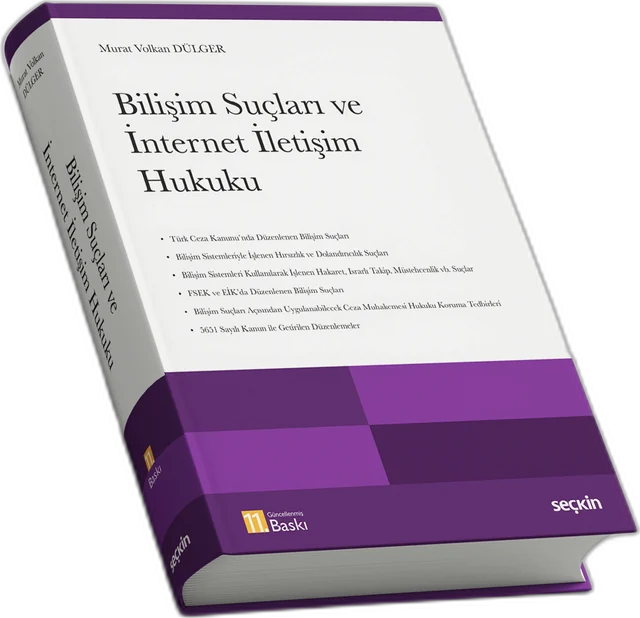
About the book
This work was written in Turkish. The summary on this page is a translation; the citation gives the original title in parentheses.
Cybercrime and Internet Communication Law (Bilişim Suçları ve İnternet İletişim Hukuku) is a many-sided book intended for readers at every level, from undergraduate law students to academics. It was prepared as a basic source of information for lawyers who have recently become interested in IT law and for students taking an IT law course at their faculties, and the subjects it covers are examined and explained from every angle. In this respect the book is a general reference work and textbook. For readers in postgraduate education and for those carrying out scholarly work or research in this field, the subjects in the book are examined in depth, including the differing views in legal scholarship and comparative law.
In addition to this, the book serves as a guide for readers with its up-to-date and extensive bibliography. It offers answers to problems encountered in practice and contains a large number of recent court decisions, so that it is also a reference work for practitioners. Although nearly twenty years have passed since it was first prepared, the book has been updated and renewed in every edition. As a result it has become a dynamic source of information that conveys to the reader, in their most current form, the legal problems that may arise in the rapidly developing field of information technology. With these features the book is able to provide sufficient and satisfying information to readers at every level who are interested in IT law, and in particular in cybercrime and internet communication law.
Table of contents
Table of contents of the 11th edition (May 2025). The book is in Turkish; the headings below are a translation. Page numbers refer to the printed book. Select a chapter to see its sub-headings.
- Preface to the Eleventh Edition6
- Preface to the Tenth Edition7
- Preface to the Ninth Edition9
- Preface to the Eighth Edition11
- Preface to the Seventh Edition12
- Preface to the Sixth Edition14
- Preface to the Fifth Edition16
- Preface to the Fourth Edition19
- Preface to the Third Edition22
- Preface to the Second Edition24
- Preface to the First Edition26
- Abbreviations51
- Introduction55
Chapter OneDEFINITION OF THE COMPUTER, INFORMATICS, CYBERCRIME AND RELATED CONCEPTS, AND THE HISTORY OF THE COMPUTER AND OF CYBERCRIME38 headings
- I.TERM AND CONCEPT61
- A.The Computer62
- 1.The Term Computer62
- 2.Definition of the Computer63
- a.Definition Based on the Tasks and Functions Performed by the Computer64
- b.Definition Based on the Physical Characteristics of the Computer and the Tasks and Functions It Performs65
- c.Main Components of the Computer66
- aa.Central Processing Unit67
- bb.Read-Only Memory67
- cc.Random-Access Memory67
- dd.Peripheral Input – Output Units68
- ee.Operating Software68
- ff.Application Software69
- d.Types of Computer69
- e.Distinguishing Features and a Reconciling Definition70
- f.Assessment and My View71
- g.Operating Logic and System of the Computer72
- B.Informatics and the Information System72
- C.Cybercrime76
- 1.The Problem of Terminology76
- 2.Content of the Concept of Cybercrime80
- D.Data83
- E.The Internet84
- 1.Definition84
- 2.Technical Structure, Infrastructure and Governance of the Internet87
- a.Technical Structure of the Internet87
- aa.The TCP/IP Protocol88
- bb.The World Wide Web System88
- b.Infrastructure of the Internet88
- c.Governance of the Internet in General89
- II.HISTORICAL DEVELOPMENT92
- A.Historical Development of the Computer92
- 1.First Period94
- 2.Second Period95
- 3.Third Period95
- 4.Fourth Period96
- B.Historical Development of the Internet97
- C.Historical Development of Cybercrime100
Chapter TwoMODES OF COMMISSION OF CYBERCRIME, ITS RELATIONSHIP WITH CRIMINOLOGY, ECONOMIC OFFENCES AND TERRORISM, AND CYBERCRIME IN COMPARATIVE LAW120 headings
- I.MODES OF COMMISSION OF CYBERCRIME109
- A.In General109
- B.Modes of Commission110
- 1.Trojan Horse110
- 2.Salami Technique111
- 3.Breaking System Security and Gaining Entry (Hacking)112
- a.Computer Intruders Who Commit Offences (Hackers)112
- b.Former Computer Intruders Who Test System Security (Ethical Hackers)115
- 4.Network Worms115
- 5.Rabbits116
- 6.Chameleons117
- 7.Logic Bombs117
- 8.Computer Viruses118
- 9.Unsolicited Electronic Mail (Spam)119
- 10.Offering Unlawful Content122
- 11.Denial-of-Service (DoS) and Distributed Denial-of-Service (DDoS) Attacks123
- 12.Phishing Attacks123
- 13.Password-Cracking Attacks123
- 14.Botnet Attack124
- 15.Dumpster Diving (Scavenging)125
- 16.Wrongful Misuse of the DNS125
- 17.Web Page Redirection126
- 18.Scanning126
- 19.Cyberbullying127
- 20.Ransomware128
- 21.Other Methods129
- II.RELATIONSHIP OF CYBERCRIME WITH CRIMINOLOGY AND ECONOMIC OFFENCES129
- A.Relationship of Cybercrime with Criminology129
- 1.In General129
- 2.General Characteristics of Perpetrators of Cybercrime132
- B.Relationship of Cybercrime with Economic Offences134
- 1.Economic Law135
- 2.White-Collar Crime and the Economic Offence137
- a.White-Collar Crime137
- b.Concept and Definition of the Economic Offence139
- aa.Economic Offences from the Criminological – Sociological Perspective140
- bb.Economic Offences from the Perspective of the Rules of Criminal Procedure141
- cc.Economic Offences from the Perspective of the Legal Interest Protected by the Offence141
- c.Assessment and My View142
- 3.Cybercrimes as Economic Offences143
- III.SOCIAL MEDIA144
- A.In General144
- B.Definition145
- C.Forms of Social Media146
- D.How Social Media Differs from Industrial Media147
- E.Effect of Social Media on Companies148
- F.Building Social Authority149
- G.Effects of Social Media on Internet Use150
- H.Possible Historical / Political Effects of Social Media153
- I.Economic Effects of the Social Marketing Arising from Social Media153
- İ.Effects of Social Media on Education155
- J.Ownership of the Content Making Up Social Media156
- K.Social Media and the COVID–19 Pandemic156
- L.Criticisms of Social Media158
- IV.THE EFFECT OF THE MASS MEDIA –IN PARTICULAR THE INTERNET– ON TERRORISM159
- A.Terrorism in General and the Definition of Terrorism159
- B.Effects on Terrorism of Developments in Technology and in Information Technologies in General163
- 1.Effects on Terrorism of Technological Developments in Means of Transport165
- 2.Effects on Terrorism of Developments in Weapons Technology166
- 3.Effects on Terrorism of Developments in the Technology of Personal Communication Devices167
- 4.Effects on Terrorism of Developments in Information Systems168
- C.Effects on Terrorism of Developments in the Mass Media173
- 1.The Relationship between the Mass Media and Terrorism in General173
- 2.Coverage of Terrorist Acts by the Mass Media175
- a.Coverage during the Act178
- b.Coverage after the Act180
- 3.Assessment of the Debates on Mass Media Coverage of Terrorist Acts from the Perspective of Freedom of Expression and Freedom of the Press180
- a.The View that the Restriction Must Be Imposed by Law181
- b.The View that the Restriction Must Be Achieved through Self-Regulation182
- D.Cyberterrorism183
- 1.Concept and Definition183
- 2.Differences between Cyberterrorism and Traditional Terrorism and the Advantages of the Former186
- 3.The Risk of Cyberterrorism and Methods of Attack189
- E.Cyberwarfare191
- F.Hacktivism and a Legal Assessment of Hacktivist Acts193
- G.Assessment and My View194
- V.THE INTERNATIONAL DIMENSION OF CYBERCRIME AND THE PROVISIONS ON CYBERCRIME IN INTERNATIONAL LAW AND IN FOREIGN NATIONAL LAWS198
- A.The International Dimension of Cybercrime198
- 1.The Need for International Cooperation in Combating Cybercrime198
- 2.Reasons Why Cybercrimes Are Transnational Offences199
- 3.Relationship of Cybercrime with International Criminal Law201
- 4.Assessment and My View205
- B.Cybercrime in International Law207
- 1.Work of the Council of Europe on Cybercrime207
- a.The Convention on Cybercrime208
- b.Additional Protocol to the Convention on Cybercrime concerning the Criminalisation of Acts of a Racist and Xenophobic Nature Committed through Computer Systems212
- 2.Legal Bases of International Mutual Legal Assistance from the Perspective of Türkiye213
- a.Basic Principles of Mutual Legal Assistance215
- aa.Requests Are Executed in Accordance with the Legislation of the Requested State215
- bb.As a Rule, No Costs Are Charged215
- cc.The Request and Its Annexes Are Translated into the Official Language of the Requested State215
- b.Grounds for Refusing a Request for Mutual Legal Assistance215
- aa.The Requested State Considers the Request to Concern Political Offences or Fiscal Offences215
- bb.The Requested State Considers Execution of the Request Contrary to Its Sovereignty, Public Order or Other Interests216
- c.The Requirement of Dual Criminality216
- 3.Mutual Legal Assistance under the Convention on Cybercrime216
- a.Articles of the Convention Concerning Mutual Legal Assistance216
- b.Requests for Mutual Legal Assistance to Obtain Traffic Data / IP Numbers in Cybercrime Cases218
- c.Problems in Cybercrime Cases Arising from the Place of Commission of the Offence or the Whereabouts of the Suspect Being Unknown219
- d.Situations in Which Judicial Authorities May Obtain IP Information and Traffic Data Directly220
- e.International Letters Rogatory within the 24/7 Framework in Cybercrime Cases221
- 4.Work of the European Union on Cybercrime222
- 5.Work of Other Supranational Organisations on Cybercrime223
- C.Cybercrime in National Laws223
- 1.In General223
- 2.Cybercrime in US Law224
- a.The Computer Fraud and Abuse Act225
- b.The Communications Decency Act226
- c.The Child Pornography Prevention Act226
- d.The Child Online Protection Act227
- e.The Electronic Communications Privacy Act228
- f.The Internet Gambling Prohibition Act228
- g.The Identity Theft Act229
- h.The Anti-Terrorism Act229
- ı.Provisions on Information Security Expertise230
- 3.Cybercrime in German Law232
- 4.Cybercrime in English Law233
- 5.Cybercrime in French Law234
- 6.Cybercrime in Italian Law235
- 7.Cybercrime in the Laws of Other Countries236
Chapter ThreeCYBERCRIMES PROVIDED FOR IN THE TURKISH CRIMINAL CODE271 headings
- I.FORMATION OF THE TURKISH CRIMINAL CODE (TCK), ITS STRUCTURE IN GENERAL AND COMPARISON OF THE OFFENCE TYPES241
- A.Formation of the TCK241
- B.Structure of the TCK in General242
- C.Classification of the Cybercrimes Provided for in the TCK248
- II.OFFENCE TYPES PROVIDED FOR IN THE CHAPTER ON OFFENCES IN THE FIELD OF INFORMATICS249
- A.The Offence of Unlawfully Accessing an Information System or Remaining in the System (Art. 243(1)–(3))249
- 1.In General249
- 2.Legal Interest Protected by the Offence253
- a.The Problem of the Change in the Protected Legal Interest253
- b.Protected Legal Interests257
- 3.Conformity with the Statutory Definition of the Offence260
- a.Material (Objective) Elements of the Statutory Definition of the Offence261
- aa.Perpetrator261
- aaa.The Perpetrator in General261
- bbb.The Question Whether Legal Persons Can Be Perpetrators263
- aaaa.Liability of Legal Persons from the Perspective of the Principle of the Personal Nature of Penalties263
- bbbb.Criminal Liability of Legal Persons from the Perspective of the Principle of Culpability265
- cccc.Criminal Liability of Legal Persons from the Perspective of the Theory of the Act266
- dddd.Assessment and Our View266
- eeee.The Position of Legal Persons with Regard to Cybercrime269
- bb.Victim270
- cc.Object of the Offence271
- dd.Conduct (Act)271
- ee.No Separate Result Is Required for This Offence278
- ff.The Form of the Offence Aggravated by Its Result: Destruction or Alteration of the Data Contained in the System as a Result of the Commission of the Offence (Art. 243(3))279
- gg.Qualified Forms of the Offence281
- aaa.In General281
- bbb.Commission of the Offence in Respect of Systems That May Be Used Against Payment (Art. 243(2))283
- ccc.Where the Perpetrator’s Conduct Fulfils Both the Qualified Form and the Form Aggravated by Its Result (Art. 243(2)–(3))288
- ddd.Commission of the Offence for Terrorist Purposes (Arts. 4, 5 of the Anti-Terror Law No. 3713 (TMK))289
- b.Mental (Subjective) Element of the Statutory Definition of the Offence290
- 4.The Element of Unlawfulness294
- a.In General294
- b.The Function of Including the Expression “Unlawfully” among the Elements of the Offence296
- aa.The View of Special Unlawfulness297
- bb.The Doctrine of Elements Evaluating the Act as a Whole and the Solution Based on Differentiation298
- cc.Our View299
- c.Consent of the Victim303
- d.Application of a Statutory Provision304
- e.Is Self-Defence Possible?304
- f.The Practice of Journalism Does Not Constitute the Ground of Justification of Exercise of a Right for Accessing a System without Authorisation305
- g.Exceeding the Limits of Grounds of Justification307
- 5.Culpability307
- a.In General307
- b.Force and Threat310
- c.Carrying Out an Unlawful Binding Order311
- 6.Special Forms of Appearance of the Offence312
- a.Attempt312
- b.Participation313
- c.Concurrence314
- 7.Sanction, Investigation and Prosecution319
- B.The Offence of Interception (Art. 243(4))324
- 1.In General324
- 2.Legal Interest Protected by the Offence326
- 3.Conformity with the Statutory Definition of the Offence326
- a.Material (Objective) Elements of the Statutory Definition of the Offence326
- aa.Perpetrator326
- bb.Victim327
- cc.Object of the Offence327
- dd.Conduct (Act)329
- ee.Qualified Forms of the Offence330
- b.Mental (Subjective) Elements of the Statutory Definition of the Offence330
- 4.Unlawfulness330
- 5.Special Forms of Appearance of the Offence332
- a.Attempt332
- b.Participation332
- c.Concurrence332
- 6.Sanction, Investigation and Prosecution333
- C.The Offence of Hindering or Disrupting the Functioning of an Information System and the Offence of Destroying or Altering Data (Art. 244(1)–(2))333
- 1.In General333
- 2.Legal Interests Protected by the Offences335
- 3.Conformity with the Statutory Definition of the Offence338
- a.Material (Objective) Elements of the Statutory Definition of the Offence338
- aa.Perpetrator338
- bb.Victim339
- cc.Object of the Offences339
- aaa.In General339
- bbb.Whether Subjects and Objects in Virtual Reality Games Can Constitute the Object of the Offence340
- dd.Conduct (Act)341
- aaa.Acts Provided for in Art. 244(1)342
- aaaa.Hindering the Functioning of an Information System342
- bbbb.Disrupting the Functioning of an Information System343
- bbb.Acts Provided for in Art. 244(2)345
- aaaa.Damaging Data345
- bbbb.Destroying Data345
- cccc.Altering Data347
- dddd.Rendering Data Inaccessible347
- eeee.Introducing Data into an Information System350
- ffff.Sending Data Existing in an Information System Elsewhere351
- ccc.Assessment and My View352
- ddd.Parallels between the Acts in the Offence Definition and the Convention on Cybercrime (ASSS)353
- eee.The Difference between the Acts in Paragraphs 1 and 2 of Article 244 and Their Application354
- ee.Result354
- ff.Qualified Forms of the Offence355
- aaa.Commission of the Offence on an Information System Belonging to a Bank or Credit Institution or to a Public Institution or Body (Art. 244(3))355
- bbb.Commission of the Offence for Terrorist Purposes (Arts. 4, 5 of the Anti-Terror Law No. 3713 (TMK))357
- b.Mental (Subjective) Elements of the Statutory Definition of the Offence357
- 4.The Element of Unlawfulness357
- 5.Special Forms of Appearance of the Offence359
- a.Attempt359
- b.Participation359
- c.Concurrence360
- 6.Sanction, Investigation and Prosecution362
- D.The Offence of Obtaining an Unlawful Benefit by Means of an Information System (Art. 244(4))363
- 1.In General363
- 2.Legal Interest Protected by the Offence365
- 3.Conformity with the Statutory Definition of the Offence366
- a.Material (Objective) Elements of the Statutory Definition of the Offence366
- aa.Perpetrator366
- bb.Victim367
- cc.Object of the Offence368
- dd.Conduct (Act)368
- ee.Result373
- b.Mental (Subjective) Elements of the Statutory Definition of the Offence375
- 4.The Element of Unlawfulness377
- 5.Special Forms of Appearance of the Offence377
- a.Attempt377
- b.Participation380
- c.Concurrence380
- 6.Sanction, Investigation and Prosecution381
- E.The Offences of Misuse of Bank or Credit Cards (Art. 245)382
- 1.In General382
- 2.Legal Interest Protected by the Offence384
- 3.Conformity with the Statutory Definition of the Offence387
- a.Material (Objective) Elements of the Statutory Definition of the Offence387
- aa.Perpetrator387
- bb.Victim388
- cc.Object of the Offence394
- aaa.Bank Card394
- bbb.Credit Card395
- ccc.The Bank Card, the Credit Card and the Benefit Obtained as the Object of the Offence395
- ddd.The Bank or Credit Card Belonging to Another Person396
- dd.Conduct (Act)397
- aaa.Obtaining an Unlawful Benefit with a Bank or Credit Card Belonging to Another Person (Art. 245(1))398
- aaaa.It Is a Combined-Act and Free-Form Offence398
- bbbb.The Acts of Acquiring and Possessing399
- cccc.The Acts of Using and Causing to Be Used401
- dddd.Obtaining a Benefit with a Card Not Yet Delivered to Its Holder401
- eeee.Use of Bank or Credit Cards Belonging to Another Person for Purchases403
- ffff.Obtaining and Using a Supplementary Card Linked to Another Person’s Credit Card408
- gggg.Card Purchases over Virtual Networks409
- hhhh.Use of Cards in Excess of the Amount Specified in the Agreement with the Holder410
- ıııı.Use of ATMs to Obtain an Unjust Benefit411
- iiii.Withdrawal of Money or Salary from the Account of a Deceased Person by Using His or Her Bank Card412
- jjjj.Use of Another Person’s Bank or Credit Card at a Member Merchant by Producing a Sales Slip413
- bbb.Producing, Selling, Transferring, Purchasing or Accepting Counterfeit Bank or Credit Cards Linked to Bank Accounts Belonging to Others (Art. 245(2))414
- ccc.Obtaining a Benefit by Using a Counterfeit or Falsified Bank or Credit Card (Art. 245(3))418
- aaaa.It Is a Free-Form Offence418
- bbbb.Obtaining a Benefit with a Card Issued on the Basis of Untrue, Forged Documents419
- cccc.Issuing Fictitious Sales Documents with Counterfeit Cards424
- dddd.Use of Counterfeit Cards for Purchases426
- eeee.Use of a Counterfeit Bank or Credit Card at a Member Merchant by Producing a Sales Slip427
- ee.Result427
- aaa.The Result with Regard to the Offences in Paragraphs 1 – 3 of Article 245427
- bbb.The Result with Regard to the Offence in Paragraph 2 of Article 245429
- b.Mental (Subjective) Elements of the Statutory Definition of the Offence429
- 4.The Element of Unlawfulness430
- 5.Special Forms of Appearance of the Offence432
- a.Attempt432
- b.Participation439
- c.Concurrence443
- aa.In General443
- bb.Application of the Rule on the Continuing Offence444
- aaa.Application of the Continuing Offence with Regard to Art. 245(1)444
- bbb.Application of the Continuing Offence with Regard to Art. 245(2)450
- ccc.Application of the Continuing Offence with Regard to Art. 245(3)450
- cc.Various Problems of Concurrence Arising in Relation to Article 245452
- aaa.Can the Offence of Obtaining an Unlawful Benefit with a Bank or Credit Card Belonging to Another Person (Art. 245(1)) and the Offence of Theft (Art. 141) Be Applied Together to the Same Act?452
- aaaa.The Decision of the General Criminal Assembly of the Court of Cassation (YCGK) on the Matter452
- bbbb.Assessment and My View456
- bbb.Where the Bank Card Is Obtained on the Pretext of Helping and the Money Is Taken by the Perpetrator, the Offence of Theft Is Committed457
- ccc.The Relationship between the Offence of Obtaining an Unlawful Benefit with a Bank or Credit Card Belonging to Another Person (Art. 245(1)) and the Offence of Fraud (Art. 157)461
- ddd.The Relationship between the Offence of Obtaining an Unlawful Benefit with a Bank or Credit Card Belonging to Another Person (Art. 245(1)) and the Offence of Qualified Fraud (Art. 158(1)(f))472
- eee.The Relationship between the Offence of Obtaining an Unlawful Benefit with a Bank or Credit Card Belonging to Another Person (Art. 245(1)) and the Offence of Breach of Trust (Art. 155)475
- fff.The Relationship between Producing, Selling, Transferring, Purchasing or Accepting Counterfeit Bank or Credit Cards Linked to Bank Accounts Belonging to Others (Art. 245(2)) and the Offence of Forgery of Documents (Arts. 204 – 207)478
- ggg.The Relationship between the Offence of Obtaining an Unlawful Benefit with a Counterfeit Bank or Credit Card (Art. 245(3)) and the Offence of Qualified Fraud (Art. 158(1)(f))480
- hhh.Commission of Paragraph 2 and Paragraph 3 of Article 245 Together482
- ııı.Commission of Article 245 Together with Articles 135 and 136488
- 6.Personal Grounds for Exemption from Punishment and Personal Grounds Extinguishing Punishment489
- a.The Relationship between Perpetrator and Victim490
- b.Effective Remorse492
- 7.Sanction, Investigation and Prosecution497
- F.The Offence of Producing and Trading in Prohibited Devices and Programs (Art. 245/A)500
- 1.In General500
- 2.Protected Legal Interest504
- 3.Conformity with the Statutory Definition of the Offence504
- a.Material (Objective) Elements of the Statutory Definition of the Offence504
- aa.Perpetrator504
- bb.Victim504
- cc.Object of the Offence504
- dd.Conduct (Act)505
- b.Mental (Subjective) Elements of the Statutory Definition of the Offence506
- 4.The Element of Unlawfulness507
- 5.Special Forms of Appearance of the Offence507
- a.Attempt507
- b.Participation508
- c.Concurrence508
- 6.Sanction, Investigation and Prosecution508
- III.CYBERCRIMES AMONG THE OFFENCES AGAINST PROPERTY509
- A.The Offence of Theft Committed by Using an Information System (Art. 142(2)(e))509
- 1.In General509
- 2.Protected Legal Interest512
- 3.Conformity with the Statutory Definition of the Offence512
- a.Material (Objective) Elements of the Statutory Definition of the Offence512
- aa.Perpetrator512
- bb.Victim512
- cc.Object of the Offence512
- aaa.Data as the Object of the Offence512
- bbb.Views on Whether Data Can Constitute the Qualified Form of the Offence of Theft and the Decisions of the Court of Cassation on the Matter513
- aaaa.The View that Data Can Be the Object of the Qualified Form of the Offence of Theft and the Decisions of the Court of Cassation513
- bbbb.The View that Data Cannot Be the Object of the Qualified Form of the Offence of Theft and the Decisions of the Court of Cassation514
- cccc.The Decision of the YCGK that Data Can Be the Object of the Qualified Form of the Offence of Theft and the Decisions of the Court of Cassation to the Same Effect515
- dddd.Assessment and My View517
- dd.Conduct (Act)521
- ee.Result523
- ff.Qualified Form of the Offence523
- b.Mental (Subjective) Elements of the Statutory Definition of the Offence523
- 4.The Element of Unlawfulness523
- 5.Special Forms of Appearance of the Offence524
- a.Attempt524
- b.Participation524
- c.Concurrence524
- 6.Sanction, Investigation and Prosecution526
- B.The Offence of Fraud Committed by Using an Information System (Art. 158(1)(f))526
- 1.Information Systems as Constituting the Qualified Form of the Offence of Fraud, in General526
- 2.Is Commission of the Offence of Fraud through Online Shopping Sites a Qualified Form?537
- 3.Assessment and My View539
- 4.Personal Grounds Extinguishing or Reducing Punishment539
- IV.OTHER OFFENCE TYPES THAT MAY BE COMMITTED BY MEANS OF INFORMATION SYSTEMS540
- A.The Offence of Hindering Communication (Art. 124)540
- B.The Offence of Insult (Art. 125)541
- C.The Offence of Persistent Stalking (Art. 123/A)545
- 1.Introduction545
- a.The Need for a Provision on Persistent Stalking545
- b.How the Acts Constituting the Offence of Persistent Stalking First Emerged549
- c.The Importance of Normative Regulation552
- 2.Protected Legal Interest555
- 3.Conformity with the Statutory Definition of the Offence556
- a.Material (Objective) Elements of the Statutory Definition of the Offence556
- aa.Perpetrator556
- bb.Victim556
- cc.Object of the Offence556
- dd.Conduct (Act)557
- aaa.Nature of the Act557
- bbb.Persisting558
- ccc.Physically Following560
- ddd.Attempting to Establish Contact with the Victim562
- aaaa.Using Means of Correspondence and Communication563
- bbbb.Using Information Systems563
- cccc.Using Third Parties564
- ee.Result565
- aaa.Causing Serious Distress to the Victim565
- bbb.The Victim Fearing for His or Her Own Safety or That of a Person Close to Him or Her567
- ff.Qualified Form of the Offence568
- aaa.Commission of the Offence against a Child568
- bbb.Commission of the Offence against a Spouse from Whom the Perpetrator Is Judicially Separated or Divorced569
- ccc.The Offence Causing the Victim to Change School, Workplace or Home, or to Leave School or Work570
- ddd.Commission of the Offence by a Perpetrator Subject to a Removal Order or to an Order Not to Approach the Home, School or Workplace570
- eee.A Missing Qualifying Element: The Hate Motive571
- b.Mental (Subjective) Element of the Statutory Definition of the Offence572
- 4.The Element of Unlawfulness572
- 5.Special Forms of Appearance of the Offence572
- a.Attempt572
- b.Participation573
- c.Concurrence574
- 6.Sanction, Investigation and Prosecution575
- D.The Offence of Violating the Confidentiality of Communications (Art. 132)578
- E.The Offence of Listening to or Recording Conversations between Persons (Art. 133)580
- F.The Offence of Violating the Privacy of Private Life (Art. 134)582
- G.The Offence of Obscenity (Art. 226)584
- H.Providing a Place and Facilities for Gambling by Using Information Systems (Art. 228(3))588
Chapter FourCYBERCRIMES PROVIDED FOR IN THE LAW ON INTELLECTUAL AND ARTISTIC WORKS AND IN THE ELECTRONIC SIGNATURE LAW72 headings
- I.CYBERCRIMES PROVIDED FOR IN THE LAW ON INTELLECTUAL AND ARTISTIC WORKS591
- A.In General591
- B.Offences of Infringement of Economic, Moral and Related Rights (Art. 71)593
- 1.In General593
- 2.Legal Interest Protected by the Offence594
- 3.Conformity with the Statutory Definition of the Offence595
- a.Material (Objective) Elements of the Statutory Definition of the Offence595
- aa.Perpetrator595
- bb.Victim596
- cc.Object of the Offence598
- dd.Conduct (Act)599
- aaa.Acts Constituting the Offence against Moral Rights599
- aaaa.Communicating to the Public and Publishing599
- bbbb.Giving Information about the Content of a Work Not Yet Made Public601
- cccc.Putting a Name to the Work601
- dddd.Distributing, Disseminating and Publishing the Work under the Name of a Well-Known Other Person601
- eeee.Failure to Cite the Source Quoted, or Citing a Wrong, Inadequate or Misleading Source601
- ffff.Modification of the Work602
- bbb.Acts against Economic Rights602
- aaaa.Adaptation of the Work602
- bbbb.Reproduction of the Work602
- cccc.Offering for Sale Copies of the Work Reproduced by the Perpetrator Himself or Herself603
- dddd.Distribution of the Work by Rental or Public Lending603
- eeee.Importation of the Work604
- ffff.Performance of the Work604
- gggg.Dissemination and Publication of the Work over a Data Transmission Network604
- hhhh.Purchase of the Work for Commercial Purposes605
- ıııı.Possession and Storage of the Work Other than for Personal Purposes605
- ccc.Acts against Related Rights605
- ee.Result606
- b.Mental (Subjective) Elements of the Statutory Definition of the Offence606
- 4.The Element of Unlawfulness606
- 5.Special Forms of Appearance of the Offence608
- a.Attempt608
- b.Participation608
- c.Concurrence609
- 6.Effective Remorse610
- 7.Sanction, Investigation and Prosecution611
- C.The Offence of Unauthorised Removal or Alteration of Information Appearing When the Work Is Presented to the Public and of the Numbers or Codes Representing That Information (Art. 71(2))613
- D.The Offence of Preparatory Acts Aimed at Rendering Protective Programs Ineffective (Art. 72)614
- II.CYBERCRIMES PROVIDED FOR IN THE ELECTRONIC SIGNATURE LAW615
- A.Offences in the Electronic Signature Law (EİK) (Arts. 16 – 17)615
- B.Legal Interest Protected by the Offence618
- C.Conformity with the Statutory Definition of the Offence619
- 1.Material (Objective) Elements of the Statutory Definition of the Offence619
- a.Perpetrator619
- b.Victim619
- c.Object of the Offence620
- d.Conduct (Act)622
- aa.With Regard to the Offence of Unauthorised Use of Electronic Signature Creation Data (Art. 16 EİK)622
- aaa.In General622
- bbb.Obtaining the Data or the Device623
- ccc.Giving the Data or the Device623
- ddd.Copying the Data or the Device624
- eee.Recreating the Signature Creation Device624
- fff.Creating an Electronic Signature without Authorisation624
- bb.With Regard to the Offence of Forgery of Electronic Certificates (Art. 17 EİK)625
- aaa.In General625
- bbb.Creating a False Electronic Certificate626
- ccc.Imitating Valid Certificates626
- ddd.Falsifying Valid Certificates627
- eee.Using a False Certificate627
- e.Result628
- f.Qualified Form of the Offence628
- 2.Mental (Subjective) Elements of the Statutory Definition of the Offence628
- D.The Element of Unlawfulness629
- E.Special Forms of Appearance of the Offence630
- 1.Attempt630
- 2.Participation630
- 3.Concurrence630
- F.Sanction, Investigation and Prosecution631
- G.Misdemeanours under the Electronic Signature Law (EİK) (Art. 18)631
Chapter FiveCOERCIVE MEASURES OF CRIMINAL PROCEDURE WITH REGARD TO CYBERCRIME, DIGITAL FORENSICS AND MEASURES TO BE TAKEN IN COMBATING CYBERCRIME90 headings
- I.IN GENERAL635
- II.COERCIVE MEASURES OF CRIMINAL PROCEDURE DIRECTED AT INFORMATION SYSTEMS636
- A.Search, Copying and Seizure in Information Systems636
- 1.Legal Basis636
- 2.Existence of Strong Grounds for Suspicion Based on Concrete Evidence638
- 3.Impossibility of Obtaining Evidence by Other Means640
- 4.The Measure of Search and Copying642
- 5.The Measure of Seizure642
- 6.Objection to the Decision Ordering the Measure645
- 7.Art. 134 of the Code of Criminal Procedure (CMK) Is a Special Provision645
- 8.Criticisms Raised in Practice and the Method Applied646
- B.Legislative Innovations and Shortcomings in Investigation and Prosecution648
- 1.The Convention on Cybercrime (ASSS) Becoming Part of Our Domestic Law648
- 2.The Amendment Introduced with regard to Investigations by Art. 3(4) of Law No. 5651 and the Situation after the Annulment of Paragraph 4 by the Constitutional Court (AYM)649
- 3.The Uncertainty as to What Is to Be Done at the End of the Proceedings with Forensic Images Taken under Art. 134 CMK Should Be Removed650
- 4.The Failure to Mention Cybercrime in Art. 135 CMK Leads to Deficient Investigations or to Unlawfully Obtained Evidence651
- C.An IP Address Alone Does Not Identify the Perpetrator652
- D.The Perpetrator Cannot Be Reached without an IP Address657
- E.NAT IP and Port Information Must Be Obtained in Order to Identify the Perpetrator Fully and Correctly658
- F.What Needs to Be Done in Investigation and Prosecution661
- III.DIGITAL FORENSICS664
- A.Introduction664
- B.The Science of Computer Criminalistics665
- C.The Concept of Digital Forensics665
- 1.Definition665
- 2.Benefits of the Digital Forensics Methodology667
- D.Digital Evidence and Types of Digital Evidence668
- 1.What Is Digital (Electronic) Evidence?668
- 2.Conditions Required for Digital Evidence to Be Usable671
- 3.Media on Which Digital Evidence Is Found672
- a.Motherboard673
- b.Processor673
- c.Memory: RAM (Random Access Memory) – ROM (Read Only Memory) – Cache Memory674
- d.Hard Disk (Hard Disk Drive)675
- e.Floppy Disks and CD/DVD/Blu-ray676
- f.Memory Cards676
- g.Digital Storage Devices676
- h.Mobile Phones676
- ı.Digital Video and Still Cameras677
- i.MP3 Players/iPod677
- j.Handheld Computers (PDA, PALM, Pocket PC)677
- k.Portable Memory Devices (Flash Memory)677
- l.Printers, Fax Machines, Photocopiers and Other Hardware678
- 4.The Council of Europe Electronic Evidence Guide678
- E.Stages of Digital Forensics680
- 1.The Crime Scene – Collection and Preservation of Evidence680
- 2.Points to Be Observed before Starting to Collect Evidence680
- a.First Step680
- b.Second Step681
- 3.What Must Not Be Done at the Crime Scene682
- a.Mistake 1 – Operating the Computer682
- b.Mistake 2 – Asking the Owner of the Computer for Help682
- c.Mistake 3 – Failing to Check for Computer Viruses682
- d.Mistake 4 – Taking No Precautions during the Transport of Electronic Evidence682
- 4.Live Analysis682
- 5.Packaging – Transport – Preservation684
- 6.The Latent Nature of Electronic Evidence684
- F.The Digital Forensics Expert’s Approach to Electronic Evidence685
- 1.In General685
- 2.Examination685
- a.Disk Write Protection685
- b.Forensic Imaging686
- c.Hash Value688
- d.Result of the Examination689
- 3.Interpretation (Evaluation/Analysis)690
- a.Stages of Computer Analysis690
- b.Stages of Mobile Phone Analysis690
- c.Stages of Network Traffic Data Analysis691
- d.Stages of Analysis of External Disks, CD/DVDs, Memory Cards and Flash Drives692
- e.User-Protected Files693
- f.Anti-Forensics and Concealment Methods693
- 4.General Principles to Be Observed by Experts694
- 5.Data Recovery694
- 6.Features and Preparation of the Digital Forensics Report694
- IV.MEASURES TO BE TAKEN IN COMBATING CYBERCRIME695
- A.Measures to Be Taken by Individuals and/or Institutions695
- 1.In General695
- 2.Ensuring and Testing System Security697
- B.Measures to Be Taken by States699
- 1.Establishment and Training of Units Prosecuting Cybercrime699
- a.General Remarks699
- b.The Example of the USA699
- c.The Situation in Our Country700
- 2.Measures Taken against the Phenomenon of Cyberterrorism702
- 3.State Control of Cyberspace702
- 4.International Cooperation704
- 5.The Relationship between Organised Crime and Cybercrime704
- V.CYBERCRIME DE LEGE FERENDA708
- A.From the Perspective of Criminal Law708
- B.From the Perspective of the Law of Criminal Procedure711
Chapter SixINTERNET COMMUNICATION LAW153 headings
- I.INTRODUCTION715
- II.THE MEANING AND LIMITS OF FREEDOM OF THOUGHT (EXPRESSION) AND ITS IMPORTANCE FOR THE INTERNET717
- A.Concept718
- B.Content of Freedom of Thought (Expression)721
- C.Freedom of Expression under the European Convention on Human Rights (ECHR)722
- 1.The Origin of the ECHR and Its Entry into the Turkish Legal Order722
- 2.Meaning and Application of Freedom of Expression724
- a.The Concept of Freedom of Expression in the ECHR724
- b.Art. 10(1) ECHR: Content of Freedom of Expression724
- c.Art. 10(2) ECHR: Cases in Which Freedom of Expression May Be Restricted728
- d.Art. 10(2) ECHR: The Limit of Restriction733
- 3.The Approach of the European Court of Human Rights (ECtHR) to the Internet in the Context of Freedom of Expression735
- D.Assessment and Our View736
- III.DISTINCTIONS CONCERNING THE BLOCKING OF INTERNET COMMUNICATION740
- A.The Distinction between Blocking of Access to the Internet and Blocking of Internet Communication740
- B.The Distinction between the Technical and the Legal Possibility of Blocking Internet Communication742
- 1.Scope of the Distinction742
- 2.Technical Methods of Blocking742
- C.The Distinction as to the Possibility of Blocking Internet Communication by the Methods of “General Blocking – Specific Blocking”748
- IV.PROVISIONS INTRODUCED BY LAW NO. 5651 “ON THE REGULATION OF PUBLICATIONS ON THE INTERNET AND COMBATING OFFENCES COMMITTED BY MEANS OF SUCH PUBLICATIONS”749
- A.Drafting Process, Purpose and Scope of the Law749
- 1.Drafting Process of the Law749
- 2.Purpose and Scope752
- 3.Legal Nature of the Measures Provided for in Law No. 5651753
- B.Institutions Involved in the Governance of the Internet754
- 1.The Information and Communication Technologies Authority754
- 2.The Internet Development Board758
- C.Definitions758
- D.Obligation to Inform the Public759
- E.Duty to Collect and Transmit Traffic Data764
- F.Liability of Internet Actors769
- 1.In General769
- 2.The Example of Germany769
- 3.The Regulation in Law No. 5651771
- a.Responsibilities and Obligations of Content Providers771
- b.Responsibilities and Obligations of Hosting Providers780
- i.Hosting Providers’ Non-Liability for Content780
- ii.Hosting Providers’ Responsibility to Retain Traffic Data782
- iii.Sanctions for Breach of Obligations782
- iv.Classification and Differentiation of Hosting Providers783
- c.Responsibilities and Obligations of Access Providers784
- d.The Union of Access Providers787
- e.Responsibilities and Obligations of Mass-Use Providers790
- f.Assessment and My View792
- V.GENERAL BLOCKING OF INTERNET ACCESS (FILTERING)793
- A.The Internet Is a Field Subject to Legal Regulation795
- B.Governance of the Internet797
- C.Models for the Regulation of Cyberspace800
- 1.Regulation at National Level801
- 2.Regulation by International Conventions801
- 3.Regulation through International Organisations802
- 4.Self-Regulation802
- 5.Our View on the Models of Regulation803
- D.The Internet as a Medium of Mass Communication and the Blocking of Its Communication804
- 1.The Concept of Mass Communication in General804
- 2.The Phenomenon of Misuse of Internet Communication805
- 3.Views on the General Blocking of Internet Communication807
- 4.State Regulation of Cyberspace and General Filtering808
- E.An Administrative Practice of General Blocking of Internet Communication – The Powers of the Telecommunications Authority over the Internet and the Decisions It Has Taken810
- F.General Blocking of Internet Communication under Law No. 5651 on the Regulation of Internet Publications812
- VI.SPECIFIC BLOCKING OF INTERNET ACCESS (BLOCKING OF ACCESS)818
- A.Blocking of Internet Communication by Court Decision818
- 1.A Case Study on the Blocking of Internet Communication by Court Decision819
- 2.Assessment of the Case Study on the Blocking of Internet Communication by Court Decision821
- 3.The ECtHR Judgment Holding That Law No. 5651 Violates Article 10 of the ECHR823
- 4.The Constitutional Court Judgment Holding That the Decision of the Presidency of Telecommunication and Communication (TİB) to Block Communication Violated Freedom of Expression828
- a.As to Admissibility828
- b.As to the Merits829
- c.Assessment and Our View834
- 5.The Constitutional Court Judgment of 26/12/2019, Published in the Official Gazette on 20/01/2020, on the Application of Wikimedia Foundation Inc. and Others835
- a.As to Admissibility835
- b.As to the Merits837
- c.Assessment and Our View839
- 6.The Constitutional Court Judgment of 27/10/2021, Published in the Official Gazette on 07/01/2022, on the Application of Keskin Kalem Yayıncılık ve Ticaret A.Ş. and Others840
- a.As to Admissibility844
- b.As to the Merits844
- c.Assessment and Our View857
- B.Blocking of Internet Communication by Administrative Practice – The Example of Blocking of Communication by Decision of the Telecommunications Board858
- 1.A Case Study on the Blocking of Internet Communication by Administrative Practice858
- 2.Assessment of the Case Study on the Blocking of Internet Communication by Administrative Practice860
- C.Blocking of Internet Communication by a “Legal Person Governed by Private Law” – The Example of Blocking of Communication by Decision of the Turkish Football Federation863
- VII.ASSESSMENT OF LAW NO. 5651 WITH REGARD TO THE SPECIFIC BLOCKING OF INTERNET COMMUNICATION (REMOVAL OF CONTENT AND/OR BLOCKING OF ACCESS)865
- A.Types of Offence for Which a Decision to Remove Content and/or Block Access May Be Issued865
- 1.In General865
- 2.Obscene Publications869
- 3.Providing a Place and Facilities for Gambling874
- 4.Offences Relating to the Law on Football and Other Sports Competitions876
- 5.Offences Committed against Atatürk877
- 6.Offences Relating to the Law on Taxes, Funds and Shares Levied on the Proceeds of Games of Chance878
- 7.Additional Article 4 of the Law on Intellectual and Artistic Works (FSEK)878
- B.The Decision to Remove Content and/or Block Access as a Coercive Measure879
- 1.Legal Basis879
- 2.Who May Issue the Decision879
- a.Judge and Public Prosecutor879
- b.The Power of the President of the TİB880
- 3.The Procedure to Be Applied882
- 4.Lifting of the Measure883
- 5.Sanction885
- 6.The Situation in Practice and Our View885
- C.The Decision to Remove Content and/or Block Access as an Administrative Measure889
- 1.Legal Basis889
- 2.Who May Issue the Decision889
- 3.Legal Nature of Blocking of Access as an Administrative Measure891
- 4.The Procedure to Be Applied899
- 5.Sanction900
- D.Compensation for Unjustified Blocking Decisions901
- E.Removal of Content and Blocking of Access in Cases Where Delay Is Prejudicial (Art. 8/A)901
- F.Removal of Unlawful Content from Publication and Blocking of Access (Art. 9)903
- G.Blocking of Access to Content on Grounds of Privacy (Art. 9/A)908
- H.The Competent Court909
- VIII.LEGAL REGIME OF SOCIAL NETWORK PROVIDERS909
- A.The Need to Regulate Social Network Providers909
- B.Legal Regime of Social Network Providers under the Internet Law912
- 1.In General912
- 2.Obligation to Appoint a Representative, and the Representative’s Qualifications and Responsibilities912
- 3.Liability of Social Network Providers in Respect of Applications Made under Art. 9/A of the Internet Law914
- 4.Obligation to Submit to the Authority Reports on the Implementation of Decisions to Remove Content and/or Block Access914
- 5.Obligation to Provide Information on Certain Offences to the Authorities Competent for Investigation and Prosecution915
- 6.Obligation to Store Data in Turkey916
- 7.Obligation to Take the Necessary Measures to Provide Differentiated Services Specific to Children917
- 8.Sanctions Applicable to Social Network Providers in Connection with Blocking of Access and Removal of Content918
- 9.Sanction for Failure to Comply with a Decision to Remove Content and/or Block Access Issued by the President of the Information and Communication Technologies Authority (BTK)918
- 10.Obligation to Comply with the Rules on User Rights920
- 11.Liability for Damages on Account of Unlawful Content921
- 12.Obligation to Establish an Effective Application Mechanism for the Removal of Hashtags and Featured Content by Way of Notice and Takedown921
- 13.Notification to Law Enforcement of Content Endangering the Safety of Life and Property of Persons921
- 14.Obligations of Social Network Providers as Content and Hosting Providers under the Internet Law922
- 15.The BTK’s Power to Request Information and Conduct On-Site Inspections922
- 16.Obligation to Draw Up a Crisis Plan923
- 17.Secondary Legislation923
- 18.Transitional Provision924
- C.Assessment and Our View925
- IX.LEGAL REGIME OF INTERNET NEWS SITES927
- A.The Question of the Applicability of the Rules of Press Law to Internet Publishing927
- B.Legal Regime of Internet News Sites under the Press Law929
- 1.In General929
- 2.Definition929
- 3.Freedom and Its Limit930
- 4.Obligation to Display Information on the Site930
- 5.Obligation to Display News and Content Updates Clearly on the Site931
- 6.Consequences of Treating Internet News Sites as Periodicals932
- a.General Obligations Arising from the Press Law932
- b.Obligation to File a Declaration and Its Consequences933
- c.Loss of the Rights relating to Official Announcements and Advertisements and to Employees’ Press Cards as a Consequence of Filing the Declaration934
- 7.Obligation to Preserve Content Published on an Internet News Site in a Manner Ensuring Its Accuracy and Integrity937
- 8.Right of Correction and Reply938
- 9.The Manner of Reporting News of Sexual Assault, Murder and Encouragement of Suicide939
- 10.Time Limits and Procedure for Prosecution and Investigation940
- X.LEGAL REGIME OF OVER-THE-TOP SERVICE PROVIDERS940
- A.Definition and Concept940
- B.Rights and Obligations941
- C.Sanction944
- XI.ASSESSMENT AND OUR VIEW945
- Bibliography957
- Table of Cases989
- Subject Index999
- Author’s Curriculum Vitae1007
Related publications
Dülger, Murat Volkan / Modoğlu, Gözde, Practice Guide to Cybercrime, Methods of Investigation and Prosecution, and Internet Communication Law (Bilişim Suçları, Soruşturma ve Kovuşturma Yöntemleri ile İnternet İletişim Hukuku Uygulama Rehberi), Joint Publication of the European Union and the Council of Europe, Ankara, 2014.
Dülger, Murat Volkan, “Account Suspension and Seizure in Cybercrime Cases: An Analysis of Article 128/A of the Code of Criminal Procedure (CMK) in Terms of Fundamental Rights, the System of Criminal Procedure and Comparative Law” (Bilişim Suçlarında Hesabın Askıya Alınması ve Elkoyma: CMK (Ceza Muhakemesi Kanunu) m. 128/A’nın Temel Haklar, Ceza Muhakemesi Sistematiği ve Karşılaştırmalı Hukuk Açısından Analizi), conference presentation, 2026.
Dülger, Murat Volkan, “The Use of Crypto Assets in Money Laundering and the Measures to Be Taken Against It”, Istanbul Aydın University Faculty of Law Journal, Vol. 10, No. 1, 2024, pp. 41-94.
Dülger, Murat Volkan, “The Use of Crypto Assets in the Laundering of Proceeds of Crime and the Measures to Be Taken” (Kripto Varlıkların Suç Gelirlerinin Aklanmasında Kullanılması ve Alınması Gereken Önlemler), Istanbul Aydın University Faculty of Law Journal (İstanbul Aydın Üniversitesi Hukuk Fakültesi Dergisi), Vol. 10, No. 1, 2024, pp. 41-94.
Dülger, Murat Volkan, “The Legal Regime of Social Network Providers, Internet News Sites and Over-the-Top Service Providers, and a Critique” (Sosyal Ağ Sağlayıcıların İnternet Haber Sitelerinin ve Şebekeler Üstü Hizmet Sağlayıcıların Hukuki Rejimi ve Eleştirisi), Dülger Law Office, 1 June 2023.